Mass is a measure of the amount of a matter in an object. Mass is usually measured in grams (g) or
kilograms (kg).
The law of conservation of mass states that no atoms are lost or made during a chemical reactions so
that the mass of the products equals the mass of reactants.( MASS OF THE PRODUCT = MASS OF THE REACTANT)
Some reactants may appear to involve a change in mass but this can be explained because a
reactant or product is usually a gas and its mass has not been taken in account.
A relative atomic mass can be found in the periodic table. The relative formula mass (M r) of a
compound is the sum of the relative atomic masses of the atoms shown in the formula.
In a closed system- no substances can enter o leave a closed system, such as a stoppered flask.
Sometimes reactions that happen in open beakers are closed systems, for example acid-alkali
neutralisation reaction. Since all the reactants and products stay in the beaker, the total mass of the
beaker and the substances in it stay the same during the reaction.
In a non-closed systems- substances can enter or leave. These systems include open flask, boiling
tubes . Magnesium reacts with oxygen, gained from the air to produce magnesium oxide. If a gas
escapes, the total mass will look like it has decreased or vice versa. The total mass however stays the
same if the mass of the gas is included.
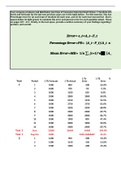
range of measurment
Percentage of Uncertainty = mean
x 100
One mole of a substance is just the amount of that substance that contains an Avogadro’s number of
particles, so 6.02x10²³ particles.
Relative Formula Mass= actual mass of 1 mole
Chemical amounts are measured in moles. The unit is mol.
mass ( g )
Number of Moles (mol) =
molar mass ( relative formula mass ) ( molg )
Avogadro’s law states that one mole of any substance will contain the same number of entities
(atoms, ions, particles or molecules) and that amount is 6.02x10 23.
Number of entities= number of moles x (6.02x10 23)
The masses of reactants and products can be calculated from balanced symbol equations
Sulphuric Acid- H2SO4 Calcium Carbonate- CaCO3
Nitric Acid- HNO3 Copper Sulphate- CuCO4
Hydrochloric Acid- HCl Sodium Hydroxide- NaOH
In a balanced chemical equation, the sum of the relative formula masses of the reactants equals the
sum of the relative formula masses of the product.
Isotopes- when you have the same amount of protons but different amount of neutrons.
(% x atomic mass)(% x atomic mass)(% x atomic mass)
Average relative atomic mass-
100
kilograms (kg).
The law of conservation of mass states that no atoms are lost or made during a chemical reactions so
that the mass of the products equals the mass of reactants.( MASS OF THE PRODUCT = MASS OF THE REACTANT)
Some reactants may appear to involve a change in mass but this can be explained because a
reactant or product is usually a gas and its mass has not been taken in account.
A relative atomic mass can be found in the periodic table. The relative formula mass (M r) of a
compound is the sum of the relative atomic masses of the atoms shown in the formula.
In a closed system- no substances can enter o leave a closed system, such as a stoppered flask.
Sometimes reactions that happen in open beakers are closed systems, for example acid-alkali
neutralisation reaction. Since all the reactants and products stay in the beaker, the total mass of the
beaker and the substances in it stay the same during the reaction.
In a non-closed systems- substances can enter or leave. These systems include open flask, boiling
tubes . Magnesium reacts with oxygen, gained from the air to produce magnesium oxide. If a gas
escapes, the total mass will look like it has decreased or vice versa. The total mass however stays the
same if the mass of the gas is included.
range of measurment
Percentage of Uncertainty = mean
x 100
One mole of a substance is just the amount of that substance that contains an Avogadro’s number of
particles, so 6.02x10²³ particles.
Relative Formula Mass= actual mass of 1 mole
Chemical amounts are measured in moles. The unit is mol.
mass ( g )
Number of Moles (mol) =
molar mass ( relative formula mass ) ( molg )
Avogadro’s law states that one mole of any substance will contain the same number of entities
(atoms, ions, particles or molecules) and that amount is 6.02x10 23.
Number of entities= number of moles x (6.02x10 23)
The masses of reactants and products can be calculated from balanced symbol equations
Sulphuric Acid- H2SO4 Calcium Carbonate- CaCO3
Nitric Acid- HNO3 Copper Sulphate- CuCO4
Hydrochloric Acid- HCl Sodium Hydroxide- NaOH
In a balanced chemical equation, the sum of the relative formula masses of the reactants equals the
sum of the relative formula masses of the product.
Isotopes- when you have the same amount of protons but different amount of neutrons.
(% x atomic mass)(% x atomic mass)(% x atomic mass)
Average relative atomic mass-
100