
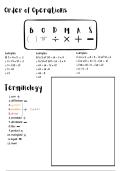
Order of Operations
B O D M A S
“OF”
Examples: Examples: Examples:
a) 3 + 4 x 5 2 b) 1/2 of 20 + 16 - 2 x 4 c) 12 x 4 8 + 5 - (2 of 5) 2
= 3 + (4 x 5) 2 = (1/2) of 20) + 16 - 2 x 4 = (12 x4) 8 + 5 - (10 2)
= 3 + (20 2) = 10 + 16 - (2 x 4) = (48 8) + 5 - (10 2)
= 3 + 10 = 10 + 16 -8 =6+5-5
= 13 = 26 - 8 =6
= 18
Terminology
1. sum
2. difference
3. quotient
4. dividend 8 2=4
5. divisor
6. increased
7. decreased
8. less
9. product
10. multiplied
11. equal
12. more
, Common Fractions
4
Proper fraction Improper fraction Mixed fraction
Equivalent fraction
Simplifying fractions:
1. Find the highest common factor (HCF) of both the numerator and denominator.
2. Divide both the numerator and the denominator by the HCF.
Mixed fractions and improper fractions:
A mixed number is a number written as a whole number and a fraction.
An improper fraction is a fraction in which the numerator is larger than the
denominator.
Write 4 as an improper fraction
1. Multiply the denominator by the whole number and add the numerator
2. Write the sum over the denominator
= (3 x 4 = 12 + 1 = 13) 13
4 3
13
Write as a mixed number
3
Since 13/5 means 13 3, use division to change an improper fraction to a
mixed number
13 3 =4r1= 4
, Comparing fractions:
<, > OR =
5 48
<
Adding and subtracting fractions:
When adding or subtracting the denominators have to be the SAME
Have to lowest common denominator (LCD)
Final answer ALWAYS simplified
When you have a mixed fraction:
1. Turn fraction into improper fraction
2. LCD
3. Solve and simplify
Multiplying fractions
Multiply numerators & multiply denominators
B O D M A S
“OF”
Examples: Examples: Examples:
a) 3 + 4 x 5 2 b) 1/2 of 20 + 16 - 2 x 4 c) 12 x 4 8 + 5 - (2 of 5) 2
= 3 + (4 x 5) 2 = (1/2) of 20) + 16 - 2 x 4 = (12 x4) 8 + 5 - (10 2)
= 3 + (20 2) = 10 + 16 - (2 x 4) = (48 8) + 5 - (10 2)
= 3 + 10 = 10 + 16 -8 =6+5-5
= 13 = 26 - 8 =6
= 18
Terminology
1. sum
2. difference
3. quotient
4. dividend 8 2=4
5. divisor
6. increased
7. decreased
8. less
9. product
10. multiplied
11. equal
12. more
, Common Fractions
4
Proper fraction Improper fraction Mixed fraction
Equivalent fraction
Simplifying fractions:
1. Find the highest common factor (HCF) of both the numerator and denominator.
2. Divide both the numerator and the denominator by the HCF.
Mixed fractions and improper fractions:
A mixed number is a number written as a whole number and a fraction.
An improper fraction is a fraction in which the numerator is larger than the
denominator.
Write 4 as an improper fraction
1. Multiply the denominator by the whole number and add the numerator
2. Write the sum over the denominator
= (3 x 4 = 12 + 1 = 13) 13
4 3
13
Write as a mixed number
3
Since 13/5 means 13 3, use division to change an improper fraction to a
mixed number
13 3 =4r1= 4
, Comparing fractions:
<, > OR =
5 48
<
Adding and subtracting fractions:
When adding or subtracting the denominators have to be the SAME
Have to lowest common denominator (LCD)
Final answer ALWAYS simplified
When you have a mixed fraction:
1. Turn fraction into improper fraction
2. LCD
3. Solve and simplify
Multiplying fractions
Multiply numerators & multiply denominators


