Week 2:
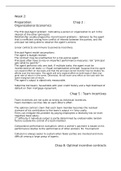
Preparation: Chap 2 :
Organizational Economics
The Principal-Agent problem: motivating a person or organization to act in the
interest of the other (principal).
Relationship usually plagued by moral hazard problems – behavior by the agent
that is inefficient arising from conflict of interest between the parties, and the
principal not being able to observe the agent’s actions.
Linear contracts are immune to perverse incentives.
Principal-Agent model assumptions:
The agent is budget restrain.
The contract may be unattractive for a risk-averse agent.
Principals often have to rely on imperfect performance measures: risk “principal
gets what he paid for”.
The agent performs only one task. If multiple tasks, the agent must be
incentivized on all tasks => Equal compensation principal: Suppose that the agent
can expend effort on two tasks and that the principal cannot monitor how he divides his
efforts over the two tasks. The agent will only expend effort on both tasks if their mar
ginal rate of return is the same. Otherwise, he will exert zero effort on the task with the
lower marginal rate of return.
The agent’s output is objectively measurable.
Subprime borrowers: households with poor credit history and a high likelihood of
default on their mortgage repayment.
Chap 5 : Team incentives
Team incentives are not quite as strong as individual incentives.
Team members can free ride on each other’s effort.
The optimal contract claim that each team member becomes the residual
claimant of his contribution to the team’s output => Very costly.
Firms can mitigate this problem by paying employees a relatively low (or even
negative) base salary.
2nd difficulty if individual output is partly determined by unobservable random
factors outside the control of a team member.
Comparative performance evaluation: when a worker’s payment is based on his
performance relative to the performance of other workers. Ex: Tournament
Collusion is always easier to sustain when fewer parties are involved and more
difficult among a large group of agents.
Chap 8: Optimal incentive contracts
, No Incentives: ß = 0 -> The contract is totally risk free. The principal doesn’t
have to pay the agent a risk premium. The higher the power of incentives, the
greater ß, the greater ßx, the higher the risk payoff
The incentive intensity principle: The optimal intensity of incentives (β) is higher:
(1) the lower the agent’s marginal effort costs (i.e., the lower γ); (2) the greater
the principal’s incremental profits from additional effort (i.e., the higher p); (3)
the more precisely performance can be measured (i.e., the lower the vari ance of
x); and (4) the greater the agent’s risk tolerance.
The informativeness principle: Total value is increased by correcting for events
beyond the agent’s control in such a way that the error with which the principal
measures the agent’s performance is reduced.
Yardstick competition: for eg if the regulator imposes on each regional monopoly
a maximum price depending on the costs of the other regional monopolies.
Prevent skyrocketing and welfare reducing prices, takes into account common
shocks, and give the firms greater incentives to operate cost efficiently.
Informativeness principal cautioness : The principal may be tempted to condition
an agent’s performance standard on the basis of the agent’s past performance.
Ratchet effect (undesirable cuz the agent will have all the incentives to
underperform in early periods.
Performance is positively related to effort and since effort is unpleasant a money
is good, a monetary compensation will tend to increase the performance. But
sometimes other factors are also to take into account.
Lecture:
The principal-Agent problem:
Main problem in organizational economics: how to align incentives.
In a one-person company, no conflicts of interest. But in larger firms, they are
abundant – Shareholders-Management; Manager-Employee – and companies
solve it with contracts.
Contracts: in the labor market, there is a wide range of contracts: fixed wage;
piece rate, commissions; targets (with bonus); relative bonuses and promotions;
franchise contracts (fast food, logistics). Contracts can be implicit (eg promotion
and salary increases).
PB: Moral Hazard problem: conflicts of interest between P and A or P cannot
observe A’s actions.
If A’s output is observable for P, contracts can solve the P-A problem.
° Linear contracts: P pays A w + ßQ
w: fixed wage
ß: bonus
Q: output
Simple to analyze
Many applications in practice
Preparation: Chap 2 :
Organizational Economics
The Principal-Agent problem: motivating a person or organization to act in the
interest of the other (principal).
Relationship usually plagued by moral hazard problems – behavior by the agent
that is inefficient arising from conflict of interest between the parties, and the
principal not being able to observe the agent’s actions.
Linear contracts are immune to perverse incentives.
Principal-Agent model assumptions:
The agent is budget restrain.
The contract may be unattractive for a risk-averse agent.
Principals often have to rely on imperfect performance measures: risk “principal
gets what he paid for”.
The agent performs only one task. If multiple tasks, the agent must be
incentivized on all tasks => Equal compensation principal: Suppose that the agent
can expend effort on two tasks and that the principal cannot monitor how he divides his
efforts over the two tasks. The agent will only expend effort on both tasks if their mar
ginal rate of return is the same. Otherwise, he will exert zero effort on the task with the
lower marginal rate of return.
The agent’s output is objectively measurable.
Subprime borrowers: households with poor credit history and a high likelihood of
default on their mortgage repayment.
Chap 5 : Team incentives
Team incentives are not quite as strong as individual incentives.
Team members can free ride on each other’s effort.
The optimal contract claim that each team member becomes the residual
claimant of his contribution to the team’s output => Very costly.
Firms can mitigate this problem by paying employees a relatively low (or even
negative) base salary.
2nd difficulty if individual output is partly determined by unobservable random
factors outside the control of a team member.
Comparative performance evaluation: when a worker’s payment is based on his
performance relative to the performance of other workers. Ex: Tournament
Collusion is always easier to sustain when fewer parties are involved and more
difficult among a large group of agents.
Chap 8: Optimal incentive contracts
, No Incentives: ß = 0 -> The contract is totally risk free. The principal doesn’t
have to pay the agent a risk premium. The higher the power of incentives, the
greater ß, the greater ßx, the higher the risk payoff
The incentive intensity principle: The optimal intensity of incentives (β) is higher:
(1) the lower the agent’s marginal effort costs (i.e., the lower γ); (2) the greater
the principal’s incremental profits from additional effort (i.e., the higher p); (3)
the more precisely performance can be measured (i.e., the lower the vari ance of
x); and (4) the greater the agent’s risk tolerance.
The informativeness principle: Total value is increased by correcting for events
beyond the agent’s control in such a way that the error with which the principal
measures the agent’s performance is reduced.
Yardstick competition: for eg if the regulator imposes on each regional monopoly
a maximum price depending on the costs of the other regional monopolies.
Prevent skyrocketing and welfare reducing prices, takes into account common
shocks, and give the firms greater incentives to operate cost efficiently.
Informativeness principal cautioness : The principal may be tempted to condition
an agent’s performance standard on the basis of the agent’s past performance.
Ratchet effect (undesirable cuz the agent will have all the incentives to
underperform in early periods.
Performance is positively related to effort and since effort is unpleasant a money
is good, a monetary compensation will tend to increase the performance. But
sometimes other factors are also to take into account.
Lecture:
The principal-Agent problem:
Main problem in organizational economics: how to align incentives.
In a one-person company, no conflicts of interest. But in larger firms, they are
abundant – Shareholders-Management; Manager-Employee – and companies
solve it with contracts.
Contracts: in the labor market, there is a wide range of contracts: fixed wage;
piece rate, commissions; targets (with bonus); relative bonuses and promotions;
franchise contracts (fast food, logistics). Contracts can be implicit (eg promotion
and salary increases).
PB: Moral Hazard problem: conflicts of interest between P and A or P cannot
observe A’s actions.
If A’s output is observable for P, contracts can solve the P-A problem.
° Linear contracts: P pays A w + ßQ
w: fixed wage
ß: bonus
Q: output
Simple to analyze
Many applications in practice