
Enzymes
Enzyme Structure and mode of action
Globular proteins catalyse metabolic reactions
Type of enzyme determined by tertiary structure of amino acid
Only a small region of the enzyme is functional active site
Active site forms a hollow depression in the enzyme allows for a specific substrate
to temporarily bond with the active site forms an enzyme-substrate complex
The R-group on the active site forms a bond with the groups on the substrate
molecule
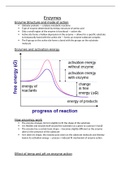
Enzymes and activation energy
How enzymes work
The enzyme changes its form slightly to fit the shape of the substrate
It is flexible and moulds itself around the substrate (as a glove to a person’s hand)
The enzyme has a certain basic shape becomes slightly different as the enzyme
alters in the presence of the substrate
As it alters its shape, the enzyme puts strain on the substrate molecule and thereby
lowers its activation energy process = induced fit mechanism of enzyme action
Effect of temp and pH on enzyme action
, Measuring enzyme-catalysed reactions
To measure the process of an enzyme catalysed reaction, the time-course reaction is
measures (how long does it take for the particular event to run its course?)
The 2 events measured are:
- The information of the products
- The disappearance of the substrate
Product formed
Concentration or mass of
substrate
At first there is a lot of substrate but no product
It is very easy for substrate molecules to come into contact with the empty enzyme
active sites
All enzyme active sites are filled with substrate – E-S complexes form rapidly, and
products are formed rapidly
The amount of substrate decreases as it is broken down increases product
The product produced per unit time decreases as there are fewer substrate
molecules available not all enzyme active sites will be filled
The rate of reaction continues to slow as the substrate concentration decreases
The graph flattens out as all the substrate has been used up no new products are
formed
Low enzyme
At low enzyme
concentratio
concentration n
At low rates of enzyme concentration there are too few enzymes molecules to allow
the substrate molecules to find an active site at one point in time said to be
enzyme limiting
Enzyme Structure and mode of action
Globular proteins catalyse metabolic reactions
Type of enzyme determined by tertiary structure of amino acid
Only a small region of the enzyme is functional active site
Active site forms a hollow depression in the enzyme allows for a specific substrate
to temporarily bond with the active site forms an enzyme-substrate complex
The R-group on the active site forms a bond with the groups on the substrate
molecule
Enzymes and activation energy
How enzymes work
The enzyme changes its form slightly to fit the shape of the substrate
It is flexible and moulds itself around the substrate (as a glove to a person’s hand)
The enzyme has a certain basic shape becomes slightly different as the enzyme
alters in the presence of the substrate
As it alters its shape, the enzyme puts strain on the substrate molecule and thereby
lowers its activation energy process = induced fit mechanism of enzyme action
Effect of temp and pH on enzyme action
, Measuring enzyme-catalysed reactions
To measure the process of an enzyme catalysed reaction, the time-course reaction is
measures (how long does it take for the particular event to run its course?)
The 2 events measured are:
- The information of the products
- The disappearance of the substrate
Product formed
Concentration or mass of
substrate
At first there is a lot of substrate but no product
It is very easy for substrate molecules to come into contact with the empty enzyme
active sites
All enzyme active sites are filled with substrate – E-S complexes form rapidly, and
products are formed rapidly
The amount of substrate decreases as it is broken down increases product
The product produced per unit time decreases as there are fewer substrate
molecules available not all enzyme active sites will be filled
The rate of reaction continues to slow as the substrate concentration decreases
The graph flattens out as all the substrate has been used up no new products are
formed
Low enzyme
At low enzyme
concentratio
concentration n
At low rates of enzyme concentration there are too few enzymes molecules to allow
the substrate molecules to find an active site at one point in time said to be
enzyme limiting


