MAT3701 ASSIGNMENT 2026
DUE 4 SEPTEMBER 2026
3
Question 1
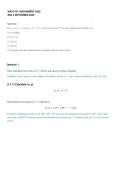
Let x = (2, 1 + i, i) and y = (2 − i, 2, 1 + 2i) be vectors in C3 . Use the standard inner product on C .
(1.1) Calculate
(1.1.1) ⟨x, y⟩.
(1.1.2) ∥x∥.
(1.1.3) ∥y∥.
(1.2) Confirm that the Cauchy-Schwarz inequality holds for these vectors.
Question 1
Topic: Standard Inner Product on ℂⁿ, Norm, and Cauchy-Schwarz Inequality
Friedberg, Insel & Spence, Linear Algebra, 4th Edition, Section 6.1: "Inner Products and Norms" (pp. 329-340)
(1.1.1) Calculate ⟨x, y⟩
⟨x, y⟩ = 8 + 5i
The standard inner product on ℂⁿ is defined as:
⟨x, y⟩ = x1 y1 + x2 y2 + ⋯ + xn yn
As stated in Friedberg Section 6.1 (p. 329), "If F = C , this gives the standard inner product on Cn ". This is also
confirmed in MAT3701 materials where the standard inner product on ℂⁿ is defined as ⟨x, y⟩ = y ∗ x for column
vectors.
, (1.1.2) Calculate ‖x‖
∥x∥ = 7
The norm (or length) of a vector is defined as:
∥x∥ = ⟨x, x⟩ = ∣x1 ∣2 + ∣x2 ∣2 + ⋯ + ∣xn ∣2
From Friedberg Section 6.1 (p. 330), the norm is derived from the inner product. The computation follows from the
property that ⟨x, x⟩ = ∣x1 ∣2 + ⋯ + ∣x 2
n ∣ .
(1.1.3) Calculate ‖y‖
∥y∥ = 14
Same as (1.1.2) above. By the definition of norm in Section 6.1.
(1.2) Confirm Cauchy-Schwarz Inequality
∣⟨x, y⟩∣ = 89 ≤ 98 = ∥x∥ ⋅ ∥y∥
The Cauchy-Schwarz Inequality (Friedberg, Section 6.1, Theorem 6.2, p. 331) states:
∣⟨x, y⟩∣ ≤ ∥x∥ ⋅ ∥y∥
This is a fundamental property of any inner product space. Equality holds if and only if one vector is a scalar multiple
of the other.
DUE 4 SEPTEMBER 2026
3
Question 1
Let x = (2, 1 + i, i) and y = (2 − i, 2, 1 + 2i) be vectors in C3 . Use the standard inner product on C .
(1.1) Calculate
(1.1.1) ⟨x, y⟩.
(1.1.2) ∥x∥.
(1.1.3) ∥y∥.
(1.2) Confirm that the Cauchy-Schwarz inequality holds for these vectors.
Question 1
Topic: Standard Inner Product on ℂⁿ, Norm, and Cauchy-Schwarz Inequality
Friedberg, Insel & Spence, Linear Algebra, 4th Edition, Section 6.1: "Inner Products and Norms" (pp. 329-340)
(1.1.1) Calculate ⟨x, y⟩
⟨x, y⟩ = 8 + 5i
The standard inner product on ℂⁿ is defined as:
⟨x, y⟩ = x1 y1 + x2 y2 + ⋯ + xn yn
As stated in Friedberg Section 6.1 (p. 329), "If F = C , this gives the standard inner product on Cn ". This is also
confirmed in MAT3701 materials where the standard inner product on ℂⁿ is defined as ⟨x, y⟩ = y ∗ x for column
vectors.
, (1.1.2) Calculate ‖x‖
∥x∥ = 7
The norm (or length) of a vector is defined as:
∥x∥ = ⟨x, x⟩ = ∣x1 ∣2 + ∣x2 ∣2 + ⋯ + ∣xn ∣2
From Friedberg Section 6.1 (p. 330), the norm is derived from the inner product. The computation follows from the
property that ⟨x, x⟩ = ∣x1 ∣2 + ⋯ + ∣x 2
n ∣ .
(1.1.3) Calculate ‖y‖
∥y∥ = 14
Same as (1.1.2) above. By the definition of norm in Section 6.1.
(1.2) Confirm Cauchy-Schwarz Inequality
∣⟨x, y⟩∣ = 89 ≤ 98 = ∥x∥ ⋅ ∥y∥
The Cauchy-Schwarz Inequality (Friedberg, Section 6.1, Theorem 6.2, p. 331) states:
∣⟨x, y⟩∣ ≤ ∥x∥ ⋅ ∥y∥
This is a fundamental property of any inner product space. Equality holds if and only if one vector is a scalar multiple
of the other.