Endocrinology
Endocrine system vs nervous system
Nervous system Endocrine system
Electrical communication Chemical communication
Transmission by neurons Transported via blood stream
Voluntary or involuntary Involuntary
Localised Often distant
Effect rapid Effect rapid or long-lasting
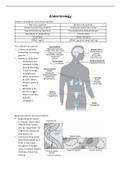
The endocrine system
• Endocrine glands:
hormones secreting
glands
• Hormone definition
o Chemicals are
released in one
part of the body
o Travel through
bloodstream
o Affect activities
of cells, often
distant parts of
body
o Affected cells
are the target
(have hormone-
specific
receptors)
Mechanisms of hormone action
• Depending on where
hormones exert their
effects, their action
can be classified into
endocrine, paracrine,
and autocrine
• Hormones that enter
the bloodstream and
bind to hormone
receptors in target
cells in distant organs
mediate endocrine
effects
,• Hormones that bind to cells near the cell that released them mediate paracrine effects
• Hormones that produce their physiologic effects by binding to receptors on the same
cell that produced them mediate autocrine effects
Hormone classification
Amines
• Small group of hormones derived from tyrosine
• Made up of catecholamines and thyroid hormones
• Catecholamines (e.g. adrenaline)
o Are water-soluble
o Do not require carrier proteins in plasma
o Receptor are located on membrane surface (of cell)
• Thyroid hormones (e.g. T3)
o Solubility in water is poor
o Require carrier proteins in the blood
o Receptors are located intracellularly (inside cell)
Peptide and protein hormones
• E.g. growth hormone, insulin, glucagon, prolactin etc.
• Largest class of hormones
• Generally water soluble
• Do not require carrier molecules in the blood
• Receptors located on membrane surface
Steroid hormones
• E.g. cortisol, aldosterone, oestrogen, progesterone etc.
• Synthesised from cholesterol
• Are not stored in vesicles
• Rapidly diffuse out of cell once synthesised (due to high lipid solubility)
• Require carrier proteins in blood (due to low water solubility)
• Free steroid hormones enter target cells primarily by passive diffusion
Hypothalamus
• Concerned with
homeostasis
• Located in brain,
below thalamus
• Funnel-shaped
stalk
(infundibulum
connects
hypothalamus to
pituitary)
• Liberins and
statins regulate pituitary hormone secretion
,Anatomical and functional relationship between the hypothalamus and the pituitary
• The hypothalamus is anatomically and functionally linked with the anterior and
posterior pituitary
• They are closely related because of the portal system of blood supply
• The superior, medial, and inferior hypophyseal arteries provide arterial blood supply to
the median eminence and the pituitary
• Magnocellular neurons of the supraoptic and paraventricular nuclei have long axons
that terminate in the posterior pituitary
• The axons of parvicellular neurons terminate in the median eminence where they
release their neuropeptides
• The long portal veins drain the median eminence, transporting the peptides from the
primary capillary plexus to the secondary plexus that provides blood supply to the
anterior pituitary
• The release of hypothalamic neuropeptides is regulated by afferent signals from other
brain regions, from visceral afferents by circulating levels of substrates and hormones
• The sleep/awake state of the individual, the light variations, noise, fear, anxiety, and
visual images all are examples of signals that are integrated by the hypothalamus
and that are involved in the regulation of hypothalamic neuropeptide release and
control of pituitary function
• The hormones released from the anterior and posterior pituitary regulate vital body
functions maintaining homeostasis
, Hypothalamus (secretes liberins)
• Liberins: releasing factors or releasing hormones)
• Thyrotropin-releasing hormone (TRH): stimulates secretion of TSH
• Corticotropin-releasing hormone (CRH): stimulates secretion of ACTH
• Gonadotropin-releasing hormone (GnRH): stimulates secretion of FSH and LH
• Growth hormone-releasing hormone (GHRH): stimulates secretion of GH
Hypothalamus (secretes statins)
• Statins: inhibiting factors or inhibiting hormones
• Inhibit hormone secretion
• Growth hormone inhibiting hormone or GHIH (somatostatin)
• Prolactin inhibiting hormone
Other hypothalamic hormones
• Synthesis and processing of oxytocin and vasopressin
• Oxytocin and vasopressin are synthesized in the endoplasmic reticulum (ER) of
hypothalamic magnocellular neurons as preprohormones
• In the Golgi apparatus (GA) they are packaged in secretory granules and are
transported down the hypothalamo-hypophyseal tract
• During their transport the precursor hormones are processed yielding the final
hormone and the respective neurophysins
• The contents of the neurosecretory vesicles are released by exocytosis from the axon
terminals in the posterior pituitary
Endocrine system vs nervous system
Nervous system Endocrine system
Electrical communication Chemical communication
Transmission by neurons Transported via blood stream
Voluntary or involuntary Involuntary
Localised Often distant
Effect rapid Effect rapid or long-lasting
The endocrine system
• Endocrine glands:
hormones secreting
glands
• Hormone definition
o Chemicals are
released in one
part of the body
o Travel through
bloodstream
o Affect activities
of cells, often
distant parts of
body
o Affected cells
are the target
(have hormone-
specific
receptors)
Mechanisms of hormone action
• Depending on where
hormones exert their
effects, their action
can be classified into
endocrine, paracrine,
and autocrine
• Hormones that enter
the bloodstream and
bind to hormone
receptors in target
cells in distant organs
mediate endocrine
effects
,• Hormones that bind to cells near the cell that released them mediate paracrine effects
• Hormones that produce their physiologic effects by binding to receptors on the same
cell that produced them mediate autocrine effects
Hormone classification
Amines
• Small group of hormones derived from tyrosine
• Made up of catecholamines and thyroid hormones
• Catecholamines (e.g. adrenaline)
o Are water-soluble
o Do not require carrier proteins in plasma
o Receptor are located on membrane surface (of cell)
• Thyroid hormones (e.g. T3)
o Solubility in water is poor
o Require carrier proteins in the blood
o Receptors are located intracellularly (inside cell)
Peptide and protein hormones
• E.g. growth hormone, insulin, glucagon, prolactin etc.
• Largest class of hormones
• Generally water soluble
• Do not require carrier molecules in the blood
• Receptors located on membrane surface
Steroid hormones
• E.g. cortisol, aldosterone, oestrogen, progesterone etc.
• Synthesised from cholesterol
• Are not stored in vesicles
• Rapidly diffuse out of cell once synthesised (due to high lipid solubility)
• Require carrier proteins in blood (due to low water solubility)
• Free steroid hormones enter target cells primarily by passive diffusion
Hypothalamus
• Concerned with
homeostasis
• Located in brain,
below thalamus
• Funnel-shaped
stalk
(infundibulum
connects
hypothalamus to
pituitary)
• Liberins and
statins regulate pituitary hormone secretion
,Anatomical and functional relationship between the hypothalamus and the pituitary
• The hypothalamus is anatomically and functionally linked with the anterior and
posterior pituitary
• They are closely related because of the portal system of blood supply
• The superior, medial, and inferior hypophyseal arteries provide arterial blood supply to
the median eminence and the pituitary
• Magnocellular neurons of the supraoptic and paraventricular nuclei have long axons
that terminate in the posterior pituitary
• The axons of parvicellular neurons terminate in the median eminence where they
release their neuropeptides
• The long portal veins drain the median eminence, transporting the peptides from the
primary capillary plexus to the secondary plexus that provides blood supply to the
anterior pituitary
• The release of hypothalamic neuropeptides is regulated by afferent signals from other
brain regions, from visceral afferents by circulating levels of substrates and hormones
• The sleep/awake state of the individual, the light variations, noise, fear, anxiety, and
visual images all are examples of signals that are integrated by the hypothalamus
and that are involved in the regulation of hypothalamic neuropeptide release and
control of pituitary function
• The hormones released from the anterior and posterior pituitary regulate vital body
functions maintaining homeostasis
, Hypothalamus (secretes liberins)
• Liberins: releasing factors or releasing hormones)
• Thyrotropin-releasing hormone (TRH): stimulates secretion of TSH
• Corticotropin-releasing hormone (CRH): stimulates secretion of ACTH
• Gonadotropin-releasing hormone (GnRH): stimulates secretion of FSH and LH
• Growth hormone-releasing hormone (GHRH): stimulates secretion of GH
Hypothalamus (secretes statins)
• Statins: inhibiting factors or inhibiting hormones
• Inhibit hormone secretion
• Growth hormone inhibiting hormone or GHIH (somatostatin)
• Prolactin inhibiting hormone
Other hypothalamic hormones
• Synthesis and processing of oxytocin and vasopressin
• Oxytocin and vasopressin are synthesized in the endoplasmic reticulum (ER) of
hypothalamic magnocellular neurons as preprohormones
• In the Golgi apparatus (GA) they are packaged in secretory granules and are
transported down the hypothalamo-hypophyseal tract
• During their transport the precursor hormones are processed yielding the final
hormone and the respective neurophysins
• The contents of the neurosecretory vesicles are released by exocytosis from the axon
terminals in the posterior pituitary