7.1 MONOSACCHARIDES
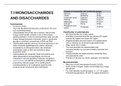
Classes of compounds and functional groups
Alcohols Hydroxyl R-OH
Thiols Sulfhydryl R-SH
AND DISACCHARIDES Carboxylic acids
Ketones
Carboxyl
Carbonyl
R-COOH
R-CO-R
Aldehydes Carbonyl R-CO-H
Carbohydrates Amines Amino R-NH2
• Formula Cn(H2O)n Phosphoric acid
Phosphate R-OPO32-
• The most abundant biomolecules, produced for CO2 and esters
H2O via photosynthesis
• Carbohydrates have three main functions, they provide Classification of carbohydrates
energy (carbohydrate oxidation is the central energy- • Monosaccharides are simple sugars
yielding pathway in most non-photosynthetic cells), provide • Examples of monosaccharides are glucose (6C sugar),
energy storage (polymers of glucose, starch in plants and fructose (6C sugar) and ribose (6C sugar)
glycogen in animals), components of DNA and RNA • Oligosaccharides are short chains of monosaccharide
• Carbohydrate polymers serve as structural elements in cell units or residues (2-10) joined by glycosidic bonds
walls of bacteria (peptidoglycans), plants (cellulose), • Oligo means few in Greek
exoskeletons of arthropods (chitin) and vertebrate • The most abundant are disaccharides (two
extracellular matrix of skin and connective tissue monosaccharides e.g. sucrose consists of glucose and
(hyaluronic acid) fructose)
• Carbohydrates are covalently linked with proteins and • Polysaccharides are sugar polymers containing many
lipids (glycoproteins and glycolipids) are informal monosaccharide units
molecules in cell-cell signalling (molecular recognition) • Polymers of glucose e.g. starch, glycogen, and cellulose
• Carbohydrates are defined as polyhydroxy aldehydes or
polyhydroxy ketones (sugar unit or building block, Monosaccharides
monosaccharide) or as a substance (polymer) that • Many (but not all) have general formula Cn(H2O)n
produces these compounds when hydrolysed • Some contain nitrogen, sulphur and phosphorous (sugar
derivatives)
• For most naturally occurring sugars, n = 3-7, 3C sugars
formed during glycolysis, 4C and 7C sugars important in
, photosynthesis and pentose phosphate pathway, 5C
sugars are compounds of nucleic acids and 6C sugars are
the most abundant
Basic nomenclature
• Number of carbon atoms in the sugar + ose
• 3 triose, 4 tetrose, 5 pentose, 6 hexose, and 7 heptose
Trioses
• 3 carbons
• Simplest monosaccharides with the formula C3H6O3
• Polyhydroxy aldehyde (carbonyl group is at end of carbon
chain) or polyhydroxy ketone (carbonyl group is at any
other position)
Aldoses and ketoses
• An aldose is a carbohydrate with aldehyde functionality
• A ketose is a carbohydrate with ketone functionality
• Drawing monosaccharides Fischer projection formulas
• Chiral compounds can be drawn using perspective • Fischer projection formulas show the configuration or
formulas (wedges and dashes) spatial arrangement of substituent groups attached to
• A chiral carbon is a carbon atom with 4 different groups chiral or asymmetric carbon atoms
• However, chiral carbohydrates are usually represented by • In Fischer projections of aldoses, the most highly oxidized
Fischer projection formulas C (carbonyl) is written at the top and is C-1
• Horizontal bonds are pointing towards you, vertical bonds • In Fischer projections of ketoses, the carbonyl is C-2
are projecting away from you • Other carbons are numbered in sequence from top to
bottom at the top and the hydroxyl functional groups
pointing right or left
, Stereoisomers
• Stereoisomers are substances with the same molecular
formula and structure, but different configurations (different
spatial orientation) of atoms or a group of atoms
• Observed in molecules with chiral or asymmetric carbon
atoms
• If n is the number of chiral carbons in a molecule, then the
number of stereoisomers is 2n
• Can be further divided into enantiomers and diastereomers
(epimers)
Enantiomers
• Enantiomers are structures that are mirror images of each
Isomers other and are nonsuperimposable
• Isomers are compounds with the same molecular formula • The D and L system is used for distinguishing enantiomers
but different structure and properties of sugars
• Further divided into structural isomers and stereoisomers • In a Fischer projection the L or D configuration depends on
the arrangement at the chiral carbon with the highest
Structural or constitutional isomers number
• Structural isomers are compounds with the same • D configuration (has the OH on the penultimate carbon on
molecular formula but have different covalent the right)
arrangements of their atoms • L configuration (has the OH on the penultimate carbon on
• Aldose-ketose pairs e.g. C3H6O3 glyceraldehyde the left)
(aldotriose) and dihydroxyacetone (ketotriose) and e.g. • Almost all the physical properties (density, mp, bp,
C6H12O6 D-Glucose (aldohexose) and D-Fructose solubility) of enantiomers are the same, except their ability
(ketohexose) to rotate plane polarized light (optical activity)
• Most hexoses in living organisms are D-stereoisomers
• Some simple sugars occur in the L-form, such as L-
Arabinose (component of glycoconjugates)
, Aldotrioses • Diastereomers have different physical properties, for
• n = 1, 21 = 2 possible stereoisomers example, water solubilities of D-threose and D-erythrose
• Know D-Glyceraldehyde (formed during glycolysis) are different
• Simplest ketotriose
• Dihydroxyacetone has no chiral carbon (no mirror image) Epimer
• Know dihydroxyacetone (formed during glycolysis) • Epimers are diastereomers that differ from each other in
configuration at only one chiral carbon e.g. D-Erythrose
Aldotetroses and D-Threose, D-Mannose and D-Galactose are both
• n = 2, 22 = 4 possible stereoisomers, 2 D and 2 L-isomers epimers of D-Glucose
• Know D-Erythrose (formed during pentose phosphate- • D-Mannose and D-Galactose vary at more than one chiral
pathway) centre and are diastereomers, but not epimers
Aldopentoses
• n = 3, 23 = 8 possible stereoisomers, 4 D-isomers and 4 L-
isomers
• Know D-Ribose (formed during pentose phosphate
pathway, component of RNA)
Aldohexoses
• n = 4, 24 = 16 possible stereoisomers, 8 D-isomers and 8
L-isomers
• Know D-Glucose, D-Mannose (glycoproteins) and D-
Galactose (component of lactose, derivative of
glycoproteins)
Glycoproteins
• Glycoproteins are molecules with 2 or more chiral or
asymmetrical carbon atoms that differ from each other with
respect to configuration at one or more carbon atoms but
are not enantiomers e.g. D-Erythrose and D-Threose
Classes of compounds and functional groups
Alcohols Hydroxyl R-OH
Thiols Sulfhydryl R-SH
AND DISACCHARIDES Carboxylic acids
Ketones
Carboxyl
Carbonyl
R-COOH
R-CO-R
Aldehydes Carbonyl R-CO-H
Carbohydrates Amines Amino R-NH2
• Formula Cn(H2O)n Phosphoric acid
Phosphate R-OPO32-
• The most abundant biomolecules, produced for CO2 and esters
H2O via photosynthesis
• Carbohydrates have three main functions, they provide Classification of carbohydrates
energy (carbohydrate oxidation is the central energy- • Monosaccharides are simple sugars
yielding pathway in most non-photosynthetic cells), provide • Examples of monosaccharides are glucose (6C sugar),
energy storage (polymers of glucose, starch in plants and fructose (6C sugar) and ribose (6C sugar)
glycogen in animals), components of DNA and RNA • Oligosaccharides are short chains of monosaccharide
• Carbohydrate polymers serve as structural elements in cell units or residues (2-10) joined by glycosidic bonds
walls of bacteria (peptidoglycans), plants (cellulose), • Oligo means few in Greek
exoskeletons of arthropods (chitin) and vertebrate • The most abundant are disaccharides (two
extracellular matrix of skin and connective tissue monosaccharides e.g. sucrose consists of glucose and
(hyaluronic acid) fructose)
• Carbohydrates are covalently linked with proteins and • Polysaccharides are sugar polymers containing many
lipids (glycoproteins and glycolipids) are informal monosaccharide units
molecules in cell-cell signalling (molecular recognition) • Polymers of glucose e.g. starch, glycogen, and cellulose
• Carbohydrates are defined as polyhydroxy aldehydes or
polyhydroxy ketones (sugar unit or building block, Monosaccharides
monosaccharide) or as a substance (polymer) that • Many (but not all) have general formula Cn(H2O)n
produces these compounds when hydrolysed • Some contain nitrogen, sulphur and phosphorous (sugar
derivatives)
• For most naturally occurring sugars, n = 3-7, 3C sugars
formed during glycolysis, 4C and 7C sugars important in
, photosynthesis and pentose phosphate pathway, 5C
sugars are compounds of nucleic acids and 6C sugars are
the most abundant
Basic nomenclature
• Number of carbon atoms in the sugar + ose
• 3 triose, 4 tetrose, 5 pentose, 6 hexose, and 7 heptose
Trioses
• 3 carbons
• Simplest monosaccharides with the formula C3H6O3
• Polyhydroxy aldehyde (carbonyl group is at end of carbon
chain) or polyhydroxy ketone (carbonyl group is at any
other position)
Aldoses and ketoses
• An aldose is a carbohydrate with aldehyde functionality
• A ketose is a carbohydrate with ketone functionality
• Drawing monosaccharides Fischer projection formulas
• Chiral compounds can be drawn using perspective • Fischer projection formulas show the configuration or
formulas (wedges and dashes) spatial arrangement of substituent groups attached to
• A chiral carbon is a carbon atom with 4 different groups chiral or asymmetric carbon atoms
• However, chiral carbohydrates are usually represented by • In Fischer projections of aldoses, the most highly oxidized
Fischer projection formulas C (carbonyl) is written at the top and is C-1
• Horizontal bonds are pointing towards you, vertical bonds • In Fischer projections of ketoses, the carbonyl is C-2
are projecting away from you • Other carbons are numbered in sequence from top to
bottom at the top and the hydroxyl functional groups
pointing right or left
, Stereoisomers
• Stereoisomers are substances with the same molecular
formula and structure, but different configurations (different
spatial orientation) of atoms or a group of atoms
• Observed in molecules with chiral or asymmetric carbon
atoms
• If n is the number of chiral carbons in a molecule, then the
number of stereoisomers is 2n
• Can be further divided into enantiomers and diastereomers
(epimers)
Enantiomers
• Enantiomers are structures that are mirror images of each
Isomers other and are nonsuperimposable
• Isomers are compounds with the same molecular formula • The D and L system is used for distinguishing enantiomers
but different structure and properties of sugars
• Further divided into structural isomers and stereoisomers • In a Fischer projection the L or D configuration depends on
the arrangement at the chiral carbon with the highest
Structural or constitutional isomers number
• Structural isomers are compounds with the same • D configuration (has the OH on the penultimate carbon on
molecular formula but have different covalent the right)
arrangements of their atoms • L configuration (has the OH on the penultimate carbon on
• Aldose-ketose pairs e.g. C3H6O3 glyceraldehyde the left)
(aldotriose) and dihydroxyacetone (ketotriose) and e.g. • Almost all the physical properties (density, mp, bp,
C6H12O6 D-Glucose (aldohexose) and D-Fructose solubility) of enantiomers are the same, except their ability
(ketohexose) to rotate plane polarized light (optical activity)
• Most hexoses in living organisms are D-stereoisomers
• Some simple sugars occur in the L-form, such as L-
Arabinose (component of glycoconjugates)
, Aldotrioses • Diastereomers have different physical properties, for
• n = 1, 21 = 2 possible stereoisomers example, water solubilities of D-threose and D-erythrose
• Know D-Glyceraldehyde (formed during glycolysis) are different
• Simplest ketotriose
• Dihydroxyacetone has no chiral carbon (no mirror image) Epimer
• Know dihydroxyacetone (formed during glycolysis) • Epimers are diastereomers that differ from each other in
configuration at only one chiral carbon e.g. D-Erythrose
Aldotetroses and D-Threose, D-Mannose and D-Galactose are both
• n = 2, 22 = 4 possible stereoisomers, 2 D and 2 L-isomers epimers of D-Glucose
• Know D-Erythrose (formed during pentose phosphate- • D-Mannose and D-Galactose vary at more than one chiral
pathway) centre and are diastereomers, but not epimers
Aldopentoses
• n = 3, 23 = 8 possible stereoisomers, 4 D-isomers and 4 L-
isomers
• Know D-Ribose (formed during pentose phosphate
pathway, component of RNA)
Aldohexoses
• n = 4, 24 = 16 possible stereoisomers, 8 D-isomers and 8
L-isomers
• Know D-Glucose, D-Mannose (glycoproteins) and D-
Galactose (component of lactose, derivative of
glycoproteins)
Glycoproteins
• Glycoproteins are molecules with 2 or more chiral or
asymmetrical carbon atoms that differ from each other with
respect to configuration at one or more carbon atoms but
are not enantiomers e.g. D-Erythrose and D-Threose