Zeyn Mahomed Grade 10 2020
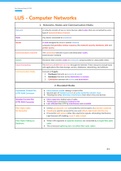
LU5 - Computer Networks
1. Networks, Nodes and Communication Media
Network A network consists of two or more devices called nodes that are connected by some
type of communications channel.
Node Any device connected to a network.
Server A node designed to act as a central network
computer that provides various resources like network security; hardware, disk and
printer access.
Communications Channel The connection between source and destination nodes.
(transmission medium)
Switch Hardware that connects nodes in a network using bounded or unbounded media.
Cloud Computing The delivery of different services through the Internet. These resources include tools
and applications like data storage, servers, databases, networking, and software.
Communication Media Consists of 3 parts
1. Hardware that acts as a source or sender
2. Hardware that acts as the destination or receiver
3. Connection between the source and destination
2. Bounded Media
Unshielded Twisted Pair ● Most common media cabling in small LANs
(UTP) RJ45 Connector ● Several pairs of twisted wires in an outer protective plastic cover
● Twisting the wires eliminates interference from other wires and devices
Shielded Twisted Pair ● More expensive, bulkier type of cable
(STP) RJ45 Connector ● Twisted pairs enclosed in protective foil
● Less affected than UTP by interference and crosstalk
Fibre Optic Cable ● Central glass/plastic core surrounded by several layers of protective materials
SC Connector ● Cladding is used to surround the core and reflects light back into the core
● It transmits light pulses rather than electronic signals, eliminating interference.
Light bounces off cladding, even if cable is bent
Fibre Optic Cabling as ● When LAN segments in separate locations are connected by a single fibre optic
Backbone cable
● This is because lightning does not affect fibre optic cables
21
, Zeyn Mahomed Grade 10 2020
Advantages and Disadvantages of Bounded Media
Bounded Advantages Disadvantages
Media
UTP ● Inexpensive and easy to install Copper Cables:
● Supports fast transmission ● Attenuation - The signal loses
rates strength over a distance.
● Widely used and tested ● Electro-Magnetic Interference
● Can be used in many different - Signals from other sources
types of networks such as machinery can corrupt
the signals travelling in copper
cables nearby.
● Eavesdropping - Signals
travelling along copper cables
STP ● Inexpensive and easy to install can be intercepted by outsiders.
● Supports fast transmission ● Crosstalk - Signals in adjacent
rates wires can interfere with each
● Widely used and tested other as in a crossed telephone.
● Can be used in many different
types of networks
● Less affected by interference
than UTP
Fibre Optic ● More secure - light signals ● Very expensive to purchase
Cable can’t be tapped and install
● Supports faster transmission ● Complex to install - strict
rates criteria
● Transmit over longer distances
- light signals do not weaken as
much
● Immune to electromagnetic
interference
● Immune to lightning and
electrical surges
22
LU5 - Computer Networks
1. Networks, Nodes and Communication Media
Network A network consists of two or more devices called nodes that are connected by some
type of communications channel.
Node Any device connected to a network.
Server A node designed to act as a central network
computer that provides various resources like network security; hardware, disk and
printer access.
Communications Channel The connection between source and destination nodes.
(transmission medium)
Switch Hardware that connects nodes in a network using bounded or unbounded media.
Cloud Computing The delivery of different services through the Internet. These resources include tools
and applications like data storage, servers, databases, networking, and software.
Communication Media Consists of 3 parts
1. Hardware that acts as a source or sender
2. Hardware that acts as the destination or receiver
3. Connection between the source and destination
2. Bounded Media
Unshielded Twisted Pair ● Most common media cabling in small LANs
(UTP) RJ45 Connector ● Several pairs of twisted wires in an outer protective plastic cover
● Twisting the wires eliminates interference from other wires and devices
Shielded Twisted Pair ● More expensive, bulkier type of cable
(STP) RJ45 Connector ● Twisted pairs enclosed in protective foil
● Less affected than UTP by interference and crosstalk
Fibre Optic Cable ● Central glass/plastic core surrounded by several layers of protective materials
SC Connector ● Cladding is used to surround the core and reflects light back into the core
● It transmits light pulses rather than electronic signals, eliminating interference.
Light bounces off cladding, even if cable is bent
Fibre Optic Cabling as ● When LAN segments in separate locations are connected by a single fibre optic
Backbone cable
● This is because lightning does not affect fibre optic cables
21
, Zeyn Mahomed Grade 10 2020
Advantages and Disadvantages of Bounded Media
Bounded Advantages Disadvantages
Media
UTP ● Inexpensive and easy to install Copper Cables:
● Supports fast transmission ● Attenuation - The signal loses
rates strength over a distance.
● Widely used and tested ● Electro-Magnetic Interference
● Can be used in many different - Signals from other sources
types of networks such as machinery can corrupt
the signals travelling in copper
cables nearby.
● Eavesdropping - Signals
travelling along copper cables
STP ● Inexpensive and easy to install can be intercepted by outsiders.
● Supports fast transmission ● Crosstalk - Signals in adjacent
rates wires can interfere with each
● Widely used and tested other as in a crossed telephone.
● Can be used in many different
types of networks
● Less affected by interference
than UTP
Fibre Optic ● More secure - light signals ● Very expensive to purchase
Cable can’t be tapped and install
● Supports faster transmission ● Complex to install - strict
rates criteria
● Transmit over longer distances
- light signals do not weaken as
much
● Immune to electromagnetic
interference
● Immune to lightning and
electrical surges
22