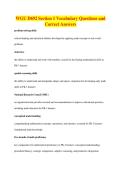
WGU D692 Section 1 Vocabulary Questions and
Correct Answers
problem-solving skills
critical thinking and analytical abilities developed by applying math concepts to real-world
problems
numeracy
the ability to understand and work with numbers, crucial for developing mathematical skills in
PK-3 learners
spatial reasoning skills
the ability to understand and manipulate shapes and spaces, important for developing early math
skills in PK-3 learners
National Research Council (NRC)
an organization that provides research and recommendations to improve educational practices,
including math education for PK-3 learners
conceptual understanding
comprehending mathematical concepts, operations, and relations, essential for PK-3 learners'
foundational math knowledge
five strands of math proficiency
key components for mathematical proficiency in PK-3 learners: conceptual understanding,
procedural fluency, strategic competence, adaptive reasoning, and productive disposition
, procedural fluency
the ability to carry out mathematical procedures accurately and efficiently, important for PK-3
learners' skill development
strategic competence
the ability to formulate, represent, and solve mathematical problems, crucial for PK-3 learners'
problem-solving skills
adaptive reasoning
the capacity to think logically about relationships among concepts and situations, important for
PK-3 learners' mathematical thinking
productive disposition
a positive attitude towards math, believing that effort leads to success, important for PK-3
learners' engagement and persistence
explaining and justifying mathematical reasoning
the process of articulating and defending one's mathematical thinking, important for PK-3
learners' understanding and communication of math concepts
contextualizing and decontextualizing
the ability to connect abstract math concepts to real-world situations and vice versa, important
for PK-3 learners' comprehension and application of math
read-alouds
Correct Answers
problem-solving skills
critical thinking and analytical abilities developed by applying math concepts to real-world
problems
numeracy
the ability to understand and work with numbers, crucial for developing mathematical skills in
PK-3 learners
spatial reasoning skills
the ability to understand and manipulate shapes and spaces, important for developing early math
skills in PK-3 learners
National Research Council (NRC)
an organization that provides research and recommendations to improve educational practices,
including math education for PK-3 learners
conceptual understanding
comprehending mathematical concepts, operations, and relations, essential for PK-3 learners'
foundational math knowledge
five strands of math proficiency
key components for mathematical proficiency in PK-3 learners: conceptual understanding,
procedural fluency, strategic competence, adaptive reasoning, and productive disposition
, procedural fluency
the ability to carry out mathematical procedures accurately and efficiently, important for PK-3
learners' skill development
strategic competence
the ability to formulate, represent, and solve mathematical problems, crucial for PK-3 learners'
problem-solving skills
adaptive reasoning
the capacity to think logically about relationships among concepts and situations, important for
PK-3 learners' mathematical thinking
productive disposition
a positive attitude towards math, believing that effort leads to success, important for PK-3
learners' engagement and persistence
explaining and justifying mathematical reasoning
the process of articulating and defending one's mathematical thinking, important for PK-3
learners' understanding and communication of math concepts
contextualizing and decontextualizing
the ability to connect abstract math concepts to real-world situations and vice versa, important
for PK-3 learners' comprehension and application of math
read-alouds