Problem 4. Misconceptions & Expertise
Block 1.8 Educational Psychology
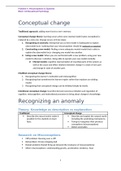
Conceptual change
Traditional approach: adding more facts to one’s memory
Conceptual change theory: learning occurs when ones mental model (naïve conception) is
replaced by a new one. Change occurs in three steps:
1. Recognizing an anomaly: Seeing that you current model is inadequate to explain
observable facts- realizing that your misconceptions should be replaced or repaired.
2. Constructing a new model: Finding a more adequate mental model that is able to
explain the observable facts- changing one model into another.
3. Using a new model: When you are confronted with a new problem, using your new
model to discover a solution- being able to operate your new model mentally.
Mental models: cognitive representation of essential parts of the system as
well as the cause and effect relations between change in a state of one part
and change in state of another part.
Modified conceptual-change theory:
1. Recognizing the learner’s motivation and metacognition.
2. Recognizing that sometimes the learner repairs rather than replaces an existing
model.
3. Recognizing that conceptual change can be initiated simply by words.
Intentional conceptual change: Goal directed and conscious initiation and regulation of
cognitive, metacognitive, and motivational processes to bring about changes in knowledge.
Recognizing an anomaly
Theory: Knowledge as description vs explanation
Traditional Conceptual change
Describe the natural world; make it Describe and explain the natural world
possible for the students to learn including the underlying mechanisms
facts. Trying to reorganize their previous
conceptions (misconceptions)
Detect anomalies
Research on Misconceptions
Cliff problem: Running over a cliff
Ball problem: Person dropping ball
Rocket problem: Rocket firing up (showed the resistance of misconceptions)
Other misconceptions: understanding gravity, acceleration, tendency, heat
1
, Problem 4. Misconceptions & Expertise
Block 1.8 Educational Psychology
Some misconceptions decrease as the person is getting older but others
intensify around 14-16 years old and others remain until adulthood (e.g.,
heat and temperature are the same)
Confronting misconceptions
Predict-Observe Explain Model (POE): Students predict what will happen, observe what
happens and explain why their observations conflict their predictions.
The goal is to confront the learner with the anomalous info that will generate
cognitive conflict (expose the misconception)
No assuming students’ mind is a blank space and just indicate the correct
Most children learn one set of rules for science and another for the real world/
others repair or replace the misconceptions.
Cognitive conflict in classroom: Conflict and discussion stimulated conceptual change that
can lead to greater gains. (The starting point)
It is not necessarily has to be an on-hands task to create conflict. Conceptual change
can be initiated by conflict between mental model and a model described in a text.
Self-repair: it occurs when a mental model conflict with a text model.
o Self-explanation: explain out-loud as they read the text initiates self-repair.
Obstacles in recognizing an anomaly:
Theory based bias (at the observation level): Misinterpretation of the experience in
order to be consistent with their existing concepts.
o It cannot be assumed that change will happen after the exposure
o Need to provide them with undoubtable evidence that they will not
misinterpret.
Five ways of reacting in conflict (Chan, Burtis, Bereiter):
Subassimilation Off association: Give response related to text
but not to main concept
Direct assimilation Stonewalling: Ignore new info and tell your
beliefs
Distortion
Surface-constructive Paraphrasing: Make simple inferences without
actually revising your beliefs
Juxtaposition: Attend new info but disconnect
them form existing beliefs, no integration.
Implicit knowledge Problem recognition: Recognize new info as
different than your existing beliefs
Explanation: Construct explanations to
reconcile knowledge conflict
Explicit knowledge Coherence: Halt present interpretation and try
to connect pieces of conflicting information
Model comparison: Identify conflicting
conceptions and their predictions.
2
Block 1.8 Educational Psychology
Conceptual change
Traditional approach: adding more facts to one’s memory
Conceptual change theory: learning occurs when ones mental model (naïve conception) is
replaced by a new one. Change occurs in three steps:
1. Recognizing an anomaly: Seeing that you current model is inadequate to explain
observable facts- realizing that your misconceptions should be replaced or repaired.
2. Constructing a new model: Finding a more adequate mental model that is able to
explain the observable facts- changing one model into another.
3. Using a new model: When you are confronted with a new problem, using your new
model to discover a solution- being able to operate your new model mentally.
Mental models: cognitive representation of essential parts of the system as
well as the cause and effect relations between change in a state of one part
and change in state of another part.
Modified conceptual-change theory:
1. Recognizing the learner’s motivation and metacognition.
2. Recognizing that sometimes the learner repairs rather than replaces an existing
model.
3. Recognizing that conceptual change can be initiated simply by words.
Intentional conceptual change: Goal directed and conscious initiation and regulation of
cognitive, metacognitive, and motivational processes to bring about changes in knowledge.
Recognizing an anomaly
Theory: Knowledge as description vs explanation
Traditional Conceptual change
Describe the natural world; make it Describe and explain the natural world
possible for the students to learn including the underlying mechanisms
facts. Trying to reorganize their previous
conceptions (misconceptions)
Detect anomalies
Research on Misconceptions
Cliff problem: Running over a cliff
Ball problem: Person dropping ball
Rocket problem: Rocket firing up (showed the resistance of misconceptions)
Other misconceptions: understanding gravity, acceleration, tendency, heat
1
, Problem 4. Misconceptions & Expertise
Block 1.8 Educational Psychology
Some misconceptions decrease as the person is getting older but others
intensify around 14-16 years old and others remain until adulthood (e.g.,
heat and temperature are the same)
Confronting misconceptions
Predict-Observe Explain Model (POE): Students predict what will happen, observe what
happens and explain why their observations conflict their predictions.
The goal is to confront the learner with the anomalous info that will generate
cognitive conflict (expose the misconception)
No assuming students’ mind is a blank space and just indicate the correct
Most children learn one set of rules for science and another for the real world/
others repair or replace the misconceptions.
Cognitive conflict in classroom: Conflict and discussion stimulated conceptual change that
can lead to greater gains. (The starting point)
It is not necessarily has to be an on-hands task to create conflict. Conceptual change
can be initiated by conflict between mental model and a model described in a text.
Self-repair: it occurs when a mental model conflict with a text model.
o Self-explanation: explain out-loud as they read the text initiates self-repair.
Obstacles in recognizing an anomaly:
Theory based bias (at the observation level): Misinterpretation of the experience in
order to be consistent with their existing concepts.
o It cannot be assumed that change will happen after the exposure
o Need to provide them with undoubtable evidence that they will not
misinterpret.
Five ways of reacting in conflict (Chan, Burtis, Bereiter):
Subassimilation Off association: Give response related to text
but not to main concept
Direct assimilation Stonewalling: Ignore new info and tell your
beliefs
Distortion
Surface-constructive Paraphrasing: Make simple inferences without
actually revising your beliefs
Juxtaposition: Attend new info but disconnect
them form existing beliefs, no integration.
Implicit knowledge Problem recognition: Recognize new info as
different than your existing beliefs
Explanation: Construct explanations to
reconcile knowledge conflict
Explicit knowledge Coherence: Halt present interpretation and try
to connect pieces of conflicting information
Model comparison: Identify conflicting
conceptions and their predictions.
2