Summary Engineering Geology 214 - Minerals 2
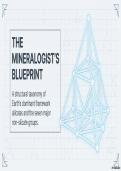
These notes provide an overview of mineral classification and identification, focusing on the major groups of silicate and non-silicate minerals that form the Earth's crust. The document introduces mineral structures, chemical compositions, and the key characteristics used to distinguish different mineral groups. Topics Covered: - Classification of silicate minerals based on the arrangement of silica tetrahedra - Nesosilicates (isolated tetrahedra): Olivine, Zircon, and Garnet - Sorosilicates (double tetrahedra): Epidote - Inosilicates (chain silicates): Pyroxene and Amphibole (Hornblende) - Phyllosilicates (sheet silicates): Muscovite, Biotite, Talc, Chlorite, and Kaolinite Tectosilicates (framework silicates): Feldspar minerals (Orthoclase, Albite, Anorthite) and Quartz Chemical compositions and major elements found within each mineral group. - Non-Silicate Mineral Groups: - Oxides: Hematite, Magnetite, Rutile, and Corundum - Hydroxides: Goethite and Limonite - Sulphides: Pyrite, Chalcopyrite, and Galena - Carbonates: Calcite and Dolomite - Sulphates: Gypsum - Halides: Fluorspar (Fluorite) and Halite (Rock Salt).
Written for
Document information
- Uploaded on
- June 16, 2026
- Number of pages
- 13
- Written in
- 2025/2026
- Type
- SUMMARY
Subjects

Document also available in package deal