

PYTHAGOREAN THEOREM
The Pythagorean/Pythagoras theorem is one of the most important and most used theorems in
mathematics. It is mostly used in geometry, both Euclidean and analytical, and trigonometry and to find
the length of an unknown side when given two sides. It explains the relationship of the three sides of a
right-angled triangle.
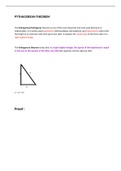
The Pythagorean theorem states that: In a right-angled triangle, the square of the hypotenuse is equal
to the sum of the squares of the other two sides(the opposite and the adjacent side).
c2 = a2 + b2
Proof :
, Given: ∆ABC with
Required to prove:
PROOF:
Construction: draw BD Ʇ AC
In ∆ABC and ∆ADB
( )
∠B1 + ∠B2 = 90° (given)
The Pythagorean/Pythagoras theorem is one of the most important and most used theorems in
mathematics. It is mostly used in geometry, both Euclidean and analytical, and trigonometry and to find
the length of an unknown side when given two sides. It explains the relationship of the three sides of a
right-angled triangle.
The Pythagorean theorem states that: In a right-angled triangle, the square of the hypotenuse is equal
to the sum of the squares of the other two sides(the opposite and the adjacent side).
c2 = a2 + b2
Proof :
, Given: ∆ABC with
Required to prove:
PROOF:
Construction: draw BD Ʇ AC
In ∆ABC and ∆ADB
( )
∠B1 + ∠B2 = 90° (given)


