IAS 10 Events After the Reporting
Period
By Fungai Madya
Why IAS 10?
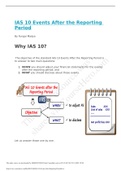
The objective of the standard IAS 10 Events After the Reporting Period is
to answer to two main questions:
m
er as
1. WHEN you should adjust your financial statements for the events
co
eH w
after the reporting period; and
2. WHAT you should disclose about those events.
o.
rs e
ou urc
o
aC s
v i y re
ed d
ar stu
sh is
Th
Let us answer those one by one.
This study source was downloaded by 100000823763039 from CourseHero.com on 05-22-2021 04:55:11 GMT -05:00
https://www.coursehero.com/file/69023340/IAS-10-Events-After-Reporting-Perioddocx/
, When should you consider events
after the reporting period?
By definition (IAS 10. 3), events after the reporting period are those
events, both favourable and unfavourable, that occur between:
The end of the reporting period, and
The date when the financial statements are authorized for issue
.
m
er as
co
eH w
o.
rs e
ou urc
o
aC s
v i y re
So imagine that the end of your reporting period is 31 December 20X1,
ed d
your accountants finish the closing works on 31 January 20X2, the board
ar stu
of directors authorizes them for issue on 15 February 20X2 and the
shareholders approve them on 28 February 20X2.
By definition, you need to consider everything that happens between 31
sh is
December 20X1 and 15 February 20X2 as an event after the reporting
Th
period.
OK, but what if earthquake happens on 16 February 20X2 and destroys
your building?
Well, that is the event after the reporting period for sure, but not under
the definition of IAS 10, because it falls outside those two important
dates.
Of course, the date of authorization of the financial statements for issue
by the management might defer based on the specific country legislation.
This study source was downloaded by 100000823763039 from CourseHero.com on 05-22-2021 04:55:11 GMT -05:00
https://www.coursehero.com/file/69023340/IAS-10-Events-After-Reporting-Perioddocx/
Period
By Fungai Madya
Why IAS 10?
The objective of the standard IAS 10 Events After the Reporting Period is
to answer to two main questions:
m
er as
1. WHEN you should adjust your financial statements for the events
co
eH w
after the reporting period; and
2. WHAT you should disclose about those events.
o.
rs e
ou urc
o
aC s
v i y re
ed d
ar stu
sh is
Th
Let us answer those one by one.
This study source was downloaded by 100000823763039 from CourseHero.com on 05-22-2021 04:55:11 GMT -05:00
https://www.coursehero.com/file/69023340/IAS-10-Events-After-Reporting-Perioddocx/
, When should you consider events
after the reporting period?
By definition (IAS 10. 3), events after the reporting period are those
events, both favourable and unfavourable, that occur between:
The end of the reporting period, and
The date when the financial statements are authorized for issue
.
m
er as
co
eH w
o.
rs e
ou urc
o
aC s
v i y re
So imagine that the end of your reporting period is 31 December 20X1,
ed d
your accountants finish the closing works on 31 January 20X2, the board
ar stu
of directors authorizes them for issue on 15 February 20X2 and the
shareholders approve them on 28 February 20X2.
By definition, you need to consider everything that happens between 31
sh is
December 20X1 and 15 February 20X2 as an event after the reporting
Th
period.
OK, but what if earthquake happens on 16 February 20X2 and destroys
your building?
Well, that is the event after the reporting period for sure, but not under
the definition of IAS 10, because it falls outside those two important
dates.
Of course, the date of authorization of the financial statements for issue
by the management might defer based on the specific country legislation.
This study source was downloaded by 100000823763039 from CourseHero.com on 05-22-2021 04:55:11 GMT -05:00
https://www.coursehero.com/file/69023340/IAS-10-Events-After-Reporting-Perioddocx/