

FMT3701 – Assignment 742669 – Student 49432087
Question 1
1.1 Concrete
Use 5 beer caps and a number line to revise counting objects.
1) Put 1 beer cap on number 1
2) Put 3 beer caps above number 3
3) Put 2 beer caps below number 2
4) Put 4 beer caps below number 4
5) Put 5 beer caps above number 5
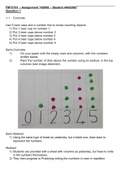
Semi-Concrete
1) On your paper with the empty rows and columns, with the numbers
written below.
2) Paint the number of dots above the number using an earbud, in the top
columns (see image attached).
Semi-Abstract
1) Using the same type of sheet as yesterday, but a blank one, draw stars to
represent the numbers.
Abstract
1) Students are provided with a sheet with columns as yesterday, but have to write
in the numbers themselves.
2) They then progress to Practising writing the numbers in rows in repetition.
, 1.2 The official definition of problem solving is:
Students develop the ability to make choices, interpret, formulate, model and
investigate problem situations, and communicate solutions effectively. Students
formulate and solve problems when they use mathematics to represent
unfamiliar or meaningful situations, when they design investigations and plan
their approaches, when they apply their existing strategies to seek solutions, and
when they verify that their answers are reasonable.
The benefits of problem-solving are1:
Problem solving places the focus on the student making sense of
mathematical ideas.
Problem solving encourages students to believe in their ability to think
mathematically.
Problem solving provides ongoing assessment information that can help
teachers make instructional decisions.
Good problem-solving activities provide an entry point that allows all students
to be working on the same problem.
Problem solving develops mathematical power.
Problem solving is enjoyable.
Problem solving better represents the nature of mathematics.
Examples2:
Addition: Tom grew 6 pumpkins. Alyssa grew 9 pumpkins. How many pumpkins
did they grow in all?
Subtraction: Fred's high school played 8 football games this year. He attended
5 games. How many football games did Fred miss?
Multiplication: Benny has 7 dozen golf balls. How many golf balls does he
have?
Division: Dan has 96 muffins, which he needs to box up into dozens. How many
boxes does he need?
1
(Government 2020)
2
(Math-Aids.com n.d.)
Question 1
1.1 Concrete
Use 5 beer caps and a number line to revise counting objects.
1) Put 1 beer cap on number 1
2) Put 3 beer caps above number 3
3) Put 2 beer caps below number 2
4) Put 4 beer caps below number 4
5) Put 5 beer caps above number 5
Semi-Concrete
1) On your paper with the empty rows and columns, with the numbers
written below.
2) Paint the number of dots above the number using an earbud, in the top
columns (see image attached).
Semi-Abstract
1) Using the same type of sheet as yesterday, but a blank one, draw stars to
represent the numbers.
Abstract
1) Students are provided with a sheet with columns as yesterday, but have to write
in the numbers themselves.
2) They then progress to Practising writing the numbers in rows in repetition.
, 1.2 The official definition of problem solving is:
Students develop the ability to make choices, interpret, formulate, model and
investigate problem situations, and communicate solutions effectively. Students
formulate and solve problems when they use mathematics to represent
unfamiliar or meaningful situations, when they design investigations and plan
their approaches, when they apply their existing strategies to seek solutions, and
when they verify that their answers are reasonable.
The benefits of problem-solving are1:
Problem solving places the focus on the student making sense of
mathematical ideas.
Problem solving encourages students to believe in their ability to think
mathematically.
Problem solving provides ongoing assessment information that can help
teachers make instructional decisions.
Good problem-solving activities provide an entry point that allows all students
to be working on the same problem.
Problem solving develops mathematical power.
Problem solving is enjoyable.
Problem solving better represents the nature of mathematics.
Examples2:
Addition: Tom grew 6 pumpkins. Alyssa grew 9 pumpkins. How many pumpkins
did they grow in all?
Subtraction: Fred's high school played 8 football games this year. He attended
5 games. How many football games did Fred miss?
Multiplication: Benny has 7 dozen golf balls. How many golf balls does he
have?
Division: Dan has 96 muffins, which he needs to box up into dozens. How many
boxes does he need?
1
(Government 2020)
2
(Math-Aids.com n.d.)


