Antitrust
• Sherman Act (1890)
• Section 1 : prohibits contracts, combinations, or conspiracies in restraint of trade that
unreasonably restrain competition
• e.g. horizontal and vertical price-fixing exclusive dealing, market allocation
• Section 2: related to unilateral conduct, monopolisation and conspiracies to monopolise
• Rule of Reason vs per se violations (no matter it’s impact, it’s illegal)
• Clayton act: section 7 prohibits mergers that “may substantially lessen competition
• or tend to create a monopoly”
• FTC formed to regulate unfair trade practices. FTC does Clayton 7
• DOJ enforces Sherman Act 1 and 2 and Clayton section 7
• DOJ= Financial Services, Telecommunications, and Agricultural Industries
FTC= Defence, Pharmaceutical, and Retail Industries
• 1939-70s= rise of populism / economic structuralism - monopolies bad
• 70s-2010= Chicago price theory approach
1982 merger guidelines: mergers should not create or enhance market power and use HHI
• 2010 guidelines: describes analytical techniques to use. Issues: not legally binding and
what is the threshold for substantially lesson. Efficiencies should be passed down to
customers.
• Merger Lifecycle: 1= HSR filing which includes customers, revenues, sectors. Regulators
must consider within 30 days.
• 2= second request from FTC/DOJ for more info. 3= post-second request where regulators
identify at-risk customers and categories. May lead to the merger closing
• 4=litigation
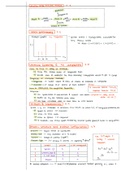
HHI
• HHI= sum of squared market shares times 10,000
• More competition means HHI moves towards 0
• Find HHI before and after the merger
• Mergers that increase HHI by more than 100 points and result in moderately or highly
concentrated markets “raise significant competitive concerns and often warrant scrutiny” d
• Mergers that increase HHI by more than 200 points and result in highly concentrated
markets are “presumed to be likely to enhance market power”
• These are not “bright line” tests; Agencies also consider other factors when determining
whether to challenge a merger (e.g., ease of entry, dynamic considerations, efficiencies)
• In markets where firms compete over quantities, m= (1/ε) * (HHI/10000)
• m= average percent margin, find elasticity using Lerner index
, Collusion and Monopolisation
• Collusion = joint optimisation ≠ competition
• Higher profits for colluders, higher prices for consumers, typically less
• production
• Closer to monopolistic outcome, but depends on cost function
• Not necessarily sustainable̶ Unclear effect on innovation
• illegal
Cartels
• Group of firms that explicitly agree to coordinate their activities ̶ Type of coordination depends
on the game being played:
• Bertrand: coordinate on price; Cournot: coordinate on quantity
Collusion is more profitable when:
- Demand is inelastic: greater benefits of collusion (price increases more)
- Relative size of cartel: greater ability to increase prices
- Entry is difficult : entry would limit benefits of collusion
- More homogeneous products: competition is more intense than with differentiated products
(remember Bertrand)
Government antitrust policy matters
- Harsh punishment lower benefits of collusion
- Leniency programs can incentive reporting
Collusion is easier to implement and sustain when:
- Demand is inelastic: cheating less beneficial
- Capacity of cartel members is limited: cheating less beneficial
- Demand is stable : cheating less beneficial, easier to monitor
- Industry is concentrated and cartel is small: easier to agree and monitor Information is
available: easier to agree and monitor
- Firms are symmetric (e.g., cost structure): easier to agree
- More homogeneous products and more stable industry: easier to coordinate (one
dimensionality), harder to deviate and compete by other mean (e.g., on quality or product
characteristics)
• Sherman Act (1890)
• Section 1 : prohibits contracts, combinations, or conspiracies in restraint of trade that
unreasonably restrain competition
• e.g. horizontal and vertical price-fixing exclusive dealing, market allocation
• Section 2: related to unilateral conduct, monopolisation and conspiracies to monopolise
• Rule of Reason vs per se violations (no matter it’s impact, it’s illegal)
• Clayton act: section 7 prohibits mergers that “may substantially lessen competition
• or tend to create a monopoly”
• FTC formed to regulate unfair trade practices. FTC does Clayton 7
• DOJ enforces Sherman Act 1 and 2 and Clayton section 7
• DOJ= Financial Services, Telecommunications, and Agricultural Industries
FTC= Defence, Pharmaceutical, and Retail Industries
• 1939-70s= rise of populism / economic structuralism - monopolies bad
• 70s-2010= Chicago price theory approach
1982 merger guidelines: mergers should not create or enhance market power and use HHI
• 2010 guidelines: describes analytical techniques to use. Issues: not legally binding and
what is the threshold for substantially lesson. Efficiencies should be passed down to
customers.
• Merger Lifecycle: 1= HSR filing which includes customers, revenues, sectors. Regulators
must consider within 30 days.
• 2= second request from FTC/DOJ for more info. 3= post-second request where regulators
identify at-risk customers and categories. May lead to the merger closing
• 4=litigation
HHI
• HHI= sum of squared market shares times 10,000
• More competition means HHI moves towards 0
• Find HHI before and after the merger
• Mergers that increase HHI by more than 100 points and result in moderately or highly
concentrated markets “raise significant competitive concerns and often warrant scrutiny” d
• Mergers that increase HHI by more than 200 points and result in highly concentrated
markets are “presumed to be likely to enhance market power”
• These are not “bright line” tests; Agencies also consider other factors when determining
whether to challenge a merger (e.g., ease of entry, dynamic considerations, efficiencies)
• In markets where firms compete over quantities, m= (1/ε) * (HHI/10000)
• m= average percent margin, find elasticity using Lerner index
, Collusion and Monopolisation
• Collusion = joint optimisation ≠ competition
• Higher profits for colluders, higher prices for consumers, typically less
• production
• Closer to monopolistic outcome, but depends on cost function
• Not necessarily sustainable̶ Unclear effect on innovation
• illegal
Cartels
• Group of firms that explicitly agree to coordinate their activities ̶ Type of coordination depends
on the game being played:
• Bertrand: coordinate on price; Cournot: coordinate on quantity
Collusion is more profitable when:
- Demand is inelastic: greater benefits of collusion (price increases more)
- Relative size of cartel: greater ability to increase prices
- Entry is difficult : entry would limit benefits of collusion
- More homogeneous products: competition is more intense than with differentiated products
(remember Bertrand)
Government antitrust policy matters
- Harsh punishment lower benefits of collusion
- Leniency programs can incentive reporting
Collusion is easier to implement and sustain when:
- Demand is inelastic: cheating less beneficial
- Capacity of cartel members is limited: cheating less beneficial
- Demand is stable : cheating less beneficial, easier to monitor
- Industry is concentrated and cartel is small: easier to agree and monitor Information is
available: easier to agree and monitor
- Firms are symmetric (e.g., cost structure): easier to agree
- More homogeneous products and more stable industry: easier to coordinate (one
dimensionality), harder to deviate and compete by other mean (e.g., on quality or product
characteristics)