

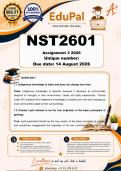
NST2601
Assignment 3 2026
Unique number:
Due date: 14 August 2026
QUESTION 1
1.1 Indigenous knowledge is static and does not change over time.
False. Indigenous knowledge is dynamic because it develops as communities
respond to changes in their environment, needs and daily experiences. Tutorial
Letter 501 explains that indigenous knowledge is created over time and changes as
local communities adapt to their surroundings.
1.2 Charles Lyell claimed to be the true originator of the basic principles of
geology.
True. Lyell presented himself as the true creator of the basic principles of geology
and sometimes exaggerated the originality of his own contribution. Tutorial Letter
501 explains that he placed himself in a special position in the history of geology
, QUESTION 1
1.1 Indigenous knowledge is static and does not change over time.
False. Indigenous knowledge is dynamic because it develops as communities
respond to changes in their environment, needs and daily experiences. Tutorial
Letter 501 explains that indigenous knowledge is created over time and changes as
local communities adapt to their surroundings.
1.2 Charles Lyell claimed to be the true originator of the basic principles of
geology.
True. Lyell presented himself as the true creator of the basic principles of geology
and sometimes exaggerated the originality of his own contribution. Tutorial Letter
501 explains that he placed himself in a special position in the history of geology
through the way he presented earlier scientific developments.
1.3 Traditional energy sources such as wood are entirely sustainable and pose
no threat to the environment.
False. Wood can be used sustainably, but excessive dependence on it places
pressure on natural vegetation and can cause deforestation and environmental
damage. Tutorial Letter 501 explains that sustainable harvesting methods are
needed to protect wood producing species and the surrounding environment.
1.4 Traditional musical instruments in Southern Africa were originally made
using locally available natural materials.
True. Traditional Southern African musical instruments were originally made from
materials that people could obtain from their local natural environment. Examples
include gourds, curved twigs, animal horns and bamboo used to make different
traditional instruments.
1.5 The CAPS curriculum has fully integrated Indigenous Knowledge into all
learning areas.
False. Indigenous Knowledge has been included in CAPS, but Tutorial Letter 501
does not state that it has been fully integrated into every learning area. The material
Assignment 3 2026
Unique number:
Due date: 14 August 2026
QUESTION 1
1.1 Indigenous knowledge is static and does not change over time.
False. Indigenous knowledge is dynamic because it develops as communities
respond to changes in their environment, needs and daily experiences. Tutorial
Letter 501 explains that indigenous knowledge is created over time and changes as
local communities adapt to their surroundings.
1.2 Charles Lyell claimed to be the true originator of the basic principles of
geology.
True. Lyell presented himself as the true creator of the basic principles of geology
and sometimes exaggerated the originality of his own contribution. Tutorial Letter
501 explains that he placed himself in a special position in the history of geology
, QUESTION 1
1.1 Indigenous knowledge is static and does not change over time.
False. Indigenous knowledge is dynamic because it develops as communities
respond to changes in their environment, needs and daily experiences. Tutorial
Letter 501 explains that indigenous knowledge is created over time and changes as
local communities adapt to their surroundings.
1.2 Charles Lyell claimed to be the true originator of the basic principles of
geology.
True. Lyell presented himself as the true creator of the basic principles of geology
and sometimes exaggerated the originality of his own contribution. Tutorial Letter
501 explains that he placed himself in a special position in the history of geology
through the way he presented earlier scientific developments.
1.3 Traditional energy sources such as wood are entirely sustainable and pose
no threat to the environment.
False. Wood can be used sustainably, but excessive dependence on it places
pressure on natural vegetation and can cause deforestation and environmental
damage. Tutorial Letter 501 explains that sustainable harvesting methods are
needed to protect wood producing species and the surrounding environment.
1.4 Traditional musical instruments in Southern Africa were originally made
using locally available natural materials.
True. Traditional Southern African musical instruments were originally made from
materials that people could obtain from their local natural environment. Examples
include gourds, curved twigs, animal horns and bamboo used to make different
traditional instruments.
1.5 The CAPS curriculum has fully integrated Indigenous Knowledge into all
learning areas.
False. Indigenous Knowledge has been included in CAPS, but Tutorial Letter 501
does not state that it has been fully integrated into every learning area. The material




