Chapter 2
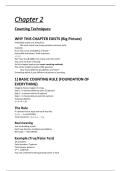
Counting Techniques:
WHY THIS CHAPTER EXISTS (Big Picture)
Probability needs one thing first:
We must count how many possible outcomes exist.
Example:
If you flip a coin, probability of heads =
favourable outcomes / total outcomes
=1/2
But if you toss 6 coins, how many outcomes exist?
You can’t list them manually.
So this chapter teaches you smart counting methods.
This entire chapter answers ONE question:
How many different possibilities are there?
Everything below is just different situations of counting.
1) BASIC COUNTING RULE (FOUNDATION OF
EVERYTHING)
Imagine choices happen in steps.
Step 1 → choose collection point (2 options)
Step 2 → choose vehicle (3 options)
Step 3 → choose delivery point (4 options)
Total possibilities:
2 × 3 × 4 = 24
The Rule
If a process has k steps and each step has:
n₁, n₂, …, nₖ possibilities
Total outcomes = n₁ × n₂ × … × nₖ
Real meaning
You are building a path.
Each new decision multiplies possibilities.
NOT adds — MULTIPLIES.
Example (True/False Test)
20 questions
Each question: 2 options
Total answer patterns:
2²⁰ = 1 048 576
You now understand why guessing exams is hard.
Counting Techniques:
WHY THIS CHAPTER EXISTS (Big Picture)
Probability needs one thing first:
We must count how many possible outcomes exist.
Example:
If you flip a coin, probability of heads =
favourable outcomes / total outcomes
=1/2
But if you toss 6 coins, how many outcomes exist?
You can’t list them manually.
So this chapter teaches you smart counting methods.
This entire chapter answers ONE question:
How many different possibilities are there?
Everything below is just different situations of counting.
1) BASIC COUNTING RULE (FOUNDATION OF
EVERYTHING)
Imagine choices happen in steps.
Step 1 → choose collection point (2 options)
Step 2 → choose vehicle (3 options)
Step 3 → choose delivery point (4 options)
Total possibilities:
2 × 3 × 4 = 24
The Rule
If a process has k steps and each step has:
n₁, n₂, …, nₖ possibilities
Total outcomes = n₁ × n₂ × … × nₖ
Real meaning
You are building a path.
Each new decision multiplies possibilities.
NOT adds — MULTIPLIES.
Example (True/False Test)
20 questions
Each question: 2 options
Total answer patterns:
2²⁰ = 1 048 576
You now understand why guessing exams is hard.