Giant covalent molecules & Structure and bonding in metals– Chemistry
Substances with many covalent bonds
Covalent bonding leads to the formation of substances with different types of structures, for
example:
- small molecules, which contain a fixed number of atoms joined by covalent bonds
- giant covalent substances, which contain many atoms joined by covalent bonds
Example - Silicon dioxide
Silicon dioxide (often called silica) is the main compound found in sand. It is an example of a
substance with a giant covalent structure. It contains many silicon and oxygen atoms. All the
atoms in its structure are linked to each other by strong covalent bonds. The atoms are
joined to each other in a regular arrangement, forming a giant covalent structure. There is
no set number of atoms joined together in this type of structure.
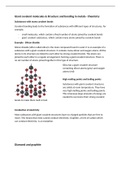
Silica has a giant covalent structure
containing silicon atoms (grey) and oxygen
atoms (red)
High melting points and boiling points
Substances with giant covalent structures
are solids at room temperature. They have
very high melting points and boiling points.
This is because large amounts of energy are
needed to overcome their strong covalent
bonds to make them melt or boil.
Conduction of electricity
Most substances with giant covalent structures have no charged particles that are free to
move. This means that most cannot conduct electricity. Graphite, a form of carbon which
can conduct electricity, is an exception.
Diamond and graphite
, Diamond and graphite are different forms of the element carbon. They both have giant structures of
carbon atoms, joined together by covalent bonds. However, their structures are different so some of
their properties are different.
Diamond
Structure and bonding-
Diamond is a giant covalent structure in which:
- each carbon atom is joined to four other carbon atoms by strong covalent bonds
- the carbon atoms form a regular tetrahedral network structure
- there are no free electrons
Carbon atoms in diamond form a tetrahedral arrangement
Properties and uses-
The rigid network of carbon atoms, held together by strong covalent bonds, makes diamond very
hard. This makes it useful for cutting tools, such as diamond-tipped glass cutters and oil rig drills.
Like silica, diamond has a very high melting point and it does not conduct electricity.
Graphite
Structure and bonding
Graphite has a giant covalent structure in which:
- each carbon atom forms three covalent bonds with other carbon atoms
- the carbon atoms form layers of hexagonal rings
- there are no covalent bonds between the layers
- there is one non-bonded - or delocalised - electron from each atom
Substances with many covalent bonds
Covalent bonding leads to the formation of substances with different types of structures, for
example:
- small molecules, which contain a fixed number of atoms joined by covalent bonds
- giant covalent substances, which contain many atoms joined by covalent bonds
Example - Silicon dioxide
Silicon dioxide (often called silica) is the main compound found in sand. It is an example of a
substance with a giant covalent structure. It contains many silicon and oxygen atoms. All the
atoms in its structure are linked to each other by strong covalent bonds. The atoms are
joined to each other in a regular arrangement, forming a giant covalent structure. There is
no set number of atoms joined together in this type of structure.
Silica has a giant covalent structure
containing silicon atoms (grey) and oxygen
atoms (red)
High melting points and boiling points
Substances with giant covalent structures
are solids at room temperature. They have
very high melting points and boiling points.
This is because large amounts of energy are
needed to overcome their strong covalent
bonds to make them melt or boil.
Conduction of electricity
Most substances with giant covalent structures have no charged particles that are free to
move. This means that most cannot conduct electricity. Graphite, a form of carbon which
can conduct electricity, is an exception.
Diamond and graphite
, Diamond and graphite are different forms of the element carbon. They both have giant structures of
carbon atoms, joined together by covalent bonds. However, their structures are different so some of
their properties are different.
Diamond
Structure and bonding-
Diamond is a giant covalent structure in which:
- each carbon atom is joined to four other carbon atoms by strong covalent bonds
- the carbon atoms form a regular tetrahedral network structure
- there are no free electrons
Carbon atoms in diamond form a tetrahedral arrangement
Properties and uses-
The rigid network of carbon atoms, held together by strong covalent bonds, makes diamond very
hard. This makes it useful for cutting tools, such as diamond-tipped glass cutters and oil rig drills.
Like silica, diamond has a very high melting point and it does not conduct electricity.
Graphite
Structure and bonding
Graphite has a giant covalent structure in which:
- each carbon atom forms three covalent bonds with other carbon atoms
- the carbon atoms form layers of hexagonal rings
- there are no covalent bonds between the layers
- there is one non-bonded - or delocalised - electron from each atom