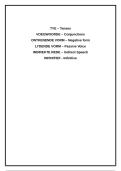
TYE – Tenses
VOEGWOORDE – Conjunctions
ONTKENENDE VORM – Negative form
LYDENDE VORM – Passive Voice
INDIREKTE REDE – Indirect Speech
INFINITIEF - Infinitive
, TYE – Tenses
Some general observations –
1) Underline verbs.
2) Check for conjunctions. If there is a conjunction ∴ 2 sentences change.
3) Infinitive is always at the end.
S v1 T O M P v2 I
RULE 1 – regular verbs het+ge for past tense; sal for future tense
RULE 2 – if a verb begins with be, ge, her, er, ont, ver and mis we use het but no
“ge”
RULE 3 – If the verb is and “is” it changes as follows:
PAST TENSE – ‘is’ becomes ‘was’
FUTURE TENSE – ‘is’ is replaced by ‘sal’ and ‘wees’ goes to the end of the
sentence before the infinitive (if there is an infinitive)
RULE 4 – if the verb is already ‘het’ and there is no ‘ge’ it becomes:
PAST TENSE – ‘het’ stays ‘het’ and you add ‘gehad’ at the end of the sentence.
FUTURE TENSE – ‘het’ becomes ‘sal’ and ‘hê’ is added to the end of the sentence.
RULE 5 – If there is a verb and a preposition it becomes one word in both past and
future.
EG: Ek tel die boek op.
PAST TENSE – Ek het die boek opgetel.
FUTURE TENSE – Ek sal die boek optel.
, RULE 6 – If there is a helping verb and a normal verb ONLY the helping verb
changes.
EG 1: Ek moet my werk doen.
PAST TENSE – Ek moes my werk doen.
FUTURE TENSE – Ek sal my werk moet doen.
EG 2: Ek wil ‘n present koop.
PAST TENSE – Ek wou ‘n present koop.
FUTURE TENSE – Ek sal ‘n present wil koop.
EG 3: Ek kan goed swem.
PAST TENSE – Ek kon goed swem.
FUTURE TENSE – Ek sal goed kan swem.
EG 4: Ek sal my werk doen. (****already in the future)
PAST TENSE – Ek sou my werk doen.
FUTURE TENSE – stays the same
RULE 7 – If there are 2 verbs in a sentence occurring together connected by an
‘en’:
PAST TENSE –
If you can do both verbs together use ‘ge’ only on the first verb
If you cannot both verbs together use ‘ge’ on both verbs
FUTURE TENSE – move both verbs connected by ‘en’ as you normally would.
EG: Die man sit en lees op die stoep.
PAST TENSE – Die man het op die stoep gesit en lees.
FUTURE TENSE – Die man sal op die stoep sit en lees.
EG: Hy slaap en werk in my slaapkamer. [you cannot sleep and work at the same
time]
PAST TENSE – Hy het in my slaapkamer geslaap en gewerk.
FUTURE TENSE – Hy sal in my slaapkamer slaap en werk.
VOEGWOORDE – Conjunctions
ONTKENENDE VORM – Negative form
LYDENDE VORM – Passive Voice
INDIREKTE REDE – Indirect Speech
INFINITIEF - Infinitive
, TYE – Tenses
Some general observations –
1) Underline verbs.
2) Check for conjunctions. If there is a conjunction ∴ 2 sentences change.
3) Infinitive is always at the end.
S v1 T O M P v2 I
RULE 1 – regular verbs het+ge for past tense; sal for future tense
RULE 2 – if a verb begins with be, ge, her, er, ont, ver and mis we use het but no
“ge”
RULE 3 – If the verb is and “is” it changes as follows:
PAST TENSE – ‘is’ becomes ‘was’
FUTURE TENSE – ‘is’ is replaced by ‘sal’ and ‘wees’ goes to the end of the
sentence before the infinitive (if there is an infinitive)
RULE 4 – if the verb is already ‘het’ and there is no ‘ge’ it becomes:
PAST TENSE – ‘het’ stays ‘het’ and you add ‘gehad’ at the end of the sentence.
FUTURE TENSE – ‘het’ becomes ‘sal’ and ‘hê’ is added to the end of the sentence.
RULE 5 – If there is a verb and a preposition it becomes one word in both past and
future.
EG: Ek tel die boek op.
PAST TENSE – Ek het die boek opgetel.
FUTURE TENSE – Ek sal die boek optel.
, RULE 6 – If there is a helping verb and a normal verb ONLY the helping verb
changes.
EG 1: Ek moet my werk doen.
PAST TENSE – Ek moes my werk doen.
FUTURE TENSE – Ek sal my werk moet doen.
EG 2: Ek wil ‘n present koop.
PAST TENSE – Ek wou ‘n present koop.
FUTURE TENSE – Ek sal ‘n present wil koop.
EG 3: Ek kan goed swem.
PAST TENSE – Ek kon goed swem.
FUTURE TENSE – Ek sal goed kan swem.
EG 4: Ek sal my werk doen. (****already in the future)
PAST TENSE – Ek sou my werk doen.
FUTURE TENSE – stays the same
RULE 7 – If there are 2 verbs in a sentence occurring together connected by an
‘en’:
PAST TENSE –
If you can do both verbs together use ‘ge’ only on the first verb
If you cannot both verbs together use ‘ge’ on both verbs
FUTURE TENSE – move both verbs connected by ‘en’ as you normally would.
EG: Die man sit en lees op die stoep.
PAST TENSE – Die man het op die stoep gesit en lees.
FUTURE TENSE – Die man sal op die stoep sit en lees.
EG: Hy slaap en werk in my slaapkamer. [you cannot sleep and work at the same
time]
PAST TENSE – Hy het in my slaapkamer geslaap en gewerk.
FUTURE TENSE – Hy sal in my slaapkamer slaap en werk.