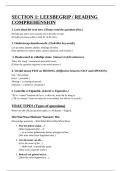
SECTION 1: LEESBEGRIP / READING
COMPREHENSION
1. Lees altyd die vrae eers. (Always read the questions first.)
Dit help jou om te weet waarna om in die teks te soek.
(It helps you know what to look for in the text.)
2. Onderstreep sleutelwoorde. (Underline key words.)
Let op name, datums, plekke, menings en redes.
(Pay attention to names, dates, places, opinions, and reasons.)
3. Beantwoord in volledige sinne. (Answer in full sentences.)
Tensy die vraag ’n eenwoord-antwoord vereis.
(Unless the question requires a one-word answer.)
4. Verskil tussen FEIT en MENING. (Difference between FACT and OPINION.)
Feit = bewysbaar.
(Fact = provable.)
Mening = ’n siening of gevoel.
(Opinion = a belief or viewpoint.)
5. Letterlik vs Figuurlik. (Literal vs Figurative.)
“Hy is ’n muis” beteken nie hy is ’n dier nie, maar dat hy bang is.
(“He is a mouse” does not mean he is an animal, but that he is scared.)
VRAE TIPES (Types of questions)
Below are the official question types, in Afrikaans + English.
Wie/Wat/Waar/Hoekom/ Wanneer/ Hoe
(Knowledge questions – Who/What/Where/Why/When/How)
1. Wat het gebeur nadat…?
(What happened after…?)
→ Jy sê watter gebeurtenis daarna plaasgevind het.
(You state what event happened next.)
2. Gee die naam van die…
(Give the name of the…)
→ Hulle soek ’n spesifieke naam.
(They want a specific name.)
3. Beskryf wat gebeur het by…
(Describe what happened at…)
, 4. Wie het met wie gepraat?
(Who spoke to whom?)
5. Waaroor het hulle gebaklei of saamgestem?
(What did they argue or agree about?)
6. Wat is die betekenis van hierdie sin?
(What is the meaning of this sentence?)
7. Waarvandaan het die persoon gekom?
(Where did the person come from?)
8. Hoekom het dit daardie dag gebeur?
(Why did it happen on that day?)
9. Noem die name van die mense wat betrokke was.
(List the names of the people involved.)
10.Wat het aan die einde gebeur?
(What happened at the end?)
SECTION 2: OPSOMMING / SUMMARY
✔️Afrikaans sentence
✔️English explanation in brackets
OPSOMMING (SUMMARY)
1. Vind die hoofgedagtes.
(Find the main ideas.)
Elke paragraaf bevat gewoonlik een belangrike punt.
(Each paragraph usually contains one key point.)
2. Gebruik jou eie woorde.
(Use your own words.)
Moenie die oorspronklike teks kopieer nie.
(Do not copy the original text.)
3. Moenie onnodige besonderhede insluit nie.
(Do not include unnecessary details.)
Hou net die essensiële feite.
(Keep only the essential facts.)
COMPREHENSION
1. Lees altyd die vrae eers. (Always read the questions first.)
Dit help jou om te weet waarna om in die teks te soek.
(It helps you know what to look for in the text.)
2. Onderstreep sleutelwoorde. (Underline key words.)
Let op name, datums, plekke, menings en redes.
(Pay attention to names, dates, places, opinions, and reasons.)
3. Beantwoord in volledige sinne. (Answer in full sentences.)
Tensy die vraag ’n eenwoord-antwoord vereis.
(Unless the question requires a one-word answer.)
4. Verskil tussen FEIT en MENING. (Difference between FACT and OPINION.)
Feit = bewysbaar.
(Fact = provable.)
Mening = ’n siening of gevoel.
(Opinion = a belief or viewpoint.)
5. Letterlik vs Figuurlik. (Literal vs Figurative.)
“Hy is ’n muis” beteken nie hy is ’n dier nie, maar dat hy bang is.
(“He is a mouse” does not mean he is an animal, but that he is scared.)
VRAE TIPES (Types of questions)
Below are the official question types, in Afrikaans + English.
Wie/Wat/Waar/Hoekom/ Wanneer/ Hoe
(Knowledge questions – Who/What/Where/Why/When/How)
1. Wat het gebeur nadat…?
(What happened after…?)
→ Jy sê watter gebeurtenis daarna plaasgevind het.
(You state what event happened next.)
2. Gee die naam van die…
(Give the name of the…)
→ Hulle soek ’n spesifieke naam.
(They want a specific name.)
3. Beskryf wat gebeur het by…
(Describe what happened at…)
, 4. Wie het met wie gepraat?
(Who spoke to whom?)
5. Waaroor het hulle gebaklei of saamgestem?
(What did they argue or agree about?)
6. Wat is die betekenis van hierdie sin?
(What is the meaning of this sentence?)
7. Waarvandaan het die persoon gekom?
(Where did the person come from?)
8. Hoekom het dit daardie dag gebeur?
(Why did it happen on that day?)
9. Noem die name van die mense wat betrokke was.
(List the names of the people involved.)
10.Wat het aan die einde gebeur?
(What happened at the end?)
SECTION 2: OPSOMMING / SUMMARY
✔️Afrikaans sentence
✔️English explanation in brackets
OPSOMMING (SUMMARY)
1. Vind die hoofgedagtes.
(Find the main ideas.)
Elke paragraaf bevat gewoonlik een belangrike punt.
(Each paragraph usually contains one key point.)
2. Gebruik jou eie woorde.
(Use your own words.)
Moenie die oorspronklike teks kopieer nie.
(Do not copy the original text.)
3. Moenie onnodige besonderhede insluit nie.
(Do not include unnecessary details.)
Hou net die essensiële feite.
(Keep only the essential facts.)