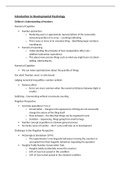
Introduction to Developmental Psychology
Children’s Understanding of Numbers
Numerical Cognition
Number abstraction
o Rendering exact or approximate representations of the numerosity
(amount/quantity) of an array – counting/estimating
o This is seen as more of an everyday thing – identifying larger numbers,
rounding etc.
Numerical reasoning
o Understanding the principles of how manipulation affect sets –
addition/subtraction equivalence
o This about more precise things such as what you might learn at school –
adding, subtracting etc.
Numerical Cognition
We can make rapid decisions about the quantity of things
Our adult ‘Number sense’ is ratio-bound
Judging numerical inequalities: number symbols
Distance effect
o Errors are more common when the numerical distance between digits is
smaller.
Subitising – Enumerating without consciously counting
Piagetian Perspective
Concrete operations (7-12 y)
o Conservation – changes in the appearance of things do not necessarily
change the nature of the thing itself
o Class inclusion – the idea that things can be organised in sets
o Seriation – sequencing, things going from small to large
Number concept acquisition is a domain general process
No innate sense of number – don’t come until later on in development
Challenges to the Piagetian Perspective
McGarrigle & Donaldson (1974)
o The experimenter’s non-linguistic behaviour (moving the counters) is
uncoupled from their linguistic behaviour (repeating the question)
Naughty Teddy Number Conservation Task
o Naughty teddy accidentally moves the counters
o 63% of 5yos test passed in this condition
o 16% of 5yos tested passed in the standard condition
, ‘Extra-linguistic’ features can influence interpretation of question
Challenges to the Piagetian Perspective
Mehler & Bever (1967)
o 200 children aged 2.5-4.5y
o A: Are they the same?
o B (clay): Which has ‘more’?
o B (M&M): Take the row you want to eat
o Children at all ages tended to succeed more in the M&Ms condition
o This suggested that children may be able to detect quantities and have some
number conservation
Principles of counting
Series of experiments with preschool aged children to study counting behaviour
Gelman & Gallistel (1986)
o Learning to count is crucial to understanding number: children obtain
representations of number by counting
o Learning to count is guided by innate abstract principles (a scheme) that
guides or constrains acquisitions of number concepts
o Domain-specific view of numerical cognition
Pre-schoolers apply ‘Principles of Counting’
Gelman & Gallister (1986)
o One-to-one principle each item in an array is tagged only once, they only
have one label
o Stable order principle tags must be arranged in a stable, repeatable order
o Abstraction principle any entities or events can be classified for counting,
anything can be numbered
o Order irrelevance order of tagging/portioning does not matter
o Cardinal principle final tag represents number of items in a set
What do measures tell us?
Verbal counting task – how high can you count starting from one?
Enumeration task – could you help Big Bird count his toys pointing to each one?
Numerical recognition – Which one is 2?
Give-a-number task – Kermit’s going to ask you for the number of toys he wants.
Could you give Kermit x dinosaurs?
Point-to-x task – Can you point to 3?
Challenges to principles of counting
Children derive the principles after experience (Fuson, 1988)
If children use one-to-one and stable-order principles but not cardinality, then
counting routine is not linked to number concepts.
Children’s Understanding of Numbers
Numerical Cognition
Number abstraction
o Rendering exact or approximate representations of the numerosity
(amount/quantity) of an array – counting/estimating
o This is seen as more of an everyday thing – identifying larger numbers,
rounding etc.
Numerical reasoning
o Understanding the principles of how manipulation affect sets –
addition/subtraction equivalence
o This about more precise things such as what you might learn at school –
adding, subtracting etc.
Numerical Cognition
We can make rapid decisions about the quantity of things
Our adult ‘Number sense’ is ratio-bound
Judging numerical inequalities: number symbols
Distance effect
o Errors are more common when the numerical distance between digits is
smaller.
Subitising – Enumerating without consciously counting
Piagetian Perspective
Concrete operations (7-12 y)
o Conservation – changes in the appearance of things do not necessarily
change the nature of the thing itself
o Class inclusion – the idea that things can be organised in sets
o Seriation – sequencing, things going from small to large
Number concept acquisition is a domain general process
No innate sense of number – don’t come until later on in development
Challenges to the Piagetian Perspective
McGarrigle & Donaldson (1974)
o The experimenter’s non-linguistic behaviour (moving the counters) is
uncoupled from their linguistic behaviour (repeating the question)
Naughty Teddy Number Conservation Task
o Naughty teddy accidentally moves the counters
o 63% of 5yos test passed in this condition
o 16% of 5yos tested passed in the standard condition
, ‘Extra-linguistic’ features can influence interpretation of question
Challenges to the Piagetian Perspective
Mehler & Bever (1967)
o 200 children aged 2.5-4.5y
o A: Are they the same?
o B (clay): Which has ‘more’?
o B (M&M): Take the row you want to eat
o Children at all ages tended to succeed more in the M&Ms condition
o This suggested that children may be able to detect quantities and have some
number conservation
Principles of counting
Series of experiments with preschool aged children to study counting behaviour
Gelman & Gallistel (1986)
o Learning to count is crucial to understanding number: children obtain
representations of number by counting
o Learning to count is guided by innate abstract principles (a scheme) that
guides or constrains acquisitions of number concepts
o Domain-specific view of numerical cognition
Pre-schoolers apply ‘Principles of Counting’
Gelman & Gallister (1986)
o One-to-one principle each item in an array is tagged only once, they only
have one label
o Stable order principle tags must be arranged in a stable, repeatable order
o Abstraction principle any entities or events can be classified for counting,
anything can be numbered
o Order irrelevance order of tagging/portioning does not matter
o Cardinal principle final tag represents number of items in a set
What do measures tell us?
Verbal counting task – how high can you count starting from one?
Enumeration task – could you help Big Bird count his toys pointing to each one?
Numerical recognition – Which one is 2?
Give-a-number task – Kermit’s going to ask you for the number of toys he wants.
Could you give Kermit x dinosaurs?
Point-to-x task – Can you point to 3?
Challenges to principles of counting
Children derive the principles after experience (Fuson, 1988)
If children use one-to-one and stable-order principles but not cardinality, then
counting routine is not linked to number concepts.