Cognitive Psychology – Introduction and everyday memory
Learning
A change in an organism’s behaviour as a result of experience.
Memory
The ability to recall or recognise previous experience
Memory trace
o A mental representation of a previous experience
Example: Hippocampus and Taxi Drivers
Have to have a satnav in your head
Elaborate training is needed
Measure the blood flow under different conditions
They had to describe how they would drive through London to get from one place to
another
They were comparing this to a condition where they were navigating through
somewhere they didn’t know very well
More activation in the right hippocampus
Also looked at the structure of the brain and saw that there was more brain matter
in the posterior hippocampus
Driving experience or spatial learning?
Do changes in hippocampal grey matter result from driving experience or from
spatial knowledge?
o Compare taxi drivers and bus drivers
Taxi drivers had a greater grey matter volume in posterior and less in anterior
hippocampus compared to bus drivers
Greater spatial knowledge, more maps, routes stored causes hippocampal changes.
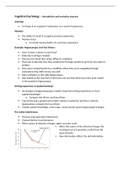
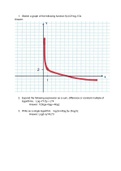
Pro-active interference
Previous trials generate interference
Gradual decline in performance
When nature of stimulus changes, again accurate recall.
When the nature of the stimulus changes the
recall goes up as it provides a relief from the
same stimulus.
New information affects the old information.
, Everyday memory
What? Memory phenomena people experience in normal life.
Autobiographical memory: memory for events in one’s own life.
How? Ecological validity.
o Representative: naturalness of experiments.
o Generalisable: applicable to real life.
Where? Naturalistic setting.
Everyday memory vs. Traditional memory research
o Content is more important than accuracy – what is it that people remember
and what is it that people struggle to remember?
o Autobiographical memories are often memories of memories...
o Note: complementary not antagonistic.
Related to and involves what is called episodic memory and semantic memory in
traditional memory research.
Schematic Processing Principle
Memory = interaction between an event and our own pre-existing schemata.
o E.g. office picture
o Restaurant schema:
Schema-relevant: better memory than schema-irrelevant
Schema-congruent: schema can provide retrieval cues
Schema-incongruent: elaboration, attracted attention
Schema-irrelevant: no good memory.
Schema’s
o Determine how we process story information
o Determine what we remember from stories
o Can change and be updated over time
Remembering = reproduction/reconstruction of an event.
o Schema-based inferences:
o Schema’s are packets of knowledge which can distort our memory
o Produce a coherent (but not necessarily accurate) story.
o Rationalisation: making it in line with own (cultural) expectations.
o Reconstructing an event based on ‘what must have been true’. This also
happens for an eye-witnesses.
Memory = combination of memory traces + general world knowledge.
Autobiographical Memory
Three important findings:
Better retention of memories of the recent
past (last 10-20 years): recency effect
Infantile amnesia: no memories before the
age of 3
Learning
A change in an organism’s behaviour as a result of experience.
Memory
The ability to recall or recognise previous experience
Memory trace
o A mental representation of a previous experience
Example: Hippocampus and Taxi Drivers
Have to have a satnav in your head
Elaborate training is needed
Measure the blood flow under different conditions
They had to describe how they would drive through London to get from one place to
another
They were comparing this to a condition where they were navigating through
somewhere they didn’t know very well
More activation in the right hippocampus
Also looked at the structure of the brain and saw that there was more brain matter
in the posterior hippocampus
Driving experience or spatial learning?
Do changes in hippocampal grey matter result from driving experience or from
spatial knowledge?
o Compare taxi drivers and bus drivers
Taxi drivers had a greater grey matter volume in posterior and less in anterior
hippocampus compared to bus drivers
Greater spatial knowledge, more maps, routes stored causes hippocampal changes.
Pro-active interference
Previous trials generate interference
Gradual decline in performance
When nature of stimulus changes, again accurate recall.
When the nature of the stimulus changes the
recall goes up as it provides a relief from the
same stimulus.
New information affects the old information.
, Everyday memory
What? Memory phenomena people experience in normal life.
Autobiographical memory: memory for events in one’s own life.
How? Ecological validity.
o Representative: naturalness of experiments.
o Generalisable: applicable to real life.
Where? Naturalistic setting.
Everyday memory vs. Traditional memory research
o Content is more important than accuracy – what is it that people remember
and what is it that people struggle to remember?
o Autobiographical memories are often memories of memories...
o Note: complementary not antagonistic.
Related to and involves what is called episodic memory and semantic memory in
traditional memory research.
Schematic Processing Principle
Memory = interaction between an event and our own pre-existing schemata.
o E.g. office picture
o Restaurant schema:
Schema-relevant: better memory than schema-irrelevant
Schema-congruent: schema can provide retrieval cues
Schema-incongruent: elaboration, attracted attention
Schema-irrelevant: no good memory.
Schema’s
o Determine how we process story information
o Determine what we remember from stories
o Can change and be updated over time
Remembering = reproduction/reconstruction of an event.
o Schema-based inferences:
o Schema’s are packets of knowledge which can distort our memory
o Produce a coherent (but not necessarily accurate) story.
o Rationalisation: making it in line with own (cultural) expectations.
o Reconstructing an event based on ‘what must have been true’. This also
happens for an eye-witnesses.
Memory = combination of memory traces + general world knowledge.
Autobiographical Memory
Three important findings:
Better retention of memories of the recent
past (last 10-20 years): recency effect
Infantile amnesia: no memories before the
age of 3