

HRM3706 Performance Management
STUDY UNIT 4 – Performance Management Stages
4.1 Introduction
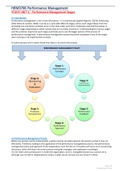
Performance management is not a once-off process – it is continuously applied (Aguinis, 2019a; Armstrong,
2018; Mone & London, 2018). It works as a cycle with different stages, where each stage follows from the
preceding one and where activities occur in the same order each time. Employees may find themselves in
different stages depending on which activity they are currently involved in. Understanding the various stages
and the activities required at each stage could help you to see the bigger picture of the process of
performance management. A performance management system would be incomplete if any of the stages
were missing or not implemented correctly.
A cyclical process and it clearly shows that there is no end to the process.
PERFORMANCE MANAGEMENT POLICY
Stage 1:
Performance
Contract
Stage 6:
Monitoring Stage 2:
Performance
& Implementation
Evaluation
Stage 5: Stage 3:
Employee Performance
Development Feedback
Stage 4:
Performance
Appraisal
4.2 Performance Management Process
Before any process can be implemented, a policy must be set which governs the process so that it may run
effectively. Therefore, leading to the application of the performance management process, the performance
management policy and approach of the organisation must first be set. This policy will serve as an overarching
document, which will direct the entire process and guide managers and employees accordingly
It is the heart and soul because it is inside the organisation, but it is intangible because you cannot see it,
although you can feel it. Organisational culture is what you do not see, but you know it is there.
Page 1 of 7
Summary by L Petzer
, Elements of a PM policy
PM Policy
Activity Details
Performance expectations The starting point and procedure used to determine performance expectations.
Rating scales Where applicable, the rating scales used to measure performance should be presented.
Performance feedback The frequency and method used to communicate performance feedback.
Consistency Measures in place to ensure that the PM system is applied consistently.
Links to other processes Links (if any) of PM to other processes such as reward and career pathing.
Change Contingency plans for when an employee transfers or a new manager is appointed.
While embedding the above elements in a performance management policy, in practice the format of a
performance management policy typically includes the following headings:
▪ Purpose
▪ Scope
▪ Key principles and objectives
▪ Performance management process
▪ Performance management documentation
▪ Roles and responsibilities of stakeholders
▪ Monitoring and review of the policy
Aguinis (2019a) refers to two prerequisites that must be met before a performance management system can
be implemented, namely knowledge (1) of the job, and (2) of the organisation’s mission and strategic goals
4.2.1 Stage 1: Performance Contract
The first stage of the performance management process is establishing the performance contract between the
employee and the supervisor, who acts on behalf of the employer. This stage could also be referred to as the
performance planning phase of the PM process. Employees and supervisors discuss their expectations and
reach a joint agreement on the objectives and performance required of the employee. By effectively including
employees in the process, employee engagement levels can be increased, and employees will demonstrate
commitment and passion towards their work behaviour.
❖ The National Standard lays out the following key principles in terms of performance expectations (SABPP,
2013):
✓ Understandable. Each employee must know exactly what is expected of him or her in terms of
performance.
✓ Relevant to the job and aligned with strategic goals. The expected performance must be linked to the
specific job of the employee and must support the strategic objectives of the organisation. These
linkages should be transparent and clear.
✓ Consistency. The performance expectations of all employees on all levels in an organisation should be
set using the same method. Consistency should always be important.
✓ Cascading goals. Performance expectations should be determined at each of the four levels –
organisational, unit/department, team and individual. Expectations at different levels should not be in
conflict with one another; every level should support the overall strategic aims of the business.
✓ Measurable. Performance expectations should be identified in such a way that it could easily be
measured and that performance progress could easily be tracked.
✓ Performance contract/agreement. After consultation with employees, individual performance
agreements should be set for every employee at the organisation. This usually takes place on an
annual basis. There should be a procedure in place to deal with differences of opinion at this stage.
✓ Collective bargaining. Formal agreements will be used for those employees who are in collective
bargaining units.
✓ Unforeseen circumstances. Performance contracts should include a process that will be used to deal
with unexpected situations and matters that may arise during the year.
Aguinis (2019a) further provides three aspects of an employee’s performance that should be covered during
the performance planning discussion:
1. Results. The outcomes that must be produced by employees should be clearly determined. This
includes an indication of:
Page 2 of 7
Summary by L Petzer
STUDY UNIT 4 – Performance Management Stages
4.1 Introduction
Performance management is not a once-off process – it is continuously applied (Aguinis, 2019a; Armstrong,
2018; Mone & London, 2018). It works as a cycle with different stages, where each stage follows from the
preceding one and where activities occur in the same order each time. Employees may find themselves in
different stages depending on which activity they are currently involved in. Understanding the various stages
and the activities required at each stage could help you to see the bigger picture of the process of
performance management. A performance management system would be incomplete if any of the stages
were missing or not implemented correctly.
A cyclical process and it clearly shows that there is no end to the process.
PERFORMANCE MANAGEMENT POLICY
Stage 1:
Performance
Contract
Stage 6:
Monitoring Stage 2:
Performance
& Implementation
Evaluation
Stage 5: Stage 3:
Employee Performance
Development Feedback
Stage 4:
Performance
Appraisal
4.2 Performance Management Process
Before any process can be implemented, a policy must be set which governs the process so that it may run
effectively. Therefore, leading to the application of the performance management process, the performance
management policy and approach of the organisation must first be set. This policy will serve as an overarching
document, which will direct the entire process and guide managers and employees accordingly
It is the heart and soul because it is inside the organisation, but it is intangible because you cannot see it,
although you can feel it. Organisational culture is what you do not see, but you know it is there.
Page 1 of 7
Summary by L Petzer
, Elements of a PM policy
PM Policy
Activity Details
Performance expectations The starting point and procedure used to determine performance expectations.
Rating scales Where applicable, the rating scales used to measure performance should be presented.
Performance feedback The frequency and method used to communicate performance feedback.
Consistency Measures in place to ensure that the PM system is applied consistently.
Links to other processes Links (if any) of PM to other processes such as reward and career pathing.
Change Contingency plans for when an employee transfers or a new manager is appointed.
While embedding the above elements in a performance management policy, in practice the format of a
performance management policy typically includes the following headings:
▪ Purpose
▪ Scope
▪ Key principles and objectives
▪ Performance management process
▪ Performance management documentation
▪ Roles and responsibilities of stakeholders
▪ Monitoring and review of the policy
Aguinis (2019a) refers to two prerequisites that must be met before a performance management system can
be implemented, namely knowledge (1) of the job, and (2) of the organisation’s mission and strategic goals
4.2.1 Stage 1: Performance Contract
The first stage of the performance management process is establishing the performance contract between the
employee and the supervisor, who acts on behalf of the employer. This stage could also be referred to as the
performance planning phase of the PM process. Employees and supervisors discuss their expectations and
reach a joint agreement on the objectives and performance required of the employee. By effectively including
employees in the process, employee engagement levels can be increased, and employees will demonstrate
commitment and passion towards their work behaviour.
❖ The National Standard lays out the following key principles in terms of performance expectations (SABPP,
2013):
✓ Understandable. Each employee must know exactly what is expected of him or her in terms of
performance.
✓ Relevant to the job and aligned with strategic goals. The expected performance must be linked to the
specific job of the employee and must support the strategic objectives of the organisation. These
linkages should be transparent and clear.
✓ Consistency. The performance expectations of all employees on all levels in an organisation should be
set using the same method. Consistency should always be important.
✓ Cascading goals. Performance expectations should be determined at each of the four levels –
organisational, unit/department, team and individual. Expectations at different levels should not be in
conflict with one another; every level should support the overall strategic aims of the business.
✓ Measurable. Performance expectations should be identified in such a way that it could easily be
measured and that performance progress could easily be tracked.
✓ Performance contract/agreement. After consultation with employees, individual performance
agreements should be set for every employee at the organisation. This usually takes place on an
annual basis. There should be a procedure in place to deal with differences of opinion at this stage.
✓ Collective bargaining. Formal agreements will be used for those employees who are in collective
bargaining units.
✓ Unforeseen circumstances. Performance contracts should include a process that will be used to deal
with unexpected situations and matters that may arise during the year.
Aguinis (2019a) further provides three aspects of an employee’s performance that should be covered during
the performance planning discussion:
1. Results. The outcomes that must be produced by employees should be clearly determined. This
includes an indication of:
Page 2 of 7
Summary by L Petzer


