Quality Management Summary
1. Define Phase
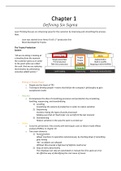
Consist of Team Chartering, Process Mapping, And Customer Focus
1. Team Chartering
Five major elements:
- Business Case: Why are we doing it?
- Problem and Goal Statements: Description of the problem or opportunity
- Scope: Process Dimensions
- Milestone: Key Steps and dates
-Roles
2. Process Mapping
3. Customer focus
Getting information from customers (Voice of Customers/VOC). Several methods, like survey
VOC/Voice of Customer process:
- Identify the customer: Customer segmentation (identify which segments is the most
important leads to money and time saving). Always the 80/20 rule
Principle of customer segmentation: Group segmentation (based on the needs), Focus on business
segments (to achieve strategy, capability to serve, and potential customer needs). The segmentation van
be based on Economic criteria, Descriptive (Geo location, demographics, etc), and extra (price, value,
service)
- Gather Customer needs
Identify the customer’s needs (Quality, Cost, Delivery, Safety/service, and CSR)
Using the CTQ (Critical to the business employees or worker) and CTP (Critical to customer or market)
development
Reactive (Information comes to you complains) and Proactive system (find the information
Interview)
- Analyze customer information
Can be done using Affinity Diagram and Kano Analysis
Affinity Diagram
,KANO Diagram
Kano Analysis definition
1.
Must be: potential dissatisfied
2. More is better: Potential Satisfier
3. Delighters: if there is an absent of dissatisfaction means the clients is delight
4. Indifferent: Client feels to whether the feature is present or not
5. Reverse: Feature causes dissatisfaction
- Determine Critical customer Requirements (CCR)
Customer buying decision (must have or must be?)
, 2. Measure Phase
Objectives
Data Collection
Variation
Six Sigma & Process capability
Measurements an introduction
o Often a financial orientation
o Often too many
o Too late
o Isolated
o Used for punishment.
o Unclearly defined.
o No connection with the customer
Preperation for analysis
o Start with abstractions
Y = f (X1,X2, ……., Xn)+
Y relates to the outputs
X relates to the inputs
Identify the X’s that might explain variation in the output measures
Collecting data efficiently: Both the Y’s and the suspected x’s
Data collection
o Develop a plan
Clarify Collection goals
Develop operational definitions and procedures
Plan for data consistency
Begin data collection
Continue improving measurement consistency
o Data collection
1. Define Phase
Consist of Team Chartering, Process Mapping, And Customer Focus
1. Team Chartering
Five major elements:
- Business Case: Why are we doing it?
- Problem and Goal Statements: Description of the problem or opportunity
- Scope: Process Dimensions
- Milestone: Key Steps and dates
-Roles
2. Process Mapping
3. Customer focus
Getting information from customers (Voice of Customers/VOC). Several methods, like survey
VOC/Voice of Customer process:
- Identify the customer: Customer segmentation (identify which segments is the most
important leads to money and time saving). Always the 80/20 rule
Principle of customer segmentation: Group segmentation (based on the needs), Focus on business
segments (to achieve strategy, capability to serve, and potential customer needs). The segmentation van
be based on Economic criteria, Descriptive (Geo location, demographics, etc), and extra (price, value,
service)
- Gather Customer needs
Identify the customer’s needs (Quality, Cost, Delivery, Safety/service, and CSR)
Using the CTQ (Critical to the business employees or worker) and CTP (Critical to customer or market)
development
Reactive (Information comes to you complains) and Proactive system (find the information
Interview)
- Analyze customer information
Can be done using Affinity Diagram and Kano Analysis
Affinity Diagram
,KANO Diagram
Kano Analysis definition
1.
Must be: potential dissatisfied
2. More is better: Potential Satisfier
3. Delighters: if there is an absent of dissatisfaction means the clients is delight
4. Indifferent: Client feels to whether the feature is present or not
5. Reverse: Feature causes dissatisfaction
- Determine Critical customer Requirements (CCR)
Customer buying decision (must have or must be?)
, 2. Measure Phase
Objectives
Data Collection
Variation
Six Sigma & Process capability
Measurements an introduction
o Often a financial orientation
o Often too many
o Too late
o Isolated
o Used for punishment.
o Unclearly defined.
o No connection with the customer
Preperation for analysis
o Start with abstractions
Y = f (X1,X2, ……., Xn)+
Y relates to the outputs
X relates to the inputs
Identify the X’s that might explain variation in the output measures
Collecting data efficiently: Both the Y’s and the suspected x’s
Data collection
o Develop a plan
Clarify Collection goals
Develop operational definitions and procedures
Plan for data consistency
Begin data collection
Continue improving measurement consistency
o Data collection