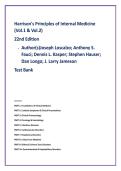
Harrison's Principles of Internal Medicine
(Vol.1 & Vol.2)
22nd Edition
• Author(s)Joseph Loscalzo; Anthony S.
Fauci; Dennis L. Kasper; Stephen Hauser;
Dan Longo; J. Larry Jameson
Test Bank
Covered
PART 1: Foundations of Clinical Medicine
PART 2: Cardinal Symptoms & Clinical Presentations
PART 3: Clinical Pharmacology
PART 4: Oncology & Hematology
PART 5: Infectious Diseases
PART 6: Cardiovascular Disorders
PART 7: Respiratory Disorders
PART 8: Critical Care Medicine
PART 9: Kidney & Urinary Tract Disorders
PART 10: Gastrointestinal & Hepatobiliary Disorders
,PART 11: Immune-Mediated & Rheumatologic Disorders
PART 12: Endocrinology & Metabolism
PART 13: Neurologic & Psychiatric Disorders
PART 14: Toxicology & Environmental Injury
PART 15: Environmental & Occupational Medicine
PART 16: Genetics, Precision & Systems Medicine
PART 17–20: Special & Emerging Topics
Nursing Examination MCQs
Harrison’s Principles of Internal Medicine, 22nd ed. (Vol. 1,
Chs. 1–13)
1.
Which principle best defines evidence-based medical practice?
• A. Reliance on expert opinion alone
• B. Use of randomized trials exclusively
• C. Integration of best research evidence with clinical
expertise and patient values
• D. Application of standardized protocols to all patients
Correct Answer: C
Rationale: Evidence-based medicine integrates scientific
,evidence, clinician judgment, and patient preferences.
Citation: Harrison’s 22nd ed., Ch. 1 – The Practice of Medicine
2.
Which factor most strongly influences population health
outcomes?
• A. Access to specialty care
• B. Genetic predisposition
• C. Social and environmental determinants
• D. Advanced diagnostic technology
Correct Answer: C
Rationale: Social determinants such as housing, education, and
income are primary drivers of health outcomes.
Citation: Harrison’s 22nd ed., Ch. 2 – Promoting Good Health
3.
A key contributor to vaccine hesitancy is:
• A. Lack of vaccine availability
• B. Mistrust in medical institutions
• C. Increased adverse reactions
• D. Insufficient cold-chain storage
, Correct Answer: B
Rationale: Vaccine opposition is often driven by misinformation
and mistrust rather than scientific evidence.
Citation: Harrison’s 22nd ed., Ch. 3 – Vaccine Opposition and
Hesitancy
4.
Clinical decision-making under uncertainty most often relies on:
• A. Intuition alone
• B. Bayesian reasoning
• C. Absolute diagnostic certainty
• D. Trial-and-error therapy
Correct Answer: B
Rationale: Clinicians update disease probability as new
information becomes available using Bayesian principles.
Citation: Harrison’s 22nd ed., Ch. 4 – Decision-Making in Clinical
Medicine
5.
Precision medicine primarily aims to:
• A. Reduce healthcare costs
• B. Standardize treatment protocols
(Vol.1 & Vol.2)
22nd Edition
• Author(s)Joseph Loscalzo; Anthony S.
Fauci; Dennis L. Kasper; Stephen Hauser;
Dan Longo; J. Larry Jameson
Test Bank
Covered
PART 1: Foundations of Clinical Medicine
PART 2: Cardinal Symptoms & Clinical Presentations
PART 3: Clinical Pharmacology
PART 4: Oncology & Hematology
PART 5: Infectious Diseases
PART 6: Cardiovascular Disorders
PART 7: Respiratory Disorders
PART 8: Critical Care Medicine
PART 9: Kidney & Urinary Tract Disorders
PART 10: Gastrointestinal & Hepatobiliary Disorders
,PART 11: Immune-Mediated & Rheumatologic Disorders
PART 12: Endocrinology & Metabolism
PART 13: Neurologic & Psychiatric Disorders
PART 14: Toxicology & Environmental Injury
PART 15: Environmental & Occupational Medicine
PART 16: Genetics, Precision & Systems Medicine
PART 17–20: Special & Emerging Topics
Nursing Examination MCQs
Harrison’s Principles of Internal Medicine, 22nd ed. (Vol. 1,
Chs. 1–13)
1.
Which principle best defines evidence-based medical practice?
• A. Reliance on expert opinion alone
• B. Use of randomized trials exclusively
• C. Integration of best research evidence with clinical
expertise and patient values
• D. Application of standardized protocols to all patients
Correct Answer: C
Rationale: Evidence-based medicine integrates scientific
,evidence, clinician judgment, and patient preferences.
Citation: Harrison’s 22nd ed., Ch. 1 – The Practice of Medicine
2.
Which factor most strongly influences population health
outcomes?
• A. Access to specialty care
• B. Genetic predisposition
• C. Social and environmental determinants
• D. Advanced diagnostic technology
Correct Answer: C
Rationale: Social determinants such as housing, education, and
income are primary drivers of health outcomes.
Citation: Harrison’s 22nd ed., Ch. 2 – Promoting Good Health
3.
A key contributor to vaccine hesitancy is:
• A. Lack of vaccine availability
• B. Mistrust in medical institutions
• C. Increased adverse reactions
• D. Insufficient cold-chain storage
, Correct Answer: B
Rationale: Vaccine opposition is often driven by misinformation
and mistrust rather than scientific evidence.
Citation: Harrison’s 22nd ed., Ch. 3 – Vaccine Opposition and
Hesitancy
4.
Clinical decision-making under uncertainty most often relies on:
• A. Intuition alone
• B. Bayesian reasoning
• C. Absolute diagnostic certainty
• D. Trial-and-error therapy
Correct Answer: B
Rationale: Clinicians update disease probability as new
information becomes available using Bayesian principles.
Citation: Harrison’s 22nd ed., Ch. 4 – Decision-Making in Clinical
Medicine
5.
Precision medicine primarily aims to:
• A. Reduce healthcare costs
• B. Standardize treatment protocols