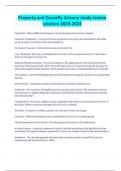
MHA 710 TEST 4 2026 FINAL PAPER EXAM PREP
QUESTIONS AND SOLUTIONS
◉ What are some of the specific challenges faced by managers in
healthcare? Answer: 1. The central roles of risk and uncertainty
2. The complexities created by insurance
3. The perils produced by information asymmetries
4. The problems posed by not-for-profit organizations
5. The rapid and confusing course of technical and institutional
change
◉ What does asymmetric information mean? Can you give an
example? Answer: When one party in a transaction has less
information than the other party. For example, physicians and other
healthcare providers usually understand patients' medical options
better than patients do. Unaware of their choices, patients may
accept recommendations for therapies that are not cost-effective or,
recognizing their vulnerability to physicians' self-serving advice,
may resist recommendations made in their best interest.
,◉ What is adverse selection? Answer: A situation that occurs when
buyers have better information than sellers. For example, high-risk
consumers are willing to pay more for insurance than low-risk
consumers are. (Organizations that have difficulty distinguishing
high-risk from low-risk consumers are unlikely to be profitable.)
◉ What is the problem of scarcity? Answer: Demand for a good or
service is greater than the availability
◉ What does it mean to say people are assumed to make choices
rationally? Answer: focuses on individuals' efforts to best realize
their goals, given their resources.
◉ What does it mean to says resources are scarce? Answer:
Anything useful in consumption or production that has alternative
uses.
◉ What is opportunity cost? Answer: Potential loss from a missed
opportunity. Passing up the next best choice.
◉ What does "marginal" refer to? Answer: The examination of the
costs and benefits through a small change in the production of goods
◉ What does efficiency refer to? Answer: No way to rearrange
production of goods in a way that makes one person more better off
, without making somebody else worse off. How well an economy
uses scare resources to meet the needs/wants of their customers
◉ How do positive economic statements differ from normative
economic statements? Answer: Positive economics is objective while
normative economics is subjective. Facts/ What is vs What should be
◉ How can economics be applied to the health sector? Answer:
Describe, Explain, Evaluate, Plan
◉ As we progress through the chapters, think about the special
characteristics that apply to the health sector that might limit the
applicability of traditional economic models. Answer: Social
determinants of health, few insurance companies that providers rely
on, not a perfectly competitive market
◉ How are healthcare products both outputs and inputs? Can you
give an example? Answer: Products (goods and services are
considered products) are commonly both inputs and outputs. For
example, a surgical tool is an input into a surgery and an output of a
surgical tool company. Similarly, the surgery itself can be considered
an output of the surgical team or an input into the health of the
patient.
◉ What is a life year? And what is it used for in the context of this
chapter? Answer: One additional year of life. It can equal one added
QUESTIONS AND SOLUTIONS
◉ What are some of the specific challenges faced by managers in
healthcare? Answer: 1. The central roles of risk and uncertainty
2. The complexities created by insurance
3. The perils produced by information asymmetries
4. The problems posed by not-for-profit organizations
5. The rapid and confusing course of technical and institutional
change
◉ What does asymmetric information mean? Can you give an
example? Answer: When one party in a transaction has less
information than the other party. For example, physicians and other
healthcare providers usually understand patients' medical options
better than patients do. Unaware of their choices, patients may
accept recommendations for therapies that are not cost-effective or,
recognizing their vulnerability to physicians' self-serving advice,
may resist recommendations made in their best interest.
,◉ What is adverse selection? Answer: A situation that occurs when
buyers have better information than sellers. For example, high-risk
consumers are willing to pay more for insurance than low-risk
consumers are. (Organizations that have difficulty distinguishing
high-risk from low-risk consumers are unlikely to be profitable.)
◉ What is the problem of scarcity? Answer: Demand for a good or
service is greater than the availability
◉ What does it mean to say people are assumed to make choices
rationally? Answer: focuses on individuals' efforts to best realize
their goals, given their resources.
◉ What does it mean to says resources are scarce? Answer:
Anything useful in consumption or production that has alternative
uses.
◉ What is opportunity cost? Answer: Potential loss from a missed
opportunity. Passing up the next best choice.
◉ What does "marginal" refer to? Answer: The examination of the
costs and benefits through a small change in the production of goods
◉ What does efficiency refer to? Answer: No way to rearrange
production of goods in a way that makes one person more better off
, without making somebody else worse off. How well an economy
uses scare resources to meet the needs/wants of their customers
◉ How do positive economic statements differ from normative
economic statements? Answer: Positive economics is objective while
normative economics is subjective. Facts/ What is vs What should be
◉ How can economics be applied to the health sector? Answer:
Describe, Explain, Evaluate, Plan
◉ As we progress through the chapters, think about the special
characteristics that apply to the health sector that might limit the
applicability of traditional economic models. Answer: Social
determinants of health, few insurance companies that providers rely
on, not a perfectly competitive market
◉ How are healthcare products both outputs and inputs? Can you
give an example? Answer: Products (goods and services are
considered products) are commonly both inputs and outputs. For
example, a surgical tool is an input into a surgery and an output of a
surgical tool company. Similarly, the surgery itself can be considered
an output of the surgical team or an input into the health of the
patient.
◉ What is a life year? And what is it used for in the context of this
chapter? Answer: One additional year of life. It can equal one added