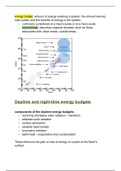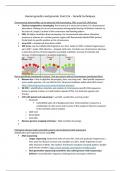
energy budget: amount of energy entering a system, the amount leaving
said system and the transfer of energy in the system.
- commonly considered at a macro-scale or at a micro-scale
- microclimate: describes regional climates, such as those
associated with urban areas, coastal areas…
Daytime and night-time energy budgets
components of the daytime energy budgets:
- incoming shortwave solar radiation - insolation
- reflected solar radiation
- surface absorption
- sensible heat transfer
- long-wave radiation
- latent heat - evaporation and condensation
These influence the gain or loss of energy at a point at the Earth's
surface
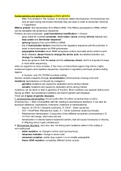
, Formula for daytime energy budget
Energy available at surface = incoming solar radiation - (reflected solar
radiation + surface absorption + sensible heat transfer + long-wave
radiation + latent heat transfers)
incoming solar radiation: short wavelengths of visible light - shortwave
surface absorption: solar energy that enter the Earth's surface
sensible heat transfer: related to changes in temperature of a gas or
object with no change in phase.
long-wave radiation: absorbed solar energy which is re-emitted in the
form of infrared rays
latent heat transfers: related to changes in phase between liquids,
gases, and solids.
Components of night-time energy budgets:
- long-wave radiation
- latent heat transfer - condensation
- absorbed energy returned to Earth - sub-surface supply
- sensible heat transfer
Incoming (shortwave) solar radiation
said system and the transfer of energy in the system.
- commonly considered at a macro-scale or at a micro-scale
- microclimate: describes regional climates, such as those
associated with urban areas, coastal areas…
Daytime and night-time energy budgets
components of the daytime energy budgets:
- incoming shortwave solar radiation - insolation
- reflected solar radiation
- surface absorption
- sensible heat transfer
- long-wave radiation
- latent heat - evaporation and condensation
These influence the gain or loss of energy at a point at the Earth's
surface
, Formula for daytime energy budget
Energy available at surface = incoming solar radiation - (reflected solar
radiation + surface absorption + sensible heat transfer + long-wave
radiation + latent heat transfers)
incoming solar radiation: short wavelengths of visible light - shortwave
surface absorption: solar energy that enter the Earth's surface
sensible heat transfer: related to changes in temperature of a gas or
object with no change in phase.
long-wave radiation: absorbed solar energy which is re-emitted in the
form of infrared rays
latent heat transfers: related to changes in phase between liquids,
gases, and solids.
Components of night-time energy budgets:
- long-wave radiation
- latent heat transfer - condensation
- absorbed energy returned to Earth - sub-surface supply
- sensible heat transfer
Incoming (shortwave) solar radiation