Problem 3 – Attachment (not) included
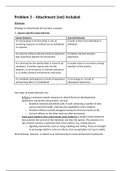
Ethology
Ethology is characterized by four basic concepts:
1 - Species-specific innate behavior
Innate behavior Learned behavior
It is stereotypes in its form (that is, has an It varies in form from individual to
unvarying sequence of actions) across individuals individual.
in a species.
It is present without relevant previous experience It requires relevant previous
that could have allowed it to be learned. experience.
It is universal for the species (that is, found in all It usually varies in occurrence among
members). If another species also has the members of the species.
behavior, it can be due to; 1) common ancestors,
or 2) similar physical environments and needs
It is relatively unchanged as a result of experience It can change as a result of
and learning after it is established. subsequent experience.
Two types of innate behaviors are:
- Reflexes: Involuntary simple responses to stimuli that have developmental
significance and permit young infants’ survival.
o Brazelton neonatal assesment scale: A scale containing a number of tests
used to asses the health, maturity and capabitlities of the newborn.
o Primitive reflexes normally disappear during the first few months of life.
o Survival reflexes on the other hand are often permanent.
- Fixed action patterns (also called modal action patterns): Complex innate behaviors
that promote the survival of the individual, and thus the species. The presence of a
sign stimulus releases a particular fixed action pattern (e.g. mating dances).
o Signaling mechanisms such as crying, babbling and smiling. These are thought
to encourage adults to come to infants, since young babies can’t go to adults.
Most behavior, however, is viewed as an interweaving of innate and learned components.
, Types of reflexes
Reflex Significance Dissapearance
Permanent reflexes:
- Eye-blink Protects the eyes from bright light or X
foreign objects.
- Paterllar tendon reflex Weak or absent in depressed babies or X
(‘’knee jerk’’) those with muscular disease.
- Biceps reflex Absent in depressed babies or those with X
congenital muscular disease.
- Withdrawal reflex Protects the infant from pain. X
- Breathing reflex Provides oxygen and expels carbon dioxide X
- Pupillary reflex Protects against bright lights; adapts the X
visual system to low illumination.
- Sucking reflex Allows baby to take in nutrients X
- Swallowing reflex Allows baby to take in nutrients X
Termporary reflexes:
- Stepping reflex Possibly a precursor for walking. 3-4 months
- Rooting reflex: When a baby’s Orients baby to breast or bottle. 3-4 months
cheek is stroked, it turns it
head and opens its mouth.
- Palmar grasp: When one Allows the infant to cling to the mother. 3-4 months
presses again the palm of a
baby’s hand, the fingers grasp.
- Swimming reflex It will keep an infant afloat for some time, 4-6 months
allowing easy rescue.
- Moro reflex: An embracing Prevents infants from being harmed when 4-6 months
movement in response to the the mother has to run when encountering a (However, the
sensation of falling or the threat. response to loud
presence of a loud noise. noises remains)
- Babkin or palmar reflex: When This is believed to be a remnant of our 4-6 months
applying pressure to both of evolutionary history that has outlived its
baby’s parms, a baby opens its original purpose. It is not clear what its
mouth, closes it eyes and purpose is.
moves its head.
- Babinski reflex: When stroking This is believed to be a remnant of our 8-12 months
the bottom of a baby’s foot, evolutionary history that has outlived its
the toes curl. original purpose. It is not clear what its
purpose is.
- Plantar or toe grasp: When Allows the infant to cling to the mother. 8-12 months
one presses on the ball of a
baby’s foot, all toes curl as if
grasping.
Ethology
Ethology is characterized by four basic concepts:
1 - Species-specific innate behavior
Innate behavior Learned behavior
It is stereotypes in its form (that is, has an It varies in form from individual to
unvarying sequence of actions) across individuals individual.
in a species.
It is present without relevant previous experience It requires relevant previous
that could have allowed it to be learned. experience.
It is universal for the species (that is, found in all It usually varies in occurrence among
members). If another species also has the members of the species.
behavior, it can be due to; 1) common ancestors,
or 2) similar physical environments and needs
It is relatively unchanged as a result of experience It can change as a result of
and learning after it is established. subsequent experience.
Two types of innate behaviors are:
- Reflexes: Involuntary simple responses to stimuli that have developmental
significance and permit young infants’ survival.
o Brazelton neonatal assesment scale: A scale containing a number of tests
used to asses the health, maturity and capabitlities of the newborn.
o Primitive reflexes normally disappear during the first few months of life.
o Survival reflexes on the other hand are often permanent.
- Fixed action patterns (also called modal action patterns): Complex innate behaviors
that promote the survival of the individual, and thus the species. The presence of a
sign stimulus releases a particular fixed action pattern (e.g. mating dances).
o Signaling mechanisms such as crying, babbling and smiling. These are thought
to encourage adults to come to infants, since young babies can’t go to adults.
Most behavior, however, is viewed as an interweaving of innate and learned components.
, Types of reflexes
Reflex Significance Dissapearance
Permanent reflexes:
- Eye-blink Protects the eyes from bright light or X
foreign objects.
- Paterllar tendon reflex Weak or absent in depressed babies or X
(‘’knee jerk’’) those with muscular disease.
- Biceps reflex Absent in depressed babies or those with X
congenital muscular disease.
- Withdrawal reflex Protects the infant from pain. X
- Breathing reflex Provides oxygen and expels carbon dioxide X
- Pupillary reflex Protects against bright lights; adapts the X
visual system to low illumination.
- Sucking reflex Allows baby to take in nutrients X
- Swallowing reflex Allows baby to take in nutrients X
Termporary reflexes:
- Stepping reflex Possibly a precursor for walking. 3-4 months
- Rooting reflex: When a baby’s Orients baby to breast or bottle. 3-4 months
cheek is stroked, it turns it
head and opens its mouth.
- Palmar grasp: When one Allows the infant to cling to the mother. 3-4 months
presses again the palm of a
baby’s hand, the fingers grasp.
- Swimming reflex It will keep an infant afloat for some time, 4-6 months
allowing easy rescue.
- Moro reflex: An embracing Prevents infants from being harmed when 4-6 months
movement in response to the the mother has to run when encountering a (However, the
sensation of falling or the threat. response to loud
presence of a loud noise. noises remains)
- Babkin or palmar reflex: When This is believed to be a remnant of our 4-6 months
applying pressure to both of evolutionary history that has outlived its
baby’s parms, a baby opens its original purpose. It is not clear what its
mouth, closes it eyes and purpose is.
moves its head.
- Babinski reflex: When stroking This is believed to be a remnant of our 8-12 months
the bottom of a baby’s foot, evolutionary history that has outlived its
the toes curl. original purpose. It is not clear what its
purpose is.
- Plantar or toe grasp: When Allows the infant to cling to the mother. 8-12 months
one presses on the ball of a
baby’s foot, all toes curl as if
grasping.