Problem 6 – And now the moral(ity) of the story
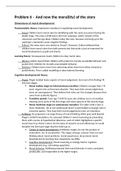
Dimensions of moral development
Psychoanalytic theory: Emphasizes emotions in explaining moral development.
- Freud: Children learn moral rules by identifying with the same-sex parent during the
phallic stage. The rules a child learns form her superego, which consists of the
conscience and the ego ideal. Children obey the rules, because not living up to the
superego’s standards causes negative feelings.
- Erikson: His views were very similar to Freud’s. However, Erikson believed that
children learn moral rules from both parents and that pride is just as important for
moral development as guilt and shame.
Learning theory: Consequences teach children to obey moral rules.
- Skinner: Adults reward their children with praise for morally acceptable behavior and
punish their children for morally unacceptable behavior.
- Bandura: Children learn more from observing others than from either rewards or
punishments. This is called modelling or observational learning.
Cognitive-developmental theory:
- Piaget: Piaget studied many aspects of moral judgement, but most of his findings fit
into two stages:
Moral realism stage (or heteronomous morality): Children younger than 7-8
years regard rules as fixed and absolute. They base their moral judgements
more on consequences. They believe that rules can’t be changes because they
come from authority figures.
Transition period: From age 7-8 till 10 years old, children are in a transition
showing some parts of the first stage and some aspects of the second stage.
Moral relativism stage (or autonomous morality): The older child’s view is
more relativistic. He or she understand that it is permissible to change rules is
everyone agrees. They base their moral judgements more on intentions.
- Kohlberg: He proposed a six stage theory of moral thinking which goes well beyond
Piaget’s initial formulations. He assessed children’s moral reasoning by presenting
them with a series of hypothetical dilemmas, each of which highlighted a specific
moral issue (e.g. Heinz’s story). On the basis of answers to such dilemmas, he could
decipher the level and stage that the child was in.
Causes of moral development: Kohlberg’s stages are not the product of
maturation, nor of socialization. The stages emerge, instead, from our own
thinking about moral problems. Social experiences do promote moral
development by learning how viewpoints can differ.
Cognitive development: Moral reasoning is strongly tied to cognitive
development (e.g. role-taking capacities).
Moral behavior: Kohlberg proposed that moral behavior is more consistent,
predictable, and responsible at the higher stages.
, Level 1: Preconventional morality: Children speak as isolated individuals rather than as
members of society. They see morality as something external to themselves, as that which
the big people say they must do.
- Stage 1. Obedience and Punishment Orientation. The child assumes that powerful
authorities hand down a fixed set of rules which he/she must unquestioningly obey.
The child decides what is wrong on the basis of what is punished.
- Stage 2. Individualism, Instrumental Purpose and Exchange. Children recognize that
there is not just one right view that is handed down by the authorities. Since
everything is relative, each person is free to pursue his or her individual interests. The
child follows rules when it is in his or her immediate interest.
Level 2: Conventional morality: Children assume that attitudes that they express are shared
by the entire community.
- Stage 3. Good interpersonal Relationships. Children see morality as more than
simple deals. They believe that people should live up to the expectations of the
family and community and behave in ‘’good’’ ways.
- Stage 4. Maintaining the Social Order. Children become more broadly concerned
with society as a whole. Now the emphasis is on obeying laws, respecting authority,
and performing one’s duties so that the social order is maintained.
Level 3: Postconventional morality: People are concerned with the principles and values that
make for a good society. A new kind of personal authority emerges and allows a person to
make individual judgements and choices based on self-chosen principles.
- Stage 5. Social Contract and Individual Rights. People recognize that different social
groups within a society will have different values, but they believe that all rational
people would agree on two points. We all want basic rights and we all want some
democratic procedures for changing unfair law and for improving society. Thus,
people act so as to achieve the ‘’greatest good for the greatest number’’.
- Stage 6. Universal Principles. The adults develops and follows self-chosen ethical
principles in determining what is right. The principles of justice require us to treat the
claims of all parties in an impartial manner, respecting the basic dignity of all people
as individuals. In actual practice, Kohlberg says, we can reach just decisions by
looking at a situation through one another’s eyes. The higher principle of justice
sometimes requires civil disobedience.
Moral development: Involves changes in thoughts, feelings, and behaviors regarding
standards of right and wrong.
- Intrapersonal dimension: Regulates a person’s activities when she or he is not
engaged in social interactions.
- Interpersonal dimension: Regulates social interactions and arbitrates conflict.
Dimensions of moral development
Psychoanalytic theory: Emphasizes emotions in explaining moral development.
- Freud: Children learn moral rules by identifying with the same-sex parent during the
phallic stage. The rules a child learns form her superego, which consists of the
conscience and the ego ideal. Children obey the rules, because not living up to the
superego’s standards causes negative feelings.
- Erikson: His views were very similar to Freud’s. However, Erikson believed that
children learn moral rules from both parents and that pride is just as important for
moral development as guilt and shame.
Learning theory: Consequences teach children to obey moral rules.
- Skinner: Adults reward their children with praise for morally acceptable behavior and
punish their children for morally unacceptable behavior.
- Bandura: Children learn more from observing others than from either rewards or
punishments. This is called modelling or observational learning.
Cognitive-developmental theory:
- Piaget: Piaget studied many aspects of moral judgement, but most of his findings fit
into two stages:
Moral realism stage (or heteronomous morality): Children younger than 7-8
years regard rules as fixed and absolute. They base their moral judgements
more on consequences. They believe that rules can’t be changes because they
come from authority figures.
Transition period: From age 7-8 till 10 years old, children are in a transition
showing some parts of the first stage and some aspects of the second stage.
Moral relativism stage (or autonomous morality): The older child’s view is
more relativistic. He or she understand that it is permissible to change rules is
everyone agrees. They base their moral judgements more on intentions.
- Kohlberg: He proposed a six stage theory of moral thinking which goes well beyond
Piaget’s initial formulations. He assessed children’s moral reasoning by presenting
them with a series of hypothetical dilemmas, each of which highlighted a specific
moral issue (e.g. Heinz’s story). On the basis of answers to such dilemmas, he could
decipher the level and stage that the child was in.
Causes of moral development: Kohlberg’s stages are not the product of
maturation, nor of socialization. The stages emerge, instead, from our own
thinking about moral problems. Social experiences do promote moral
development by learning how viewpoints can differ.
Cognitive development: Moral reasoning is strongly tied to cognitive
development (e.g. role-taking capacities).
Moral behavior: Kohlberg proposed that moral behavior is more consistent,
predictable, and responsible at the higher stages.
, Level 1: Preconventional morality: Children speak as isolated individuals rather than as
members of society. They see morality as something external to themselves, as that which
the big people say they must do.
- Stage 1. Obedience and Punishment Orientation. The child assumes that powerful
authorities hand down a fixed set of rules which he/she must unquestioningly obey.
The child decides what is wrong on the basis of what is punished.
- Stage 2. Individualism, Instrumental Purpose and Exchange. Children recognize that
there is not just one right view that is handed down by the authorities. Since
everything is relative, each person is free to pursue his or her individual interests. The
child follows rules when it is in his or her immediate interest.
Level 2: Conventional morality: Children assume that attitudes that they express are shared
by the entire community.
- Stage 3. Good interpersonal Relationships. Children see morality as more than
simple deals. They believe that people should live up to the expectations of the
family and community and behave in ‘’good’’ ways.
- Stage 4. Maintaining the Social Order. Children become more broadly concerned
with society as a whole. Now the emphasis is on obeying laws, respecting authority,
and performing one’s duties so that the social order is maintained.
Level 3: Postconventional morality: People are concerned with the principles and values that
make for a good society. A new kind of personal authority emerges and allows a person to
make individual judgements and choices based on self-chosen principles.
- Stage 5. Social Contract and Individual Rights. People recognize that different social
groups within a society will have different values, but they believe that all rational
people would agree on two points. We all want basic rights and we all want some
democratic procedures for changing unfair law and for improving society. Thus,
people act so as to achieve the ‘’greatest good for the greatest number’’.
- Stage 6. Universal Principles. The adults develops and follows self-chosen ethical
principles in determining what is right. The principles of justice require us to treat the
claims of all parties in an impartial manner, respecting the basic dignity of all people
as individuals. In actual practice, Kohlberg says, we can reach just decisions by
looking at a situation through one another’s eyes. The higher principle of justice
sometimes requires civil disobedience.
Moral development: Involves changes in thoughts, feelings, and behaviors regarding
standards of right and wrong.
- Intrapersonal dimension: Regulates a person’s activities when she or he is not
engaged in social interactions.
- Interpersonal dimension: Regulates social interactions and arbitrates conflict.