
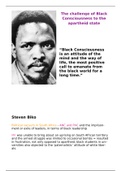
The challenge of Black
Consciousness to the
apartheid state
“Black Consciousness
is an attitude of the
mind and the way of
life, the most positive
call to emanate from
the black world for a
long time.”
Steven Biko
Political vacuum in South Africa - ANC and PAC and the imprison-
ment or exile of leaders, in terms of black leadership
MK was unable to bring about an uprising on South African territory
and the armed struggle was limited to occasional bombs = resulted
in frustration, not only opposed to apartheid, black students in uni-
versities also objected to the ‘paternalistic’ attitude of white liber-
als.
, Aims:
Late 1960s: black students (many from ‘bush colleges’ at University
of Zululand and University of the North) begin to organise resis-
tance to apartheid
• Adopted “Black Consciousness”
• Mental attitude rather than political organisation
• The term “black” was direct challenge to apartheid terminology of
“non-whites”
• ‘Black’ included all oppressed by apartheid African, Coloured, In-
dian; promoted unified identify
Main aims:
• Raising self-respect, dignity and confidence of black people to lib-
erate themselves
• Cultural transformation promoting pride in black identity, culture
and history
• Programmes aimed at overcoming passivity
• Non-dependence on whites: instead of working with white liberals
in multi-racial organisations, encouraging them to educate other
white people to change their attitudes
• Promoting unity amongst black people by mobilising them to fight
against apartheid, and to overcome divisions caused by apartheid
The struggle had two stages:
- Psychological liberation
- Physical liberation
Background
BCM’s definition of “black”differed from the Africanist ideology
Consciousness to the
apartheid state
“Black Consciousness
is an attitude of the
mind and the way of
life, the most positive
call to emanate from
the black world for a
long time.”
Steven Biko
Political vacuum in South Africa - ANC and PAC and the imprison-
ment or exile of leaders, in terms of black leadership
MK was unable to bring about an uprising on South African territory
and the armed struggle was limited to occasional bombs = resulted
in frustration, not only opposed to apartheid, black students in uni-
versities also objected to the ‘paternalistic’ attitude of white liber-
als.
, Aims:
Late 1960s: black students (many from ‘bush colleges’ at University
of Zululand and University of the North) begin to organise resis-
tance to apartheid
• Adopted “Black Consciousness”
• Mental attitude rather than political organisation
• The term “black” was direct challenge to apartheid terminology of
“non-whites”
• ‘Black’ included all oppressed by apartheid African, Coloured, In-
dian; promoted unified identify
Main aims:
• Raising self-respect, dignity and confidence of black people to lib-
erate themselves
• Cultural transformation promoting pride in black identity, culture
and history
• Programmes aimed at overcoming passivity
• Non-dependence on whites: instead of working with white liberals
in multi-racial organisations, encouraging them to educate other
white people to change their attitudes
• Promoting unity amongst black people by mobilising them to fight
against apartheid, and to overcome divisions caused by apartheid
The struggle had two stages:
- Psychological liberation
- Physical liberation
Background
BCM’s definition of “black”differed from the Africanist ideology


