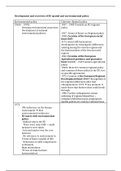
Development and overview of EU spatial and environmental policy
Environmental policy Cohesion (Spatial) policy
1960s – 1970s 1957 – 1985 Towards an EU regional
- Growing environmental awareness policy
- Development of national
environmental policies 1957: Treaty of Rome: no Regional policy
1958: Creation of the European social
fund (ESF)
To ensure ME harmonious
development by reducing the differences
existing among the various regions and
the backwardness of the less favoured
regions
1962: Creation of the European
Agricultural guidance and guarantee
fund (EAGGF) – CAP Common agricultural
policy
1960s: Ideas for common regional policy
and common defence policy in the EU, but
no specific agreements
1975: Creation of the European Regional
Development fund (ERDF) Recognition of
the regional differences after first
enlargements in 1973 key moment: it
made shore that further ideas could break
through
1986: Further enlargements meant
widening of regional disparities +
integrated Mediterranean programmes
Spatial policies are mainly a national issue
1972
- UN conference on the human
environment first
environmental conference
- EU starts with environmental
policy
- Radical step in the EU
- There were only 6 MS -> small
measures were taken
- Internal market was the core
business
- No reference to environment in
Treaty of Rome (quality of life)
- Reluctance to shift competences
to Brussels.
- Main motivations:
Fear of trade barriers
harmonisation!
, Environmental concern
1973
- Enlargement of the EU make it
more difficult to create new policy
miracle happened
- First environmental action
programme this was not
binding but ambitious
- Most of the regulations where trade
related clear treaty basis
product standards
- Others had a vague treaty basis
harder to understand quality
objectives/nature protection
Early 1980s:
- New environmental issues
acidification (verzuring)
Denmark + Sweden
- Transboundary problems
international efforts were needed:
- - In broader European context: UN
economic commission for Europe
(UN-ECE)
- - In EU: Denmark pushing for joint
measures clean car, large
combustion plants
- EU: process standards (next to
product standards), a more indirect
relation to the internal market
1970s: trade products, 1980s trade
process
- Environmental comes closer to
internal market
1986 1986-1988 The Single European Act
SEA – Single European Act
- Revitalizing the internal market 1986: Jacques Delors as president of the
project (1992) EC
- Smoother decision making: QMV Single market and European monetary
- Enlargement with Greece 1981, union
Spain and Portugal 1986 Stronger role to the structural funds
- Opportunity for establishing a and strategic EU-scale infrastructure
Treaty Basis for environmental
policy SEA
- Signed in 1986 in force in 1987 Strengthening the economic and social
The occasion of the SEA was used to create cohesion
policy for environment it gave it a legal Legal basis for Regional policy
basis but decisions had to be taken by
unanimity unless an issue was directly 1988: Reform of the structural funds
trade related QMV Poorest regions
Environmental policy Cohesion (Spatial) policy
1960s – 1970s 1957 – 1985 Towards an EU regional
- Growing environmental awareness policy
- Development of national
environmental policies 1957: Treaty of Rome: no Regional policy
1958: Creation of the European social
fund (ESF)
To ensure ME harmonious
development by reducing the differences
existing among the various regions and
the backwardness of the less favoured
regions
1962: Creation of the European
Agricultural guidance and guarantee
fund (EAGGF) – CAP Common agricultural
policy
1960s: Ideas for common regional policy
and common defence policy in the EU, but
no specific agreements
1975: Creation of the European Regional
Development fund (ERDF) Recognition of
the regional differences after first
enlargements in 1973 key moment: it
made shore that further ideas could break
through
1986: Further enlargements meant
widening of regional disparities +
integrated Mediterranean programmes
Spatial policies are mainly a national issue
1972
- UN conference on the human
environment first
environmental conference
- EU starts with environmental
policy
- Radical step in the EU
- There were only 6 MS -> small
measures were taken
- Internal market was the core
business
- No reference to environment in
Treaty of Rome (quality of life)
- Reluctance to shift competences
to Brussels.
- Main motivations:
Fear of trade barriers
harmonisation!
, Environmental concern
1973
- Enlargement of the EU make it
more difficult to create new policy
miracle happened
- First environmental action
programme this was not
binding but ambitious
- Most of the regulations where trade
related clear treaty basis
product standards
- Others had a vague treaty basis
harder to understand quality
objectives/nature protection
Early 1980s:
- New environmental issues
acidification (verzuring)
Denmark + Sweden
- Transboundary problems
international efforts were needed:
- - In broader European context: UN
economic commission for Europe
(UN-ECE)
- - In EU: Denmark pushing for joint
measures clean car, large
combustion plants
- EU: process standards (next to
product standards), a more indirect
relation to the internal market
1970s: trade products, 1980s trade
process
- Environmental comes closer to
internal market
1986 1986-1988 The Single European Act
SEA – Single European Act
- Revitalizing the internal market 1986: Jacques Delors as president of the
project (1992) EC
- Smoother decision making: QMV Single market and European monetary
- Enlargement with Greece 1981, union
Spain and Portugal 1986 Stronger role to the structural funds
- Opportunity for establishing a and strategic EU-scale infrastructure
Treaty Basis for environmental
policy SEA
- Signed in 1986 in force in 1987 Strengthening the economic and social
The occasion of the SEA was used to create cohesion
policy for environment it gave it a legal Legal basis for Regional policy
basis but decisions had to be taken by
unanimity unless an issue was directly 1988: Reform of the structural funds
trade related QMV Poorest regions