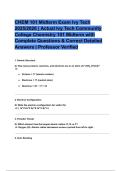
CHEM 101 Midterm Exam Ivy Tech
2025/2026 | Actual Ivy Tech Community
College Chemistry 101 Midterm with
Complete Questions & Correct Detailed
Answers | Professor Verified
1. Atomic Structure
Q: How many protons, neutrons, and electrons are in an atom of (^{35}_{17}Cl)?
A:
● Protons = 17 (atomic number)
● Electrons = 17 (neutral atom)
● Neutrons = 35 − 17 = 18
2. Electron Configuration
Q: Write the electron configuration for sulfur (S).
A: ( 1s^2 2s^2 2p^6 3s^2 3p^4 )
3. Periodic Trends
Q: Which element has the largest atomic radius: O, N, or F?
A: Oxygen (O). Atomic radius decreases across a period from left to right.
4. Ionic Bonding
,Q: What is the formula for magnesium chloride?
A: MgCl(_2) (Mg²⁺ + 2 Cl⁻)
5. Covalent Bonding
Q: Draw the Lewis structure for CO(_2).
A: O=C=O, with each O having 2 lone pairs.
6. Mole Concept
Q: How many moles are in 88 g of CO(_2)? (Molar mass CO(_2) = 44 g/mol)
A: ( n = \frac{88}{44} = 2 \text{ moles} )
7. Stoichiometry
Q: How many grams of H(_2)O are produced when 4 g of H(_2) reacts with O(_2)?
Reaction: ( 2H_2 + O_2 → 2H_2O )
A:
1. Moles of H(_2): ( 4/2 = 2 \text{ mol} )
2. From equation, 2 mol H(_2) → 2 mol H(_2)O
3. Mass H(_2)O = 2 × 18 g/mol = 36 g
8. Balancing Equations
Q: Balance: ( _ Al + _ O_2 → _ Al_2O_3 )
A: ( 4 Al + 3 O_2 → 2 Al_2O_3 )
9. Gas Laws
Q: A 2.0 L container holds 1.0 mol of N(_2) at 300 K. Calculate pressure using ideal gas
law. (R = 0.0821) L·atm/mol·K
A:
( P = \frac{nRT}{V} = \frac{1 × 0.0821 × 300}{2} ≈ 12.3 \text{ atm} )
, 10. Empirical Formula
Q: A compound contains 40% C, 6.7% H, 53.3% O by mass. Find empirical formula.
A:
1. Assume 100 g sample → C: 40 g, H: 6.7 g, O: 53.3 g
2. Moles: C: 40/12 ≈ 3.33, H: 6.7/1 ≈ 6.7, O: 53.3/16 ≈ 3.33
3. Ratio: C:H:O ≈ 1:2:1 → CH(_2)O
11. Percent Composition
Q: Find %C in C(_6)H(_12)O(_6).
A:
● Molar mass = 6×12 +12×1 +16×6 = 180 g/mol
● %C = 72/180 × 100 ≈ 40%
12. Solutions
Q: How many grams of NaCl are needed to make 500 mL of 1 M solution?
A:
● Moles = M × L = 1 × 0.5 = 0.5 mol
● Mass = 0.5 × 58.44 ≈ 29.22 g
13. Acids & Bases
Q: Identify the acid and base in: HCl + NH(_3) → NH(_4^+) + Cl⁻
A: HCl = acid, NH(_3) = base
2025/2026 | Actual Ivy Tech Community
College Chemistry 101 Midterm with
Complete Questions & Correct Detailed
Answers | Professor Verified
1. Atomic Structure
Q: How many protons, neutrons, and electrons are in an atom of (^{35}_{17}Cl)?
A:
● Protons = 17 (atomic number)
● Electrons = 17 (neutral atom)
● Neutrons = 35 − 17 = 18
2. Electron Configuration
Q: Write the electron configuration for sulfur (S).
A: ( 1s^2 2s^2 2p^6 3s^2 3p^4 )
3. Periodic Trends
Q: Which element has the largest atomic radius: O, N, or F?
A: Oxygen (O). Atomic radius decreases across a period from left to right.
4. Ionic Bonding
,Q: What is the formula for magnesium chloride?
A: MgCl(_2) (Mg²⁺ + 2 Cl⁻)
5. Covalent Bonding
Q: Draw the Lewis structure for CO(_2).
A: O=C=O, with each O having 2 lone pairs.
6. Mole Concept
Q: How many moles are in 88 g of CO(_2)? (Molar mass CO(_2) = 44 g/mol)
A: ( n = \frac{88}{44} = 2 \text{ moles} )
7. Stoichiometry
Q: How many grams of H(_2)O are produced when 4 g of H(_2) reacts with O(_2)?
Reaction: ( 2H_2 + O_2 → 2H_2O )
A:
1. Moles of H(_2): ( 4/2 = 2 \text{ mol} )
2. From equation, 2 mol H(_2) → 2 mol H(_2)O
3. Mass H(_2)O = 2 × 18 g/mol = 36 g
8. Balancing Equations
Q: Balance: ( _ Al + _ O_2 → _ Al_2O_3 )
A: ( 4 Al + 3 O_2 → 2 Al_2O_3 )
9. Gas Laws
Q: A 2.0 L container holds 1.0 mol of N(_2) at 300 K. Calculate pressure using ideal gas
law. (R = 0.0821) L·atm/mol·K
A:
( P = \frac{nRT}{V} = \frac{1 × 0.0821 × 300}{2} ≈ 12.3 \text{ atm} )
, 10. Empirical Formula
Q: A compound contains 40% C, 6.7% H, 53.3% O by mass. Find empirical formula.
A:
1. Assume 100 g sample → C: 40 g, H: 6.7 g, O: 53.3 g
2. Moles: C: 40/12 ≈ 3.33, H: 6.7/1 ≈ 6.7, O: 53.3/16 ≈ 3.33
3. Ratio: C:H:O ≈ 1:2:1 → CH(_2)O
11. Percent Composition
Q: Find %C in C(_6)H(_12)O(_6).
A:
● Molar mass = 6×12 +12×1 +16×6 = 180 g/mol
● %C = 72/180 × 100 ≈ 40%
12. Solutions
Q: How many grams of NaCl are needed to make 500 mL of 1 M solution?
A:
● Moles = M × L = 1 × 0.5 = 0.5 mol
● Mass = 0.5 × 58.44 ≈ 29.22 g
13. Acids & Bases
Q: Identify the acid and base in: HCl + NH(_3) → NH(_4^+) + Cl⁻
A: HCl = acid, NH(_3) = base