BSNC 3000 - Module 4-6 Exam Rated 100% Correct 2025-2026
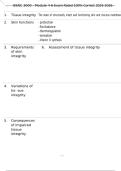
1. Tissue integrity The state of structurally intact and functioning skin and mucous membrane
2. Skin functions - protection
-fluid balance
-thermoregulation
-sensation
-Vitamin D synthesis
3. Requirements 6. Assessment of tissue integrity
of skin
integrity
4. Variations of
tis- sue
integrity
5. Consequences
of impaired
tissue
integrity
, BSNC 3000 - Module 4-6 Exam Rated 100% Correct 2025-2026
-good nutrition and hydration
-adequate GE and perfusion
mobility
-mobility
-good hygiene
-healthy immune function
-lack of trauma
-sensory perception
-trauma/injury
-loss of perfusion
-infection
-burns
-immunological reactions
-lesions
-infection
-impaired thermoregulation
-F and E imbalance
-pain/PSR
-impact on safety
-impaired body image
Skin assessment:
-intact
-CWMS
, BSNC 3000 - Module 4-6 Exam Rated 100% Correct 2025-2026
-skin turgor and texture
-inspect lesions
7. Healing - the replacement of injured tissue with newly formed living tissue
8. Types of healing - resolution
-regeneration
-repair (scar tissue, fibrosis)
9. Resolution - damaged cells are reversibly injured and recover
10. Regeneration - damaged cells are replaced by the division of remaining viable cells of the
same type
-e.g., viral hepatitis
11. Repair - damaged cells are replaced by scar tissue
12. Regenerative ischemia and injury
ca- pacity of
cells
13. Healing in
zone of
infarction
14. Healing in
zone of
, BSNC 3000 - Module 4-6 Exam Rated 100% Correct 2025-2026
Depends on the cell type: hepatocyte): normally don't divide but can when needed Heal by
-Labile cell: regularly divide
(regenerate) throughout life repair: cardiac muscle cells have a very limited capacity to divide
-Permanent cell (e.g., neuron):
not capable of cell division
-Stable cell (e.g., Heal by resolution: ischemic or injured cells recover
1. Tissue integrity The state of structurally intact and functioning skin and mucous membrane
2. Skin functions - protection
-fluid balance
-thermoregulation
-sensation
-Vitamin D synthesis
3. Requirements 6. Assessment of tissue integrity
of skin
integrity
4. Variations of
tis- sue
integrity
5. Consequences
of impaired
tissue
integrity
, BSNC 3000 - Module 4-6 Exam Rated 100% Correct 2025-2026
-good nutrition and hydration
-adequate GE and perfusion
mobility
-mobility
-good hygiene
-healthy immune function
-lack of trauma
-sensory perception
-trauma/injury
-loss of perfusion
-infection
-burns
-immunological reactions
-lesions
-infection
-impaired thermoregulation
-F and E imbalance
-pain/PSR
-impact on safety
-impaired body image
Skin assessment:
-intact
-CWMS
, BSNC 3000 - Module 4-6 Exam Rated 100% Correct 2025-2026
-skin turgor and texture
-inspect lesions
7. Healing - the replacement of injured tissue with newly formed living tissue
8. Types of healing - resolution
-regeneration
-repair (scar tissue, fibrosis)
9. Resolution - damaged cells are reversibly injured and recover
10. Regeneration - damaged cells are replaced by the division of remaining viable cells of the
same type
-e.g., viral hepatitis
11. Repair - damaged cells are replaced by scar tissue
12. Regenerative ischemia and injury
ca- pacity of
cells
13. Healing in
zone of
infarction
14. Healing in
zone of
, BSNC 3000 - Module 4-6 Exam Rated 100% Correct 2025-2026
Depends on the cell type: hepatocyte): normally don't divide but can when needed Heal by
-Labile cell: regularly divide
(regenerate) throughout life repair: cardiac muscle cells have a very limited capacity to divide
-Permanent cell (e.g., neuron):
not capable of cell division
-Stable cell (e.g., Heal by resolution: ischemic or injured cells recover