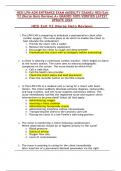
EVOLVE ELSEVIER HESI MED SURG EXAM
LATEST (2025) COMPLETE QUESTIONS
With 100% Verified Solutions||EVOLVE
ELSEVIER HESI MED SURG EXAM LATEST
(2025)
HESI med surg evolve
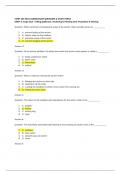
When educating a client after a total laryngectomy, which instruction would be most important for the
nurse to include in the discharge teaching?
A. Recommend that the client carry suction equipment at all times.
B. Instruct the client to have writing materials with him at all times.
C. Tell the client to carry a medical alert card that explains his condition.
D. Caution the client not to travel outside the United States alone.
C
Rationale: Neck breathers carry a medical alert card that notifies health care personnel of the need to
use mouth to stoma breathing in the event of a cardiac arrest in this client. Mouth to mouth resuscitation
will not establish a patent airway. Options A and D are not necessary. There are many alternative means
of communication for clients who have had a laryngectomy; dependence on writing messages is probably
the least effective.
The nurse receives the client's next scheduled bag of TPN labeled with the additive NPH insulin. Which
action should the nurse implement?
A. Hang the solution at the current rate.
B. Refrigerate the solution until needed.
C.Prepare the solution with new tubing.
D.Return the solution to the pharmacy.
D
Rationale: Only regular insulin is administered by the IV route, so the TPN solution containing NPH
insulin should be returned to the pharmacy. Options A, B, and C are not indicated because the solution
should not be administered.
,A postoperative client receives a Schedule II opioid analgesic for pain. Which assessment finding requires
the most immediate intervention by the nurse?
A. Hypoactive bowel sounds with abdominal distention
B. Client reports continued pain of 8 on a 10-point scale
C. Respiratory rate of 12 breaths/min, with O2 saturation of 85%
D. Client reports nausea after receiving the medication
C
Rationale: Administration of a Schedule II opioid analgesic can result in respiratory depression, which
requires immediate intervention by the nurse to prevent respiratory arrest. Options A, B, and D require
action by the nurse but are of less priority than option C.
A client is placed on a mechanical ventilator following a cerebral hemorrhage, and vecuronium bromide,
0.04 mg/kg every 12 hours IV, is prescribed. What is the priority nursing diagnosis for this client?
A. Impaired communication related to paralysis of skeletal muscles
B. High risk for infection related to increased intracranial pressure
C. Potential for injury related to impaired lung expansion
D. Social isolation related to inability to communicate
A
Rationale:To increase the client's tolerance of endotracheal intubation and/or mechanical ventilation, a
skeletal muscle relaxant such as vecuronium is usually prescribed. Option A is a serious outcome
because the client cannot communicate his or her needs. Although this client might also experience
option D, it is not a priority when compared with option A. Infection is not related to increased intracranial
pressure. The respirator will ensure that the lungs are expanded, so option C is incorrect.
A family member was taught to suction a client's tracheostomy prior to the client's discharge from the
hospital. Which observation by the nurse indicates that the family member is capable of correctly
performing the suctioning technique?
A. Turns on the continuous wall suction to 190 mm Hg.
B. Inserts the catheter until resistance or coughing occurs.
C. Withdraws the catheter while maintaining suctioning.
D. Reclears the tracheostomy after suctioning the mouth.
B
Rationale:Option B indicates correct technique for performing suctioning. Suction pressure should be
between 80 and 120 mm Hg, not 190 mm Hg. The catheter should be withdrawn 1 to 2 cm at a time with
,intermittent, not continuous, suction. Option D introduces pathogens unnecessarily into the
tracheobronchial tree.
A client is diagnosed with an acute small bowel obstruction. Which assessment finding requires the most
immediate intervention by the nurse?
A. Fever of 102° F
B. Blood pressure of 150/90 mm Hg
C. Abdominal cramping
D. Dry mucous membranes
A
Rationale:A sudden increase in temperature is an indicator of peritonitis. The nurse should notify the
health care provider immediately. Options B, C, and D are also findings that require intervention by the
nurse but are of less priority than option A. Option B may indicate a hypertensive condition but is not as
acute a condition as peritonitis. Option C is an expected finding in clients with small bowel obstruction and
may require medication. Option D indicates probable fluid volume deficit, which requires fluid volume
replacement.
In assessing a client diagnosed with primary aldosteronism, the nurse expects the laboratory test results
to indicate a decreased serum level of which substance?
A. Sodium
B. Phosphate
C. Potassium
D. Glucose
C
Rationale: Clients with primary aldosteronism exhibit a profound decline in serum levels of potassium;
hypokalemia; hypertension is the most prominent and universal sign. The serum sodium level is normal or
elevated, depending on the amount of water resorbed with the sodium. Option B is influenced by
parathyroid hormone (PTH). Option D is not affected by primary aldosteronism.
During assessment of a client in the intensive care unit, the nurse notes that the client's breath sounds
are clear on auscultation, but jugular vein distention and muffled heart sounds are present. Which
intervention should the nurse implement?
A. Prepare the client for a pericardial tap.
B. Administer intravenous furosemide (Lasix).
, C. Assist the client to cough and breathe deeply.
D. Instruct the client to restrict oral fluid intake.
A
Rationale: The client is exhibiting symptoms of cardiac tamponade, a collection of fluid in the pericardial
sac that results in a reduction in cardiac output, which is a potentially fatal complication of pericarditis.
Treatment for tamponade is a pericardial tap. Lasix IV is not indicated for treatment of pericarditis.
Because the client's breath sounds are clear, option C is not a priority. Fluids are frequently increased in
the initial treatment of tamponade to compensate for the decrease in cardiac output, but this is not the
same priority as option A.
A central venous catheter has been inserted via a jugular vein, and a radiograph has confirmed
placement of the catheter. A prescription has been received for a medication STAT, but IV fluids have not
yet been started. Which action should the nurse take prior to administering the prescribed medication?
A. Assess for signs of jugular venous distention.
B. Obtain the needed intravenous solution.
C. Flush the line with heparinized solution.
D. Flush the line with normal saline.
D
Rationale:Medication can be administered via a central line without additional IV fluids. The line should
first be flushed with a normal saline solution to ensure patency. Insufficient evidence exists on the
effectiveness of flushing catheters with heparin. Option A will not affect the decision to administer the
medication and is not a priority. Administration of the medication STAT is of greater priority than option B.
Which data would the nurse expect to find when reviewing laboratory values of an 80-year-old man who is
in good health overall?
A. Complete blood count reveals increased white blood cell (WBC) and decreased red blood cell (RBC)
counts.
B. Chemistries reveal an increased serum bilirubin level with slightly increased liver enzyme levels.
C. Urinalysis reveals slight protein in the urine and bacteriuria, with pyuria.
D. Serum electrolytes reveal a decreased sodium level and increased potassium level.
C
Rationale: In older adults, the protein found in urine slightly rises, probably as a result of kidney changes
or subclinical urinary tract infections, and clients frequently experience asymptomatic bacteriuria and
LATEST (2025) COMPLETE QUESTIONS
With 100% Verified Solutions||EVOLVE
ELSEVIER HESI MED SURG EXAM LATEST
(2025)
HESI med surg evolve
When educating a client after a total laryngectomy, which instruction would be most important for the
nurse to include in the discharge teaching?
A. Recommend that the client carry suction equipment at all times.
B. Instruct the client to have writing materials with him at all times.
C. Tell the client to carry a medical alert card that explains his condition.
D. Caution the client not to travel outside the United States alone.
C
Rationale: Neck breathers carry a medical alert card that notifies health care personnel of the need to
use mouth to stoma breathing in the event of a cardiac arrest in this client. Mouth to mouth resuscitation
will not establish a patent airway. Options A and D are not necessary. There are many alternative means
of communication for clients who have had a laryngectomy; dependence on writing messages is probably
the least effective.
The nurse receives the client's next scheduled bag of TPN labeled with the additive NPH insulin. Which
action should the nurse implement?
A. Hang the solution at the current rate.
B. Refrigerate the solution until needed.
C.Prepare the solution with new tubing.
D.Return the solution to the pharmacy.
D
Rationale: Only regular insulin is administered by the IV route, so the TPN solution containing NPH
insulin should be returned to the pharmacy. Options A, B, and C are not indicated because the solution
should not be administered.
,A postoperative client receives a Schedule II opioid analgesic for pain. Which assessment finding requires
the most immediate intervention by the nurse?
A. Hypoactive bowel sounds with abdominal distention
B. Client reports continued pain of 8 on a 10-point scale
C. Respiratory rate of 12 breaths/min, with O2 saturation of 85%
D. Client reports nausea after receiving the medication
C
Rationale: Administration of a Schedule II opioid analgesic can result in respiratory depression, which
requires immediate intervention by the nurse to prevent respiratory arrest. Options A, B, and D require
action by the nurse but are of less priority than option C.
A client is placed on a mechanical ventilator following a cerebral hemorrhage, and vecuronium bromide,
0.04 mg/kg every 12 hours IV, is prescribed. What is the priority nursing diagnosis for this client?
A. Impaired communication related to paralysis of skeletal muscles
B. High risk for infection related to increased intracranial pressure
C. Potential for injury related to impaired lung expansion
D. Social isolation related to inability to communicate
A
Rationale:To increase the client's tolerance of endotracheal intubation and/or mechanical ventilation, a
skeletal muscle relaxant such as vecuronium is usually prescribed. Option A is a serious outcome
because the client cannot communicate his or her needs. Although this client might also experience
option D, it is not a priority when compared with option A. Infection is not related to increased intracranial
pressure. The respirator will ensure that the lungs are expanded, so option C is incorrect.
A family member was taught to suction a client's tracheostomy prior to the client's discharge from the
hospital. Which observation by the nurse indicates that the family member is capable of correctly
performing the suctioning technique?
A. Turns on the continuous wall suction to 190 mm Hg.
B. Inserts the catheter until resistance or coughing occurs.
C. Withdraws the catheter while maintaining suctioning.
D. Reclears the tracheostomy after suctioning the mouth.
B
Rationale:Option B indicates correct technique for performing suctioning. Suction pressure should be
between 80 and 120 mm Hg, not 190 mm Hg. The catheter should be withdrawn 1 to 2 cm at a time with
,intermittent, not continuous, suction. Option D introduces pathogens unnecessarily into the
tracheobronchial tree.
A client is diagnosed with an acute small bowel obstruction. Which assessment finding requires the most
immediate intervention by the nurse?
A. Fever of 102° F
B. Blood pressure of 150/90 mm Hg
C. Abdominal cramping
D. Dry mucous membranes
A
Rationale:A sudden increase in temperature is an indicator of peritonitis. The nurse should notify the
health care provider immediately. Options B, C, and D are also findings that require intervention by the
nurse but are of less priority than option A. Option B may indicate a hypertensive condition but is not as
acute a condition as peritonitis. Option C is an expected finding in clients with small bowel obstruction and
may require medication. Option D indicates probable fluid volume deficit, which requires fluid volume
replacement.
In assessing a client diagnosed with primary aldosteronism, the nurse expects the laboratory test results
to indicate a decreased serum level of which substance?
A. Sodium
B. Phosphate
C. Potassium
D. Glucose
C
Rationale: Clients with primary aldosteronism exhibit a profound decline in serum levels of potassium;
hypokalemia; hypertension is the most prominent and universal sign. The serum sodium level is normal or
elevated, depending on the amount of water resorbed with the sodium. Option B is influenced by
parathyroid hormone (PTH). Option D is not affected by primary aldosteronism.
During assessment of a client in the intensive care unit, the nurse notes that the client's breath sounds
are clear on auscultation, but jugular vein distention and muffled heart sounds are present. Which
intervention should the nurse implement?
A. Prepare the client for a pericardial tap.
B. Administer intravenous furosemide (Lasix).
, C. Assist the client to cough and breathe deeply.
D. Instruct the client to restrict oral fluid intake.
A
Rationale: The client is exhibiting symptoms of cardiac tamponade, a collection of fluid in the pericardial
sac that results in a reduction in cardiac output, which is a potentially fatal complication of pericarditis.
Treatment for tamponade is a pericardial tap. Lasix IV is not indicated for treatment of pericarditis.
Because the client's breath sounds are clear, option C is not a priority. Fluids are frequently increased in
the initial treatment of tamponade to compensate for the decrease in cardiac output, but this is not the
same priority as option A.
A central venous catheter has been inserted via a jugular vein, and a radiograph has confirmed
placement of the catheter. A prescription has been received for a medication STAT, but IV fluids have not
yet been started. Which action should the nurse take prior to administering the prescribed medication?
A. Assess for signs of jugular venous distention.
B. Obtain the needed intravenous solution.
C. Flush the line with heparinized solution.
D. Flush the line with normal saline.
D
Rationale:Medication can be administered via a central line without additional IV fluids. The line should
first be flushed with a normal saline solution to ensure patency. Insufficient evidence exists on the
effectiveness of flushing catheters with heparin. Option A will not affect the decision to administer the
medication and is not a priority. Administration of the medication STAT is of greater priority than option B.
Which data would the nurse expect to find when reviewing laboratory values of an 80-year-old man who is
in good health overall?
A. Complete blood count reveals increased white blood cell (WBC) and decreased red blood cell (RBC)
counts.
B. Chemistries reveal an increased serum bilirubin level with slightly increased liver enzyme levels.
C. Urinalysis reveals slight protein in the urine and bacteriuria, with pyuria.
D. Serum electrolytes reveal a decreased sodium level and increased potassium level.
C
Rationale: In older adults, the protein found in urine slightly rises, probably as a result of kidney changes
or subclinical urinary tract infections, and clients frequently experience asymptomatic bacteriuria and