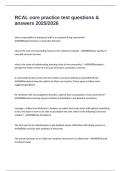
HESI Exit RN EXIT EXAM
HESI Exit RN EXIT EXAM 1 Version 4 Complete
160 Recent Questions and Correct Verified
Answers/ RN Hesi Exit Exam V4 for the RN
Hesi Exit Prep (New!)
Which interventions should the nurse include in a long-term plan of care for a client with COPD?
a- Reduce risk factors for infection
b- Administer high flow oxygen during sleep
c- Limit fluid intake to reduce secretions
d- Use diaphragmatic breathing to achieve better exhalation
a. Reduce risk factors for infection
Rationale: Interventions aimed at reducing the risk factors of infections should be included in the
plan of care COPD client are at particular risk for respiratory infection. Prevention and early
detection of infections are necessary
Following a motor vehicle collision, an adult female with a ruptured spleen and a blood pressure
of 70/44, had an emergency splenectomy. Twelve hours after the surgery, her urine output is 25
A+ TEST BANK 1
, HESI Exit RN EXIT EXAM
ml/hour for the last two hours. What pathophysiological reason supports the nurse's decision to
report this finding to the healthcare provider
a. This output is not sufficient to cleat nitrogenous waste
b. Oliguria signals tubular necrosis related to hypoperfusion
c. Low urine output puts the client at risk for fluid overload
d. An increased urine output is expected after splenectomy
Oliguria signals tubular necrosis related to hypoperfusion
Rationale: Prolonged low blood pressure leads to renal ischemia, which is the common etiology
of acute tubular necrosis(ATN) Decreasing urine output is an early indicator of ATN.
A nurse-manager is preparing the curricula for a class for charge nurses. A staffing formula based
on what data ensures quality client care and is most cost-effective?
a. Client geographic location and age
b. Number of staff and number of clients
c. Weekend and weekday staff availability
d. Skills of staff and client acuity
Skills of staff and client acuity
When performing postural drainage on a client with Chronic Obstructive Pulmonary Disease
(COPD), which approach should the nurse use?
a. Perform the drainage immediately after meals
b. Instruct the client to breath shallow and fast
c. Obtain arterial blood gases (ABG's) prior to procedure
d. Explain that the client may be placed in five positions
Explain that the client may be placed in five positions
Rationale: Frequently, the client is placed in five positions (head down, prone, right and left
lateral, and sitting upright) to aid in drainage of each of the five lobes of the lungs (D). Postural
drainage should be performed before meals to prevent nausea, vomiting and aspiration(A). The
client should breath slow and exhale through pursed lips to help keep airway open so that
secretions can be drained while assuming the various positions. C is not required
A client presents in the emergency room with right-sided facial asymmetry. The nurse asks the
client to perform a series of movements that require use of the facial muscles. What symptoms
A+ TEST BANK 2
, HESI Exit RN EXIT EXAM
suggest that the client has most likely experience a Bell's palsy rather than a stroke?
a. Slow onset of facial drooping associated with headache
b. Inability to close the affected eye, raise brow, or smile
c. A flat nasolabial fold on the right resulting in facial asymmetry.
d. Drooling is present on right side of the mouth, but not on the left.
Inability to close the affected eye, raise brow, or smile
Rationale: Because the motor function controlling eye closure, brow movement and smiling are
all carried on the 7th cranial (facial) nerve, the combination of symptoms directly relating to an
impairment of all branches of the facial nerve indicate that Bell's palsy has occurred.
The nurse is teaching a client how to perform colostomy irrigations. When observing the client's
return demonstration, which action indicated that the client understood the teaching?
a. Turns to left the side to instill the irrigating solution into the stoma
b. Keeps the irrigating container less than 18 inches above the stoma
c. Instills 1,200 ml of irrigating solution to stimulate bowel evacuation
d. Inserts irrigating catheter deeper into stoma when cramping occurs
Keeps the irrigating container less than 18 inches above the stoma
Rationale: Keeping the irrigating container less than 18 inches above the stoma permits the
solution to flow slowly with little excessive peristalsis does not cause immediate release of stool.
The nurse should teach the client to observe which precaution while taking dronedarone?
a. Stay out of direct sunlight
b. Avoid grapefruits and its juice
c. Reduce the use of herbal supplements
d. Minimize sodium intake.
b. Avoid grapefruits and its juice
Rationale: Grapefruit increase the effect of dronedarone thereby increasing the possibility of
serious side effects. A does not cause a serious effect. C may potentiate lethal arrhythmias and
should be avoided. D does not directly affect those taking dronedarone.
A client who sustained a head injury following an automobile collision is admitted to the hospital.
The nurse include the client's risk for developing increased intracranial pressure (ICP) in the plan
of care. Which signs indicate to the nurse that ICP has increased?
A+ TEST BANK 3
, HESI Exit RN EXIT EXAM
a. Increased Glasgow coma scale score.
b. Nuchal rigidity and papilledema.
c. Confusion and papilledema
d. Periorbital ecchymosis.
Confusion and papilledema
Rationale: papilledema is always an indicator of increased ICP, and confusion is usually the first
sign of increased ICP. Other options do not necessarily reflect increased ICP.
The nurse is caring for a client receiving continuous IV fluids through a single lumen central
venous catheter (CVC). Based on the CVC care bundle, which action should be completed daily to
reduce the risk for infection?
a. Remind staff to follow protective environment precautions
b. Gently flush the catheter lumen with sterile saline solution
c. Cleanse the site and change the transparent dressing.
d. Confirm the necessity for continued use of the CVC.
Confirm the necessity for continued use of the CVC
Rationale: Increase the length of use increase the risk for infection. The CVC care bundle includes
the review of the need for continued use of the CVC. Effective hand hygiene and standard
precautions should be maintained but protective environment precautions are not needed. B is
not needed if continuous IV fluid are infused, ad may introduce contaminants. Use of a
transparent dressing allows the site to be visualized for any signs of infection but changing the
dressing daily increases the risk for infection.
During an annual physical examination, an older woman's fasting blood sugar (FBS) is
determined to be 140 mg/dl or 7.8 mmol/L (SI). Which additional finding obtained during a
follow-up visit 2 weeks later is most indicative that the client has diabetes mellitus (DM)?
a. An increased thirst with frequent urination
b. Blood glucose range during past two weeks was 110 to 125 mg/dl or 6.1 to 7.0 mmol/L(SI)
c. Two-hour postprandial glucose tolerance test (GTT) is 160 mg/dL or 8.9 mmol/L (SI)
d. Repeated fasting blood sugar (FBS) is 132 mg/dl or 7.4 mmol/L (SI).
Repeated fasting blood sugar (FBS) is 132 mg/dl or 7.4 mmol/L (SI).
A new mother tells the nurse that she is unsure if she will be able to transition into parenthood.
What action should the nurse take?
A+ TEST BANK 4
HESI Exit RN EXIT EXAM 1 Version 4 Complete
160 Recent Questions and Correct Verified
Answers/ RN Hesi Exit Exam V4 for the RN
Hesi Exit Prep (New!)
Which interventions should the nurse include in a long-term plan of care for a client with COPD?
a- Reduce risk factors for infection
b- Administer high flow oxygen during sleep
c- Limit fluid intake to reduce secretions
d- Use diaphragmatic breathing to achieve better exhalation
a. Reduce risk factors for infection
Rationale: Interventions aimed at reducing the risk factors of infections should be included in the
plan of care COPD client are at particular risk for respiratory infection. Prevention and early
detection of infections are necessary
Following a motor vehicle collision, an adult female with a ruptured spleen and a blood pressure
of 70/44, had an emergency splenectomy. Twelve hours after the surgery, her urine output is 25
A+ TEST BANK 1
, HESI Exit RN EXIT EXAM
ml/hour for the last two hours. What pathophysiological reason supports the nurse's decision to
report this finding to the healthcare provider
a. This output is not sufficient to cleat nitrogenous waste
b. Oliguria signals tubular necrosis related to hypoperfusion
c. Low urine output puts the client at risk for fluid overload
d. An increased urine output is expected after splenectomy
Oliguria signals tubular necrosis related to hypoperfusion
Rationale: Prolonged low blood pressure leads to renal ischemia, which is the common etiology
of acute tubular necrosis(ATN) Decreasing urine output is an early indicator of ATN.
A nurse-manager is preparing the curricula for a class for charge nurses. A staffing formula based
on what data ensures quality client care and is most cost-effective?
a. Client geographic location and age
b. Number of staff and number of clients
c. Weekend and weekday staff availability
d. Skills of staff and client acuity
Skills of staff and client acuity
When performing postural drainage on a client with Chronic Obstructive Pulmonary Disease
(COPD), which approach should the nurse use?
a. Perform the drainage immediately after meals
b. Instruct the client to breath shallow and fast
c. Obtain arterial blood gases (ABG's) prior to procedure
d. Explain that the client may be placed in five positions
Explain that the client may be placed in five positions
Rationale: Frequently, the client is placed in five positions (head down, prone, right and left
lateral, and sitting upright) to aid in drainage of each of the five lobes of the lungs (D). Postural
drainage should be performed before meals to prevent nausea, vomiting and aspiration(A). The
client should breath slow and exhale through pursed lips to help keep airway open so that
secretions can be drained while assuming the various positions. C is not required
A client presents in the emergency room with right-sided facial asymmetry. The nurse asks the
client to perform a series of movements that require use of the facial muscles. What symptoms
A+ TEST BANK 2
, HESI Exit RN EXIT EXAM
suggest that the client has most likely experience a Bell's palsy rather than a stroke?
a. Slow onset of facial drooping associated with headache
b. Inability to close the affected eye, raise brow, or smile
c. A flat nasolabial fold on the right resulting in facial asymmetry.
d. Drooling is present on right side of the mouth, but not on the left.
Inability to close the affected eye, raise brow, or smile
Rationale: Because the motor function controlling eye closure, brow movement and smiling are
all carried on the 7th cranial (facial) nerve, the combination of symptoms directly relating to an
impairment of all branches of the facial nerve indicate that Bell's palsy has occurred.
The nurse is teaching a client how to perform colostomy irrigations. When observing the client's
return demonstration, which action indicated that the client understood the teaching?
a. Turns to left the side to instill the irrigating solution into the stoma
b. Keeps the irrigating container less than 18 inches above the stoma
c. Instills 1,200 ml of irrigating solution to stimulate bowel evacuation
d. Inserts irrigating catheter deeper into stoma when cramping occurs
Keeps the irrigating container less than 18 inches above the stoma
Rationale: Keeping the irrigating container less than 18 inches above the stoma permits the
solution to flow slowly with little excessive peristalsis does not cause immediate release of stool.
The nurse should teach the client to observe which precaution while taking dronedarone?
a. Stay out of direct sunlight
b. Avoid grapefruits and its juice
c. Reduce the use of herbal supplements
d. Minimize sodium intake.
b. Avoid grapefruits and its juice
Rationale: Grapefruit increase the effect of dronedarone thereby increasing the possibility of
serious side effects. A does not cause a serious effect. C may potentiate lethal arrhythmias and
should be avoided. D does not directly affect those taking dronedarone.
A client who sustained a head injury following an automobile collision is admitted to the hospital.
The nurse include the client's risk for developing increased intracranial pressure (ICP) in the plan
of care. Which signs indicate to the nurse that ICP has increased?
A+ TEST BANK 3
, HESI Exit RN EXIT EXAM
a. Increased Glasgow coma scale score.
b. Nuchal rigidity and papilledema.
c. Confusion and papilledema
d. Periorbital ecchymosis.
Confusion and papilledema
Rationale: papilledema is always an indicator of increased ICP, and confusion is usually the first
sign of increased ICP. Other options do not necessarily reflect increased ICP.
The nurse is caring for a client receiving continuous IV fluids through a single lumen central
venous catheter (CVC). Based on the CVC care bundle, which action should be completed daily to
reduce the risk for infection?
a. Remind staff to follow protective environment precautions
b. Gently flush the catheter lumen with sterile saline solution
c. Cleanse the site and change the transparent dressing.
d. Confirm the necessity for continued use of the CVC.
Confirm the necessity for continued use of the CVC
Rationale: Increase the length of use increase the risk for infection. The CVC care bundle includes
the review of the need for continued use of the CVC. Effective hand hygiene and standard
precautions should be maintained but protective environment precautions are not needed. B is
not needed if continuous IV fluid are infused, ad may introduce contaminants. Use of a
transparent dressing allows the site to be visualized for any signs of infection but changing the
dressing daily increases the risk for infection.
During an annual physical examination, an older woman's fasting blood sugar (FBS) is
determined to be 140 mg/dl or 7.8 mmol/L (SI). Which additional finding obtained during a
follow-up visit 2 weeks later is most indicative that the client has diabetes mellitus (DM)?
a. An increased thirst with frequent urination
b. Blood glucose range during past two weeks was 110 to 125 mg/dl or 6.1 to 7.0 mmol/L(SI)
c. Two-hour postprandial glucose tolerance test (GTT) is 160 mg/dL or 8.9 mmol/L (SI)
d. Repeated fasting blood sugar (FBS) is 132 mg/dl or 7.4 mmol/L (SI).
Repeated fasting blood sugar (FBS) is 132 mg/dl or 7.4 mmol/L (SI).
A new mother tells the nurse that she is unsure if she will be able to transition into parenthood.
What action should the nurse take?
A+ TEST BANK 4