MDC4 Exam 2 2025 – Complete Study Guide & Practice
Topics Ace MDC4 Real Exam 2 – Key Concepts, Practice
Questions, and Strategies”
MDC4 REAL EXAM 2
Assessment — Expected laboratory values — stages
The extent of injury is related to age, general health, size and depth of burn, and the specific body area injured. Priorities of care are the prevention of
infection and closure of the burn wound.
Skin can regrow as long as parts of the dermis are present.
Metabolism increases to maintain body heat as a result of burn injury and tissue damage.
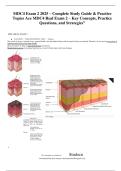
Superficial
partialthickness burns are those in
which the entire epidermis and
variable portions of the dermis
layer of skin are Epidermis
destroyed.
Uncomplicated
healing occurs in 10-
21 days.
Dermis
Deep partial-thickness
burns extend into the
deeper layers of the
dermis. Healing
occurs in 2-6 weeks.
1
This document is available on Studocu
Downloaded by denis munene ()
, Full-thickness burns
Epidermis reach through the
entire dermis and
sometimes into
the subcutaneous
fat.
Dermis The skin cannot heal on
its own.
Subcutaneous tissue
The amount of tissue integrity loss is related to the agent causing the burn, the temperature of the heat source, and how long the skin is exposed to it.
degree of burn= first, second, third, and fourth degree. degree of thickness= superficial or deep, with thickness designations.
Patients with major third-degree or fourth-degree (full-thickness) burns experience tissue destruction that leads to local and systemic problems
affecting fluid and electrolyte balance and changes in metabolic. endocrine. respiratory. cardiac. hematologic. and immune functioning.
Electrical injuries— iceberg effect: the surface injuries may look small, but the associated internal injuries can be significant.
Hot water heaters should be set below 120 0F (49 0C).
Inhalation damage findings include singed nasal hair, eyebrows, and eyelashes; sooty sputum; hoarseness; wheezing; edema of the nasal septum; and
smoky smelling breath. Indications of the impending loss of the airway include hoarseness, brassy cough, drooling or difficulty swallowing, and audible
wheezing, crowing, and stridor.
Carbon monoxide inhalation (from burns in an enclosed area) findings include headache weakness dizziness confusion, erythema (pink or cherry red
skin), and upper airway edema, followed by sloughing of the respiratory tract mucosa.
Hypovolemia and shock can result from fluid shifts from the intercellular and intravascular space to the interstitial space. Additional findings include
hypotension, tachycardia, and decreased cardiac output.
Classification of Burn Depth
Damage Appearance Edema Blistering Pain Eschar Method of Healing Healing Time
Superficial
Superficial first-degree burns Above basal layer of Dry No No Yes No Injured epidermis peels away; About 1 wk
epidermis Pink to red reveals new epidermis
Superficial second-degree Into dermis Moist Mild to Yes Yes No Re-epithelialization from skin About 2 wk
burns (superficial Red moderate (much) adnexa
partialthickness)
Blanching
Blistering
Deep
Deep second-degree burns Deeper into dermis Less moist Moderate Some Yes, soft Scar deposition, contraction, 2-6 wk
(deep partial-thickness) Less blanching and dry limited re-epithelialization; may
need grafting
Less painful
Third-degree burns Entire thickness Any color (black, Severe No No Yes, hard Contraction and scar deposition; Weeks to
(fullthickness) of skin red, yellow, and requires grafting months
destroyed,
brown, white) inelastic
into fat
Dry
Fourth-degree burns Damage extends Black Severe No No Yes Need specialized care; grafting does Weeks to
into muscle, not work months, if
tendon, bone
at all
Laboratory tests
Resuscitation phase Initial fluid shift (occurs in the first 12 hr and continues for 24 to 36 hr) after the burn injury with peak approximately 6 to 8
hours after the burn injury.
Hct and Hgb: elevated (hemoconcentration) due to the loss of fluid volume and the fluid shift into the interstitial space
(third spacing) Glucose: elevated due to stress BUN: elevated due to fluid loss Electrolytes o
Sodium: decreased due to third spacing (hyponatremia) o Potassium: increased due to cell destruction (hyperkalemia) o
2
, Chloride: increased due to fluid volume loss and chlorine reabsorption in urine Carboxyhemoglobin: more
than 10% strongly indicates smoke inhalation Plasma lactate: elevated if the client has cyanide toxicity.
Other: total protein and blood albumin (decreased), ABGs liver enzyme alterations due to
hepatic edema, apoptosis and insulin resistance, urinalysis, and clotting studies (rare decrease in platelets and prolonged
clotting times in severe burns)
Fluid remobilization (starts at about 24 hr; diuretic stage begins at 48 to 72 hr after injury).
Hgb and Hct: decreased (hemodilution) due to the fluid shift from the interstitial space back into vascular fluid.
Sodium: remains decreased due to renal and wound loss
Potassium: decreased due to renal loss and movement back into cells (hypokalemia) WBC count: initial increase
then decrease with left shift.
Blood glucose: elevated due to the stress response ABGs: slight hypoxemia and metabolic acidosis
Total protein and albumin: low due to fluid loss
Treatment — Fluids - skin grafts - Fluid overload S&S inhalation injury— administer oxygen and keep emergency airway equipment near
the bedside: oxygen, masks, cannulas, manual resuscitation bags, laryngoscope, endotracheal tubes, and equipment for tracheostomy in case
of emergency. Pain control. Medicate at least 30 mins prior to dressing changes.
tetanus vaccination = if the patient has not had one in the past 10 years.
compression garment may be applied to prevent contractures and tight hypertrophic scars. These garments also inhibit venous stasis and edema in areas
with decreased lymph flow.
Indirect calorimetry can help determine calorie needs (on admission to a burn center and weekly).
Evaluation of burn depth using indocyanine green video angiography and laser Doppler imaging. Thermography is not as reliable.
Fluid replacement
Third spacing (capillary leak syndrome) is a continuous leak of plasma from the vascular space into the interstitial space, which results in
electrolyte imbalance and hypotension.
Initiate IV access using a large-bore needle. If burns cover a large area of the body, the client requires insertion of a central venous catheter
or intraosseous catheter.
Fluid resuscitation meets individual clients' needs (TBSA of burn, burn depth, inhalation injury, associated injuries, age, urine output, cardiac
output, blood pressure, status of electrolytes).
Administer half of the total 24-hr IV fluid volume within the first 8 hr from the time the burn occurred and the remaining volume over the
next 16 hr.
Infuse isotonic crystalloid solutions (0.9% sodium chloride or lactated Ringer's).
Infuse colloid solutions (albumin or synthetic plasma expanders) after the first 24 hr of burn recovery.
Monitor vital signs.
Assess for fluid overload: edema, engorged neck veins, rapid and thready pulse, lung crackles, wheezes.
Weight the client daily.
Monitor urine hourly for color, specific gravity, protein, and to ensure output of 30 mL/hr (0.5 mL/kg/hr).
Prepare to administer blood products. Monitor for manifestations of shock.
Alterations in sensorium (confusion) o Increased capillary refill time o Urine output less than 30 mL/hr o Rapid elevations of temperature o
Decreased bowel sounds o Blood pressure average or low
If urine output is below the expected reference range, request a prescription to increase fluid replacement, and do not administer diuretics.
Urinary system= Glycosuria is expected due to breakdown of glycogen as part of the stress response.
Restrict plants and flowers due to the risk of contact with Pseudomonas aeruginosa. Use client-dedicated equipment (blood pressure cuffs,
thermometers).
Nutrition= loss of or > of body weight= need for additional calorie intake. Large burn areas= hypermetabolic state, requiring 5,000 calories/day. Caloric
needs double or triple 4-12 days after the burn. Increase protein & carbs to decrease protein catabolism.
Burn grafts:
Biologic skin coverings temporarily promote healing of large burns. Additionally, biologic skin coverings promote the retention of water and protein
and provide coverage of nerve endings, thus reducing pain. The provider stipulates whether to leave skin coverings open or protect them with a
dressing.
Allograft (homograft): Skin donations from human cadavers for partial- and full-thickness burn wounds.
Xenograft (heterograft): Skin from animals (pigs) for partial thickness burn wounds.
Amnion: From human placenta; requires frequent changes
3
This document is available on Studocu
Downloaded by denis munene ()
, Artificial skin: Two layers of skin made from beef collagen and shark cartilage.
Wound grafting can be the treatment of choice for burns covering large areas of the body.
Autografts: Skin from another area of the client's body o Sheet graft: Sheet of skin for covering the wound.
Mesh graft: Sheet of skin in which a mesher has created small slits, so the graft can stretch over large areas of the burn.
Artificial skin: Synthetic product for faster healing of partial- and full-thickness burns
Cultured epithelium: Epithelial cells to use for clients who have few grafting sites; biopsies are taken from client's unburned skin and small
sheets of skin are grown.
Nurse
Maintain immobilization of graft sites.
Elevate extremities.
Provide wound care to the donor site.
Administer analgesics.
Monitor for infection before and after applying skin coverings or grafts. o Discoloration of unburned skin surrounding burn wound o Green
subcutaneous fat o Degeneration of granulation tissue o Development of subeschar hemorrhage o Hyperventilation indicating systemic
involvement of infection. o Unstable body temperature
Determine the client's level of pain and provide additional measures to control donor site pain.
continue range-of-motion exercises & work with PT to prevent contractions, observe & report infection. Wear compression dressings and
garments as prescribed (usually 23 hr daily) to minimize scarring and prevent difficulty with mobility. Massage scar with moisturizers daily.
Clothing= not tight, best= loose dye-free fabric.
Phase of Burn Injury management — Emergent/Resuscitative Phase, Acute Phase, Rehabilitative Phase
The emergent (resuscitation) phase of a burn Injury begins at the onset of injury and continues for about 24 to 48 hours. Ends with gQDEti.tiQ.n_QL
fluid resuscitation. Priorities= (1) securing the airway, (2) supporting circulation and perfusion, (3) maintaining body temperature, (4) keeping the
patient comfortable with analgesics, and (5) providing emotional support, & preventing infection through wound care.
Inhalation injuries= inspect the mouth, nose, and pharynx. Indications of inhalation injury= Facial burns and singed hair, eyebrows, and /or eyelashes,
black carbon particles in the nose, mouth, and sputum and edema of the nasal septum, smoky breath smell. drooling, or difficulty swallowing may
indicate a pulmonary injury and impairment of gas exchange. Listen for hoarseness, cough, wheezes, and stridor. Place the patient upright, apply
oxygen, and report to the Dr.
Upper airway edema and inhalation injury are most common in the trachea and mainstem bronchi= Auscultation of these areas may reveal wheezes,
which indicate partial obstruction impairing gas exchange. Severe inhalation injury= rapid obstruction= wheezing disappears= airway obstruction and
demands immediate intubation. Many patients are intubated when an inhalation injury is first suspected.
Assess for pulmonary edema= elevating the head of the bed to at least 45 degrees, applying oxygen, and notifying the burn team or the Rapid Response
Team.
The acute (healing) phase ofburn injury begins about 36 to 48 (AT1=48-72 hr) hours after injury, when the fluid shift resolves, and lasts until wound
closure is complete. continued assessment and maintenance of the cardiovascular and respiratory systems, as well as toward nutrition status, burn
wound care to preserve tissue integrity, pain control, and psychosocial interventions.
the technical rehabilitative (restorative) phase begins with wound closure and ends when the patient achieves his or her highest level of functioning.
psychosocial adjustment of the patient, the prevention of scars and contractures, and the resumption of preburn activity, including resuming work,
family, and social roles. May take years or a lifetime.
Minor burns
Provide analgesics.
Cleanse with mild soap and tepid water. (Avoid excess friction.) Use antimicrobial ointment.
Apply a dressing (nonadherent, hydrocolloid) if clothing is irritating the burn.
Educate the family to avoid using greasy lotions or butter on the burn.
Teach the family to observe for evidence of infection. Determine the need for a tetanus immunization.
Moderate & major burns
During the initial (resuscitation) phase (from the time of injury to up to 48 hr later) following a major burn, sympathetic nervous system manifestations
(tachycardia, increased respiratory rate, decreased gastrointestinal motility, increased blood glucose) are expected findings.
Respiratory system
Assess respiratory rate and depth. Monitor chest expansion for restricted movements.
Upper airway edema becomes pronounced 8 to 12 hr after the beginning of fluid resuscitation. Crowing. stridor. or dyspnea requires nasal or
oral intubation.
Provide humidified supplemental oxygen.
Support the airway and ventilation. Mechanical ventilation and paralytic medications (atracurium or vecuronium) = if the Pa02 is less than
60 mm Hg. A tracheotomy = when long-term intubation is expected.
Monitor and maintain chest tubes.
4
Topics Ace MDC4 Real Exam 2 – Key Concepts, Practice
Questions, and Strategies”
MDC4 REAL EXAM 2
Assessment — Expected laboratory values — stages
The extent of injury is related to age, general health, size and depth of burn, and the specific body area injured. Priorities of care are the prevention of
infection and closure of the burn wound.
Skin can regrow as long as parts of the dermis are present.
Metabolism increases to maintain body heat as a result of burn injury and tissue damage.
Superficial
partialthickness burns are those in
which the entire epidermis and
variable portions of the dermis
layer of skin are Epidermis
destroyed.
Uncomplicated
healing occurs in 10-
21 days.
Dermis
Deep partial-thickness
burns extend into the
deeper layers of the
dermis. Healing
occurs in 2-6 weeks.
1
This document is available on Studocu
Downloaded by denis munene ()
, Full-thickness burns
Epidermis reach through the
entire dermis and
sometimes into
the subcutaneous
fat.
Dermis The skin cannot heal on
its own.
Subcutaneous tissue
The amount of tissue integrity loss is related to the agent causing the burn, the temperature of the heat source, and how long the skin is exposed to it.
degree of burn= first, second, third, and fourth degree. degree of thickness= superficial or deep, with thickness designations.
Patients with major third-degree or fourth-degree (full-thickness) burns experience tissue destruction that leads to local and systemic problems
affecting fluid and electrolyte balance and changes in metabolic. endocrine. respiratory. cardiac. hematologic. and immune functioning.
Electrical injuries— iceberg effect: the surface injuries may look small, but the associated internal injuries can be significant.
Hot water heaters should be set below 120 0F (49 0C).
Inhalation damage findings include singed nasal hair, eyebrows, and eyelashes; sooty sputum; hoarseness; wheezing; edema of the nasal septum; and
smoky smelling breath. Indications of the impending loss of the airway include hoarseness, brassy cough, drooling or difficulty swallowing, and audible
wheezing, crowing, and stridor.
Carbon monoxide inhalation (from burns in an enclosed area) findings include headache weakness dizziness confusion, erythema (pink or cherry red
skin), and upper airway edema, followed by sloughing of the respiratory tract mucosa.
Hypovolemia and shock can result from fluid shifts from the intercellular and intravascular space to the interstitial space. Additional findings include
hypotension, tachycardia, and decreased cardiac output.
Classification of Burn Depth
Damage Appearance Edema Blistering Pain Eschar Method of Healing Healing Time
Superficial
Superficial first-degree burns Above basal layer of Dry No No Yes No Injured epidermis peels away; About 1 wk
epidermis Pink to red reveals new epidermis
Superficial second-degree Into dermis Moist Mild to Yes Yes No Re-epithelialization from skin About 2 wk
burns (superficial Red moderate (much) adnexa
partialthickness)
Blanching
Blistering
Deep
Deep second-degree burns Deeper into dermis Less moist Moderate Some Yes, soft Scar deposition, contraction, 2-6 wk
(deep partial-thickness) Less blanching and dry limited re-epithelialization; may
need grafting
Less painful
Third-degree burns Entire thickness Any color (black, Severe No No Yes, hard Contraction and scar deposition; Weeks to
(fullthickness) of skin red, yellow, and requires grafting months
destroyed,
brown, white) inelastic
into fat
Dry
Fourth-degree burns Damage extends Black Severe No No Yes Need specialized care; grafting does Weeks to
into muscle, not work months, if
tendon, bone
at all
Laboratory tests
Resuscitation phase Initial fluid shift (occurs in the first 12 hr and continues for 24 to 36 hr) after the burn injury with peak approximately 6 to 8
hours after the burn injury.
Hct and Hgb: elevated (hemoconcentration) due to the loss of fluid volume and the fluid shift into the interstitial space
(third spacing) Glucose: elevated due to stress BUN: elevated due to fluid loss Electrolytes o
Sodium: decreased due to third spacing (hyponatremia) o Potassium: increased due to cell destruction (hyperkalemia) o
2
, Chloride: increased due to fluid volume loss and chlorine reabsorption in urine Carboxyhemoglobin: more
than 10% strongly indicates smoke inhalation Plasma lactate: elevated if the client has cyanide toxicity.
Other: total protein and blood albumin (decreased), ABGs liver enzyme alterations due to
hepatic edema, apoptosis and insulin resistance, urinalysis, and clotting studies (rare decrease in platelets and prolonged
clotting times in severe burns)
Fluid remobilization (starts at about 24 hr; diuretic stage begins at 48 to 72 hr after injury).
Hgb and Hct: decreased (hemodilution) due to the fluid shift from the interstitial space back into vascular fluid.
Sodium: remains decreased due to renal and wound loss
Potassium: decreased due to renal loss and movement back into cells (hypokalemia) WBC count: initial increase
then decrease with left shift.
Blood glucose: elevated due to the stress response ABGs: slight hypoxemia and metabolic acidosis
Total protein and albumin: low due to fluid loss
Treatment — Fluids - skin grafts - Fluid overload S&S inhalation injury— administer oxygen and keep emergency airway equipment near
the bedside: oxygen, masks, cannulas, manual resuscitation bags, laryngoscope, endotracheal tubes, and equipment for tracheostomy in case
of emergency. Pain control. Medicate at least 30 mins prior to dressing changes.
tetanus vaccination = if the patient has not had one in the past 10 years.
compression garment may be applied to prevent contractures and tight hypertrophic scars. These garments also inhibit venous stasis and edema in areas
with decreased lymph flow.
Indirect calorimetry can help determine calorie needs (on admission to a burn center and weekly).
Evaluation of burn depth using indocyanine green video angiography and laser Doppler imaging. Thermography is not as reliable.
Fluid replacement
Third spacing (capillary leak syndrome) is a continuous leak of plasma from the vascular space into the interstitial space, which results in
electrolyte imbalance and hypotension.
Initiate IV access using a large-bore needle. If burns cover a large area of the body, the client requires insertion of a central venous catheter
or intraosseous catheter.
Fluid resuscitation meets individual clients' needs (TBSA of burn, burn depth, inhalation injury, associated injuries, age, urine output, cardiac
output, blood pressure, status of electrolytes).
Administer half of the total 24-hr IV fluid volume within the first 8 hr from the time the burn occurred and the remaining volume over the
next 16 hr.
Infuse isotonic crystalloid solutions (0.9% sodium chloride or lactated Ringer's).
Infuse colloid solutions (albumin or synthetic plasma expanders) after the first 24 hr of burn recovery.
Monitor vital signs.
Assess for fluid overload: edema, engorged neck veins, rapid and thready pulse, lung crackles, wheezes.
Weight the client daily.
Monitor urine hourly for color, specific gravity, protein, and to ensure output of 30 mL/hr (0.5 mL/kg/hr).
Prepare to administer blood products. Monitor for manifestations of shock.
Alterations in sensorium (confusion) o Increased capillary refill time o Urine output less than 30 mL/hr o Rapid elevations of temperature o
Decreased bowel sounds o Blood pressure average or low
If urine output is below the expected reference range, request a prescription to increase fluid replacement, and do not administer diuretics.
Urinary system= Glycosuria is expected due to breakdown of glycogen as part of the stress response.
Restrict plants and flowers due to the risk of contact with Pseudomonas aeruginosa. Use client-dedicated equipment (blood pressure cuffs,
thermometers).
Nutrition= loss of or > of body weight= need for additional calorie intake. Large burn areas= hypermetabolic state, requiring 5,000 calories/day. Caloric
needs double or triple 4-12 days after the burn. Increase protein & carbs to decrease protein catabolism.
Burn grafts:
Biologic skin coverings temporarily promote healing of large burns. Additionally, biologic skin coverings promote the retention of water and protein
and provide coverage of nerve endings, thus reducing pain. The provider stipulates whether to leave skin coverings open or protect them with a
dressing.
Allograft (homograft): Skin donations from human cadavers for partial- and full-thickness burn wounds.
Xenograft (heterograft): Skin from animals (pigs) for partial thickness burn wounds.
Amnion: From human placenta; requires frequent changes
3
This document is available on Studocu
Downloaded by denis munene ()
, Artificial skin: Two layers of skin made from beef collagen and shark cartilage.
Wound grafting can be the treatment of choice for burns covering large areas of the body.
Autografts: Skin from another area of the client's body o Sheet graft: Sheet of skin for covering the wound.
Mesh graft: Sheet of skin in which a mesher has created small slits, so the graft can stretch over large areas of the burn.
Artificial skin: Synthetic product for faster healing of partial- and full-thickness burns
Cultured epithelium: Epithelial cells to use for clients who have few grafting sites; biopsies are taken from client's unburned skin and small
sheets of skin are grown.
Nurse
Maintain immobilization of graft sites.
Elevate extremities.
Provide wound care to the donor site.
Administer analgesics.
Monitor for infection before and after applying skin coverings or grafts. o Discoloration of unburned skin surrounding burn wound o Green
subcutaneous fat o Degeneration of granulation tissue o Development of subeschar hemorrhage o Hyperventilation indicating systemic
involvement of infection. o Unstable body temperature
Determine the client's level of pain and provide additional measures to control donor site pain.
continue range-of-motion exercises & work with PT to prevent contractions, observe & report infection. Wear compression dressings and
garments as prescribed (usually 23 hr daily) to minimize scarring and prevent difficulty with mobility. Massage scar with moisturizers daily.
Clothing= not tight, best= loose dye-free fabric.
Phase of Burn Injury management — Emergent/Resuscitative Phase, Acute Phase, Rehabilitative Phase
The emergent (resuscitation) phase of a burn Injury begins at the onset of injury and continues for about 24 to 48 hours. Ends with gQDEti.tiQ.n_QL
fluid resuscitation. Priorities= (1) securing the airway, (2) supporting circulation and perfusion, (3) maintaining body temperature, (4) keeping the
patient comfortable with analgesics, and (5) providing emotional support, & preventing infection through wound care.
Inhalation injuries= inspect the mouth, nose, and pharynx. Indications of inhalation injury= Facial burns and singed hair, eyebrows, and /or eyelashes,
black carbon particles in the nose, mouth, and sputum and edema of the nasal septum, smoky breath smell. drooling, or difficulty swallowing may
indicate a pulmonary injury and impairment of gas exchange. Listen for hoarseness, cough, wheezes, and stridor. Place the patient upright, apply
oxygen, and report to the Dr.
Upper airway edema and inhalation injury are most common in the trachea and mainstem bronchi= Auscultation of these areas may reveal wheezes,
which indicate partial obstruction impairing gas exchange. Severe inhalation injury= rapid obstruction= wheezing disappears= airway obstruction and
demands immediate intubation. Many patients are intubated when an inhalation injury is first suspected.
Assess for pulmonary edema= elevating the head of the bed to at least 45 degrees, applying oxygen, and notifying the burn team or the Rapid Response
Team.
The acute (healing) phase ofburn injury begins about 36 to 48 (AT1=48-72 hr) hours after injury, when the fluid shift resolves, and lasts until wound
closure is complete. continued assessment and maintenance of the cardiovascular and respiratory systems, as well as toward nutrition status, burn
wound care to preserve tissue integrity, pain control, and psychosocial interventions.
the technical rehabilitative (restorative) phase begins with wound closure and ends when the patient achieves his or her highest level of functioning.
psychosocial adjustment of the patient, the prevention of scars and contractures, and the resumption of preburn activity, including resuming work,
family, and social roles. May take years or a lifetime.
Minor burns
Provide analgesics.
Cleanse with mild soap and tepid water. (Avoid excess friction.) Use antimicrobial ointment.
Apply a dressing (nonadherent, hydrocolloid) if clothing is irritating the burn.
Educate the family to avoid using greasy lotions or butter on the burn.
Teach the family to observe for evidence of infection. Determine the need for a tetanus immunization.
Moderate & major burns
During the initial (resuscitation) phase (from the time of injury to up to 48 hr later) following a major burn, sympathetic nervous system manifestations
(tachycardia, increased respiratory rate, decreased gastrointestinal motility, increased blood glucose) are expected findings.
Respiratory system
Assess respiratory rate and depth. Monitor chest expansion for restricted movements.
Upper airway edema becomes pronounced 8 to 12 hr after the beginning of fluid resuscitation. Crowing. stridor. or dyspnea requires nasal or
oral intubation.
Provide humidified supplemental oxygen.
Support the airway and ventilation. Mechanical ventilation and paralytic medications (atracurium or vecuronium) = if the Pa02 is less than
60 mm Hg. A tracheotomy = when long-term intubation is expected.
Monitor and maintain chest tubes.
4