

100% satisfaction guarantee Immediately available after payment Both online and in PDF No strings attached 4.2 TrustPilot
logo-home
Exam (elaborations)

WVU NSG 460 Exam 3 Shock and GI Content, Renal/Fluid and Electrolyte Content Questions And Answers | 2026 Updated Solutions | 100% Correct Answers

Rating
-
Sold
-
Pages
25
Grade
A+
Uploaded on
17-10-2025
Written in
2025/2026

Cellular Perfusion -adequate cellular perfusion means... 1.) adequate circulation 2.) adequate cardiac output 3.) adequate vasomotor tone -these allow us to meet the cellular demands and simultaneously remove waste products efficiently Another term for shock is inadequate delivery of oxygen to the cells. Mean Arterial Pressure (MAP) -the MAP is what drives cellular perfusion -a normal MAP is 70 to 100 -ideally, we want a MAP that is >60 in order to adequately perfuse Hypoperfusion/Shock -without adequate perfusion, cells shift to anaerobic metabolism ^only 5% of energy is actually produced (1/18) -the anaerobic metabolism leads to the production of lactic acid, leading to lactic acidosis Causes of Hypoperfusion/Shock 1. lactic acid is the most common cause of metabolic acidosis 2. DKA (due to profound diuresis)3. uremia (development of sepsis) Heart's Relation to Shock 1. The Fluid (hypovolemic) 2. The Pump (cardiogenic) 3. The Pipes (distributive) Hypovolemic Shock -the most common cause of shock -inadequate circulating volume ^can be caused by GI bleed, dehydration, etc. -can also be a shift of fluid to the interstitial space (burn shock) -can shift into the peritoneal space ^can see ascites ^we can see it in regard to liver failure, or blood can pool within the pelvic cavity after a pelvic fracture -it can also be in the retroperitoneal space ^in pancreatitis, up to 11 liters of fluid can shift Early Hypovolemic Shock As the body senses the organs are underperfused it... -increases HR -increases RR -increases contractility-vasoconstricts (increases venous return; causes cool, clammy skin) -increases Na and H2O retention Late Hypovolemic Shock -low blood pressure ^decompensated/progressive -tx what is missing ^may need to provide fluid resuscitation or vasopressors Management of Hypovolemic Shock -lay patient flat or elevate their legs -trendelenburg ^do not perform in patients who have had a carotid endarterectomy; may cause a rebleed ^face is pale, raise the tale -isotonic fluids: NS, LR, and plasmalyte -PRBCs -albumin Albumin 25% Conc. Albumin -50 cc (higher concentration) -good for our cardiac patients ^ex. a patient with CHF-this is a better option because its a smaller volume, but a high concentration -we may see the patient have a diuretic ordered with this, so we don't fluid overload them 12.5% Conc. Albumin -250 cc (lesser concentration) *corrects fluid shifts *must have a filter needle for administration The intravascular space is what perfuses our organs. Cardiogenic Shock -usually from a significant MI ^ejecetion fraction becomes <35% -plenty of fluid, but a bad pump ^this causes fluid backup -mimics CHF ^could see pulmonary edema due to L. sided HF Goal for Cardiogenic Shock Patients optimize preload and SVR Distributive Shock -includes septic shock, neurogenic/spinal shock, and anaphylactic shock -massive vasodilation of the arteries ^decreased SVR causes pooling in the periphery-its as if you don't have enough fluid Labs for Shock ABGs -metabolic acidosis occurs from increased lactic acid -base deficit: measures the amount of base that has been used up by the acids in the blood ^normal: -2/+2 ^this is essentially a measurement of when our bicarb has depleted -serum lactate: shows us the amount of lactic acid Management for All Shock -oxygen -IVs (in order to provide fluid/meds) -monitoring -12 Lead, CXR, and labs -administer fluids at first, unless its cardiogenic shock Gastrointestinal Serum Albumin -can be used to measure the adequacy of nutrition -holds fluids in the intravascular space *ask about the relationship between albumin and Ca++Enteral Feeding -can be performed with an NG, OG, or Dobhoff -tube feeding is far superior to TPN ^TPN starves the gut, due to the decreased villa -an empty intestine is prone to ulceration, infection, and movement of bacteria into the blood/peritoneum ^known as bacterial translocation Stress and the GI Tract -the GI system is highly susceptible to decreased blood flow (hypoperfusion) -in the stress response (shock) blood is shunted from the GI vessels to the brain and heart Dead Gut -probably the worst effect of ischemia is necrotic bowel -this "dead gut" can quickly cause sepsis and death GI Bleed -hematemesis -coffee ground emesis -melena (lower GI bleed) -hematochezia (lower GI bleed, but fresh red blood) -guiac/occult Obstruction .v. Ileus -obstruction: blockage-ileus: lazy gut and decrease peristalsis Causes of Ileus -meds (i.e. opioids) -hypokalemia -peritonitis -sepsis -trauma -surgery -any severe illness Patho of Pacreatitis -autodigestion of the pancreas by pancreatic enzymes

Show more Read less
Institution
WVU NSG 460 Shock And GI Content, Renal/Flu
Course
WVU NSG 460 Shock and GI Content, Renal/Flu


Whoops! We can’t load your doc right now. Try again or contact support.

Written for

Institution
WVU NSG 460 Shock and GI Content, Renal/Flu
Course
WVU NSG 460 Shock and GI Content, Renal/Flu

Document information

Uploaded on
October 17, 2025
Number of pages
25
Written in
2025/2026
Type
Exam (elaborations)
Contains
Questions & answers

Subjects

Content preview

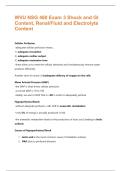
WVU NSG 460 Exam 3 Shock and GI
Content, Renal/Fluid and Electrolyte
Content

Cellular Perfusion
-adequate cellular perfusion means...
1.) adequate circulation
2.) adequate cardiac output
3.) adequate vasomotor tone
-these allow us to meet the cellular demands and simultaneously remove waste
products efficiently

Another term for shock is inadequate delivery of oxygen to the cells.

Mean Arterial Pressure (MAP)
-the MAP is what drives cellular perfusion
-a normal MAP is 70 to 100
-ideally, we want a MAP that is >60 in order to adequately perfuse

Hypoperfusion/Shock
-without adequate perfusion, cells shift to anaerobic metabolism

^only 5% of energy is actually produced (1/18)

-the anaerobic metabolism leads to the production of lactic acid, leading to lactic
acidosis

Causes of Hypoperfusion/Shock

1. lactic acid is the most common cause of metabolic acidosis
2. DKA (due to profound diuresis)

, 3. uremia (development of sepsis)

Heart's Relation to Shock

1. The Fluid (hypovolemic)
2. The Pump (cardiogenic)
3. The Pipes (distributive)

Hypovolemic Shock
-the most common cause of shock

-inadequate circulating volume

^can be caused by GI bleed, dehydration, etc.

-can also be a shift of fluid to the interstitial space (burn shock)

-can shift into the peritoneal space

^can see ascites

^we can see it in regard to liver failure, or blood can pool within the pelvic cavity after a
pelvic fracture

-it can also be in the retroperitoneal space

^in pancreatitis, up to 11 liters of fluid can shift

Early Hypovolemic Shock
As the body senses the organs are underperfused it...

-increases HR

-increases RR

-increases contractility

, -vasoconstricts (increases venous return; causes cool, clammy skin)

-increases Na and H2O retention

Late Hypovolemic Shock
-low blood pressure

^decompensated/progressive

-tx what is missing

^may need to provide fluid resuscitation or vasopressors

Management of Hypovolemic Shock
-lay patient flat or elevate their legs

-trendelenburg

^do not perform in patients who have had a carotid endarterectomy; may cause a
rebleed

^face is pale, raise the tale

-isotonic fluids: NS, LR, and plasmalyte

-PRBCs

-albumin

Albumin
25% Conc. Albumin

-50 cc (higher concentration)

-good for our cardiac patients

^ex. a patient with CHF

Get to know the seller

Seller avatar
Reputation scores are based on the amount of documents a seller has sold for a fee and the reviews they have received for those documents. There are three levels: Bronze, Silver and Gold. The better the reputation, the more your can rely on the quality of the sellers work.
PatrickKaylian Delaware State University
View profile
Follow You need to be logged in order to follow users or courses
Sold
1823
Member since
2 year
Number of followers
1044
Documents
22148
Last sold
1 day ago

3.8

317 reviews

5
147
4
60
3
54
2
16
1
40

Recently viewed by you

Why students choose Stuvia

Created by fellow students, verified by reviews

Quality you can trust: written by students who passed their tests and reviewed by others who've used these notes.

Didn't get what you expected? Choose another document

No worries! You can instantly pick a different document that better fits what you're looking for.

Pay as you like, start learning right away

No subscription, no commitments. Pay the way you're used to via credit card and download your PDF document instantly.

Student with book image

“Bought, downloaded, and aced it. It really can be that simple.”

Alisha Student

Frequently asked questions

