100% satisfaction guarantee Immediately available after payment Both online and in PDF No strings attached 4.2 TrustPilot
logo-home
Exam (elaborations)

NCEP Study Guide (2025) – Exercise Science, Nutrition, ROM, Muscle Physiology, Energy Systems

Rating
-
Sold
-
Pages
14
Grade
A+
Uploaded on
02-10-2025
Written in
2025/2026

This comprehensive 2025/2026 NCEP Certification Study Guide is designed to prepare candidates for success on the NCEP fitness certification exam. The document contains well-structured exam questions with verified answers, focusing on practical knowledge, training principles, and anatomical foundations essential for personal trainers and exercise professionals. Key areas covered include: Seven primary movement patterns: push, pull, bend, twist, squat, lunge, gait Components of fitness: nutrition, cardiovascular and resistance training, flexibility, and mindset Stretching modalities: static, dynamic, active, passive, and ballistic stretching, with examples and definitions Cardiorespiratory metrics: blood pressure explanation, heart rate training formula, cardiovascular testing (talk test, leveling, recovery) Resistance training goals for Levels 1–5 (neural pathways, endurance, hypertrophy, strength, power) with detailed rep ranges Macronutrient breakdowns and calorie conversions, including healthy eating strategies and essential nutrients Muscle mechanics and neuromuscular concepts, such as motor units, sliding filament theory, fast/slow twitch fibers, and muscle spindles Energy systems: ATP-CP, glycolysis, oxidative phosphorylation with duration and intensity associations Joint and skeletal anatomy, including spine curves, major joints, shoulder and hip mechanics, and muscular contributions to movement Postural patterns and dysfunctions, such as rounded shoulders, pelvic tilt, and pronation Also included are functional assessment strategies (e.g., overhead squat, push-up hold, leg lowering), goal-setting techniques, and tools for attitude training using the MAVA technique (Mindfulness, Affirmations, Visualization, Anchoring). This study guide is ideal for: Aspiring Certified Personal Trainers (CPTs) Health coaches and fitness instructors Strength and conditioning specialists Exercise science, kinesiology, and physical therapy students Anyone preparing for the NCEP certification exam or requiring a foundational understanding of applied anatomy and physiology Keywords: NCEP certification, personal trainer exam, movement patterns, active stretching, ballistic stretching, FITTR principle, nutrition basics, macronutrients, muscle physiology, fast twitch, slow twitch, sliding filament theory, ATP-CP, oxidative phosphorylation, body mechanics, joint actions, shoulder complex, postural dysfunctions, attitude training, MAVA, energy systems, exercise assessments, fitness components, NCEP study guide

Show more Read less
Institution
NCEP
Course
NCEP


Whoops! We can’t load your doc right now. Try again or contact support.

Written for

Institution
NCEP
Course
NCEP

Document information

Uploaded on
October 2, 2025
Number of pages
14
Written in
2025/2026
Type
Exam (elaborations)
Contains
Questions & answers

Subjects

Content preview

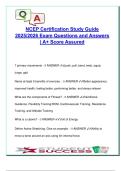
NCEP Certification Study Guide
2025/2026 Exam Questions and Answers
| A+ Score Assured


7 primary movements - 🧠 ANSWER ✔✔push, pull, bend, twist, squat,

lunge, gait


Name at least 5 benefits of exercise. - 🧠 ANSWER ✔✔Better appearance,

improved health, feeling better, performing better, and stress reliever


What are the components of Fitness? - 🧠 ANSWER ✔✔Nutritional

Guidance, Flexibility Training/ROM, Cardiovascular Training, Resistance

Training, and Attitude Training


What is a calorie? - 🧠 ANSWER ✔✔Unit of Energy


Define Active Stretching. Give an example. - 🧠 ANSWER ✔✔Ability to

move a bone around an axis using An internal force.

, An example is bringing your leg up high and then holding it there w/o

anything (other than your leg muscles themselves) to keep the leg in an

extended position.


Define Passive Stretching. Give an example. I - 🧠 ANSWER ✔✔Ability to

move a bone around an axis with help from an external force.


An example is using a belt when stretching.


Define Static Stretching. Give an example. - 🧠 ANSWER ✔✔Not continually

moving.


An example is Quadriceps Stretch (flamingos)


Define Ballistic Stretching. Give an example. - 🧠 ANSWER ✔✔In constant

motion.


An example is standing upright and putting either leg on elevation to front.

Keep legs straight. With back straight bend over and repeatedly reach

forward and relax.

Get to know the seller

Seller avatar
Reputation scores are based on the amount of documents a seller has sold for a fee and the reviews they have received for those documents. There are three levels: Bronze, Silver and Gold. The better the reputation, the more your can rely on the quality of the sellers work.
NinjaNerd Liberty University
View profile
Follow You need to be logged in order to follow users or courses
Sold
181
Member since
1 year
Number of followers
4
Documents
11385
Last sold
2 days ago
NinjaNerd

Here You will All Documents and Package Deals Offered by Seller NinjaNerd.

3.9

28 reviews

5
14
4
5
3
5
2
1
1
3

Why students choose Stuvia

Created by fellow students, verified by reviews

Quality you can trust: written by students who passed their tests and reviewed by others who've used these notes.

Didn't get what you expected? Choose another document

No worries! You can instantly pick a different document that better fits what you're looking for.

Pay as you like, start learning right away

No subscription, no commitments. Pay the way you're used to via credit card and download your PDF document instantly.

Student with book image

“Bought, downloaded, and aced it. It really can be that simple.”

Alisha Student

Frequently asked questions