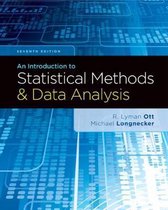
Complete Solutions Manual
to Accompany
An Introduction to
Statistical Methods and Data
Analysis
SEVENTH EDITION
© Cengage Learning. All rights reserved. No distribution allowed without express authorization.
R. Lyman Ott
Michael Longnecker
Texas A&M University
College Station, TX
Prepared by
John Daniel Draper
The Ohio State University, Columbus, OH
Australia • Brazil • Mexico • Singapore • United Kingdom • United States
, © 2016 Cengage Learning ISBN-13: 978-1-305-26990-3
ISBN-10: 1-305-26990-X
ALL RIGHTS RESERVED. No part of this work covered by the
copyright herein may be reproduced, transmitted, stored, or Cengage Learning
used in any form or by any means graphic, electronic, or 20 Channel Center Street, Floor 4
mechanical, including but not limited to photocopying, Boston, MA 02210
recording, scanning, digitizing, taping, Web distribution, USA
information networks, or information storage and retrieval
systems, except as permitted under Section 107 or 108 of the Cengage Learning is a leading provider of customized
1976 United States Copyright Act, without the prior written learning solutions with office locations around the globe,
permission of the publisher except as may be permitted by the including Singapore, the United Kingdom, Australia,
license terms below. Mexico, Brazil, and Japan. Locate your local office at:
www.cengage.com/global.
Cengage Learning products are represented in
For product information and technology assistance, contact us at Canada by Nelson Education, Ltd.
Cengage Learning Customer & Sales Support,
1-800-354-9706. To learn more about Cengage Learning Solutions,
visit www.cengage.com.
For permission to use material from this text or product, submit
all requests online at www.cengage.com/permissions Purchase any of our products at your local college
Further permissions questions can be emailed to store or at our preferred online store
.
www.cengagebrain.com.
NOTE: UNDER NO CIRCUMSTANCES MAY THIS MATERIAL OR ANY PORTION THEREOF BE SOLD, LICENSED, AUCTIONED,
OR OTHERWISE REDISTRIBUTED EXCEPT AS MAY BE PERMITTED BY THE LICENSE TERMS HEREIN.
READ IMPORTANT LICENSE INFORMATION
Dear Professor or Other Supplement Recipient: may not copy or distribute any portion of the Supplement to any
third party. You may not sell, license, auction, or otherwise
Cengage Learning has provided you with this product (the redistribute the Supplement in any form. We ask that you take
“Supplement”) for your review and, to the extent that you adopt reasonable steps to protect the Supplement from unauthorized
the associated textbook for use in connection with your course use, reproduction, or distribution. Your use of the Supplement
(the “Course”), you and your students who purchase the textbook indicates your acceptance of the conditions set forth in this
may use the Supplement as described below. Cengage Learning Agreement. If you do not accept these conditions, you must return
has established these use limitations in response to concerns the Supplement unused within 30 days of receipt.
raised by authors, professors, and other users regarding the
pedagogical problems stemming from unlimited distribution of All rights (including without limitation, copyrights, patents, and
Supplements. trade secrets) in the Supplement are and will remain the sole and
exclusive property of Cengage Learning and/or its licensors. The
Cengage Learning hereby grants you a nontransferable license to Supplement is furnished by Cengage Learning on an “as is” basis
use the Supplement in connection with the Course, subject to the without any warranties, express or implied. This Agreement will be
following conditions. The Supplement is for your personal, governed by and construed pursuant to the laws of the State of
noncommercial use only and may not be reproduced, posted New York, without regard to such State’s conflict of law rules.
electronically or distributed, except that portions of the
Supplement may be provided to your students IN PRINT FORM Thank you for your assistance in helping to safeguard the integrity of
ONLY in connection with your instruction of the Course, so long the content contained in this Supplement. We trust you find the
as such students are advised that they Supplement a useful teaching tool.
Printed in the United States of America
1 2 3 4 5 6 7 17 16 15 14 13
,Contents
Chapter 1: Statistics and the Scientific Method ............................................................................... 1
Chapter 2: Using Surveys and Experimental Studies to Gather Data .............................................. 3
Chapter 3: Data Description........................................................................................................... 11
Chapter 4: Probability and Probability Distributions ..................................................................... 47
Chapter 5: Inferences about Population Central Values ................................................................ 68
Chapter 6: Inferences Comparing Two Population Central Values ............................................... 89
Chapter 7: Inferences about Population Variances ...................................................................... 111
Chapter 8: Inferences about More Than Two Population Central Values ................................... 127
Chapter 9: Multiple Comparisons ................................................................................................ 153
Chapter 10: Categorical Data ....................................................................................................... 164
Chapter 11: Linear Regression and Correlation ........................................................................... 206
Chapter 12: Multiple Regression and the General Linear Model ................................................ 250
Chapter 13: Further Regression Topics ....................................................................................... 304
Chapter 14: Analysis of Variance for Completely Randomized Designs .................................... 368
Chapter 15: Analysis of Variance for Blocked Designs .............................................................. 393
Chapter 16: The Analysis of Covariance ..................................................................................... 415
Chapter 17: Analysis of Variance for Some Fixed-, Random-, and Mixed-Effects Models ....... 437
Chapter 18: Split-Plot, Repeated Measures, and Crossover Designs........................................... 462
Chapter 19: Analysis of Variance for Some Unbalanced Designs .............................................. 490
, Chapter 1
Statistics and the Scientific Method
1.1
a. The population of interest is all salmon released from fish farms located in Norway.
b. The samples are the two batches of salmon released (1,996 and 2,499 in northern and southern
Norway, respectively).
c. The migration pattern and survival of salmon released from fish farms.
d. Since the sample is only a small proportion of the whole population, it is necessary to evaluate what
the mean weight may be for any other random selection of farmed salmon.
1.2
a. All private water wells.
b. The 100 private water wells in or near the Barnett Shale in Texas.
c. The level of contaminants in the water wells.
d. We want to relate the level of contaminants of the 100 points in the sample to the level in the whole
suspect area. Thus we need to know how accurate a portrayal of the population is provided by the
100 points in the sample.
1.3
a. All families that have had option of SNAP (food stamps).
b. 60,782 examined over the time period of 1968 to 2009.
c. Adult health and economic outcomes (specifically, the incidence of metabolic health outcomes and
economic self-sufficiency).
d. In order to evaluate how closely the sample families represent the American population over this
time period.
1.4
a. All head impacts resulting from playing football over a given period of time.
b. The 1,281,444 head impacts recorded.
c. The number (or percent) of concussions suffered through these impacts.
d. The advances in tackling techniques imply that there is variability in how a tackle is performed.
We need to see if our sample was representative of the hits that may be sustained.
1.5
a. The population of interest is the population of those who would vote in the 2004 senatorial
campaign.
b. The population from which the sample was selected is registered voters in this state.
c. The sample will adequately represent the population, unless there is a difference between registered
voters in the state and those who would vote in the 2004 senatorial campaign.
d. The results from a second random sample of 5,000 registered voters will not be exactly the same
as the results from the initial sample. Results vary from sample to sample. With either sample we
hope that the results will be close to that of the views of the population of interest.
1
to Accompany
An Introduction to
Statistical Methods and Data
Analysis
SEVENTH EDITION
© Cengage Learning. All rights reserved. No distribution allowed without express authorization.
R. Lyman Ott
Michael Longnecker
Texas A&M University
College Station, TX
Prepared by
John Daniel Draper
The Ohio State University, Columbus, OH
Australia • Brazil • Mexico • Singapore • United Kingdom • United States
, © 2016 Cengage Learning ISBN-13: 978-1-305-26990-3
ISBN-10: 1-305-26990-X
ALL RIGHTS RESERVED. No part of this work covered by the
copyright herein may be reproduced, transmitted, stored, or Cengage Learning
used in any form or by any means graphic, electronic, or 20 Channel Center Street, Floor 4
mechanical, including but not limited to photocopying, Boston, MA 02210
recording, scanning, digitizing, taping, Web distribution, USA
information networks, or information storage and retrieval
systems, except as permitted under Section 107 or 108 of the Cengage Learning is a leading provider of customized
1976 United States Copyright Act, without the prior written learning solutions with office locations around the globe,
permission of the publisher except as may be permitted by the including Singapore, the United Kingdom, Australia,
license terms below. Mexico, Brazil, and Japan. Locate your local office at:
www.cengage.com/global.
Cengage Learning products are represented in
For product information and technology assistance, contact us at Canada by Nelson Education, Ltd.
Cengage Learning Customer & Sales Support,
1-800-354-9706. To learn more about Cengage Learning Solutions,
visit www.cengage.com.
For permission to use material from this text or product, submit
all requests online at www.cengage.com/permissions Purchase any of our products at your local college
Further permissions questions can be emailed to store or at our preferred online store
.
www.cengagebrain.com.
NOTE: UNDER NO CIRCUMSTANCES MAY THIS MATERIAL OR ANY PORTION THEREOF BE SOLD, LICENSED, AUCTIONED,
OR OTHERWISE REDISTRIBUTED EXCEPT AS MAY BE PERMITTED BY THE LICENSE TERMS HEREIN.
READ IMPORTANT LICENSE INFORMATION
Dear Professor or Other Supplement Recipient: may not copy or distribute any portion of the Supplement to any
third party. You may not sell, license, auction, or otherwise
Cengage Learning has provided you with this product (the redistribute the Supplement in any form. We ask that you take
“Supplement”) for your review and, to the extent that you adopt reasonable steps to protect the Supplement from unauthorized
the associated textbook for use in connection with your course use, reproduction, or distribution. Your use of the Supplement
(the “Course”), you and your students who purchase the textbook indicates your acceptance of the conditions set forth in this
may use the Supplement as described below. Cengage Learning Agreement. If you do not accept these conditions, you must return
has established these use limitations in response to concerns the Supplement unused within 30 days of receipt.
raised by authors, professors, and other users regarding the
pedagogical problems stemming from unlimited distribution of All rights (including without limitation, copyrights, patents, and
Supplements. trade secrets) in the Supplement are and will remain the sole and
exclusive property of Cengage Learning and/or its licensors. The
Cengage Learning hereby grants you a nontransferable license to Supplement is furnished by Cengage Learning on an “as is” basis
use the Supplement in connection with the Course, subject to the without any warranties, express or implied. This Agreement will be
following conditions. The Supplement is for your personal, governed by and construed pursuant to the laws of the State of
noncommercial use only and may not be reproduced, posted New York, without regard to such State’s conflict of law rules.
electronically or distributed, except that portions of the
Supplement may be provided to your students IN PRINT FORM Thank you for your assistance in helping to safeguard the integrity of
ONLY in connection with your instruction of the Course, so long the content contained in this Supplement. We trust you find the
as such students are advised that they Supplement a useful teaching tool.
Printed in the United States of America
1 2 3 4 5 6 7 17 16 15 14 13
,Contents
Chapter 1: Statistics and the Scientific Method ............................................................................... 1
Chapter 2: Using Surveys and Experimental Studies to Gather Data .............................................. 3
Chapter 3: Data Description........................................................................................................... 11
Chapter 4: Probability and Probability Distributions ..................................................................... 47
Chapter 5: Inferences about Population Central Values ................................................................ 68
Chapter 6: Inferences Comparing Two Population Central Values ............................................... 89
Chapter 7: Inferences about Population Variances ...................................................................... 111
Chapter 8: Inferences about More Than Two Population Central Values ................................... 127
Chapter 9: Multiple Comparisons ................................................................................................ 153
Chapter 10: Categorical Data ....................................................................................................... 164
Chapter 11: Linear Regression and Correlation ........................................................................... 206
Chapter 12: Multiple Regression and the General Linear Model ................................................ 250
Chapter 13: Further Regression Topics ....................................................................................... 304
Chapter 14: Analysis of Variance for Completely Randomized Designs .................................... 368
Chapter 15: Analysis of Variance for Blocked Designs .............................................................. 393
Chapter 16: The Analysis of Covariance ..................................................................................... 415
Chapter 17: Analysis of Variance for Some Fixed-, Random-, and Mixed-Effects Models ....... 437
Chapter 18: Split-Plot, Repeated Measures, and Crossover Designs........................................... 462
Chapter 19: Analysis of Variance for Some Unbalanced Designs .............................................. 490
, Chapter 1
Statistics and the Scientific Method
1.1
a. The population of interest is all salmon released from fish farms located in Norway.
b. The samples are the two batches of salmon released (1,996 and 2,499 in northern and southern
Norway, respectively).
c. The migration pattern and survival of salmon released from fish farms.
d. Since the sample is only a small proportion of the whole population, it is necessary to evaluate what
the mean weight may be for any other random selection of farmed salmon.
1.2
a. All private water wells.
b. The 100 private water wells in or near the Barnett Shale in Texas.
c. The level of contaminants in the water wells.
d. We want to relate the level of contaminants of the 100 points in the sample to the level in the whole
suspect area. Thus we need to know how accurate a portrayal of the population is provided by the
100 points in the sample.
1.3
a. All families that have had option of SNAP (food stamps).
b. 60,782 examined over the time period of 1968 to 2009.
c. Adult health and economic outcomes (specifically, the incidence of metabolic health outcomes and
economic self-sufficiency).
d. In order to evaluate how closely the sample families represent the American population over this
time period.
1.4
a. All head impacts resulting from playing football over a given period of time.
b. The 1,281,444 head impacts recorded.
c. The number (or percent) of concussions suffered through these impacts.
d. The advances in tackling techniques imply that there is variability in how a tackle is performed.
We need to see if our sample was representative of the hits that may be sustained.
1.5
a. The population of interest is the population of those who would vote in the 2004 senatorial
campaign.
b. The population from which the sample was selected is registered voters in this state.
c. The sample will adequately represent the population, unless there is a difference between registered
voters in the state and those who would vote in the 2004 senatorial campaign.
d. The results from a second random sample of 5,000 registered voters will not be exactly the same
as the results from the initial sample. Results vary from sample to sample. With either sample we
hope that the results will be close to that of the views of the population of interest.
1