Research skills RUG 24-25
Week 1 - Clip 1C
Scientific academic research:
Research is: “creative and systematic work undertaken in order to increase the stock of
knowledge and to devise new applications of available knowledge. […] Research is aimed at
new findings (novel), based on original concepts (and their interpretation) or hypotheses. It is
largely uncertain […] and it is aimed at producing results that could be either freely transferred
or traded in a marketplace (replicable)”.
Main characteristics of scientific research are all in black uitgedrukt
It involves the collection, organization and analysis of information to increase understanding of a
topic or issue.
John Creswell, a famed education scholar, defines research as “a process of steps used to
collect and analyze information to increase our understanding of a topic or issue
.” It consists of three (broad) steps:
1. Pose a question
2. Collect data to answer the question
3. Present an answer to the question
The scientific method:
,3 different forms of research:
-Exploratory research helps to identify and define a question or problem.
• Constructive research tests theories and proposes solutions to a question or problem.
• Empirical research tests the feasibility of a solution using empirical evidence.
• Qualitative research examines social phenomena from an individual’s perspective,
usually involving participant interviews and observations
• Quantitative research examines facts and trends in measurable ways, involving
statistical analyses such as surveys or assessments
Scientific Research Paper:
-For sharing your own (original) research work with other scientists or for reviewing the research
conducted by others
• A logical structure makes the research paper easier to read.
• A well-structured paper lies on its overall organization, its functionality, the construction of its
paragraphs, and the coherence of and transitions between paragraphs.
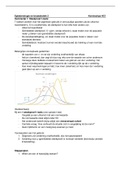
Structure: Overall Organization The Hourglass Model
Structure: Organization
The Introduction Section
Motivation and a general description regarding the subject > Problem outline, why relevant,
what we don’t know, what we want to know more > Formulate research question
-Paragraph 1: The problem – motivation (why is the study important and relevant) and brief
description of the subject
• Paragraph 2: What do we know? Acknowledge what others have said about the topic. What
don’t we know? What is the gap in the literature?
• Paragraph 3: Formulate the (central) research question (phrased explicitly/specifically, clearly
identifiable within the text) and how it is going to be addressed in this research paper (the
research method and data), contribution to existing literature
,• Paragraph 4: Summary of the findings
• Paragraph 5: Contributions
• Paragraph 6: The structure/outline of the research paper
Arouse the reader’s interest by using a provocative statement or describe an interesting
phenomenon
• by using quotations, interesting news items, assertions, shocking figures or
counter-intuitive reports
Structure: Organization
The Body Section
-Overall largest part, core of report
• Presents all information in answering the central research question
• Following an orderly approach helps in sticking to the point: Theoretical Framework/Literature
Review > Data and Methodology > Results
• Essential to have a logical arrangement and to use structural markers
Arranging the Information:
Think of a logical order to use in discussing information in each section
• Thematic organization, according to main topic’s themes or subthemes
• Chronological organization, when there is a clear passage of time
• Method-based organization, for describing methods or procedures
Structural Markers:
• Give a brief outline of the information to be presented so readers can grasp the essence
easier
• Indicate transitions
• Ex: Now that the concept of ‘economic dynamism’ has been defined, we may consider
whether this concept might also be measurable.
• Provide interim summaries after completing a section or a subtopic for readers to check
whether they have understood and to see the main point of that section
-Ex: In summary, ‘economic development’ is defined as the willingness and capacity to
create, develop and commercialize new ideas. It is a fundamentally different
phenomenon from ‘entrepreneurial spirit’, which also includes the identification of
opportunities for commercializing existing ideas.
, Structure: Organization
The Discussion and Conclusion Section
Discussion
• Outline results using accompanying critical interpretation
• Discuss how results relate to one another
• Embed results in previous findings
• Links results to sub-questions and hypotheses
• Explains what your findings contribute
• Also discuss limitations and take them into account in formulating conclusions
Conclusions
• Repeat the central question, briefly state the main points in your findings that provide an
answer
• Do not introduce new findings here!
• Final conclusion is drawn from the main points. Be concise!
• Suggest a few actions for further research with your research’s limitations in mind. Be
specific!
• Also discuss implications of your findings (theoretical vs. practical)
• Use structural markers
• Ex: Signal words “In conclusion, ..” or
• Ex: Transitional sentence “Despite the fact that the literature has shown that,… it
remains questionable whether…
Scientific Research Paper
-For sharing your own (original) research work with other scientists or for reviewing the research
conducted by others
• A logical structure makes the research paper easier to read.
• A well-structured paper lies on its overall organization, its functionality, the construction of its
paragraphs, and the coherence of and transitions between paragraphs.
Structure: Functional in the text
• The whole research paper has a purpose
• Every section, paragraph, sentence, and word has a purpose.
• For each paper, ask yourself: What do you want to say?
• Consider all the elements as they fit together
• Words form a logical sentence. Sentences should form a logical paragraph. Paragraphs
should form a logical section. Sections form a logical chapter. Chapters should form a logical
report.
Week 1 - Clip 1C
Scientific academic research:
Research is: “creative and systematic work undertaken in order to increase the stock of
knowledge and to devise new applications of available knowledge. […] Research is aimed at
new findings (novel), based on original concepts (and their interpretation) or hypotheses. It is
largely uncertain […] and it is aimed at producing results that could be either freely transferred
or traded in a marketplace (replicable)”.
Main characteristics of scientific research are all in black uitgedrukt
It involves the collection, organization and analysis of information to increase understanding of a
topic or issue.
John Creswell, a famed education scholar, defines research as “a process of steps used to
collect and analyze information to increase our understanding of a topic or issue
.” It consists of three (broad) steps:
1. Pose a question
2. Collect data to answer the question
3. Present an answer to the question
The scientific method:
,3 different forms of research:
-Exploratory research helps to identify and define a question or problem.
• Constructive research tests theories and proposes solutions to a question or problem.
• Empirical research tests the feasibility of a solution using empirical evidence.
• Qualitative research examines social phenomena from an individual’s perspective,
usually involving participant interviews and observations
• Quantitative research examines facts and trends in measurable ways, involving
statistical analyses such as surveys or assessments
Scientific Research Paper:
-For sharing your own (original) research work with other scientists or for reviewing the research
conducted by others
• A logical structure makes the research paper easier to read.
• A well-structured paper lies on its overall organization, its functionality, the construction of its
paragraphs, and the coherence of and transitions between paragraphs.
Structure: Overall Organization The Hourglass Model
Structure: Organization
The Introduction Section
Motivation and a general description regarding the subject > Problem outline, why relevant,
what we don’t know, what we want to know more > Formulate research question
-Paragraph 1: The problem – motivation (why is the study important and relevant) and brief
description of the subject
• Paragraph 2: What do we know? Acknowledge what others have said about the topic. What
don’t we know? What is the gap in the literature?
• Paragraph 3: Formulate the (central) research question (phrased explicitly/specifically, clearly
identifiable within the text) and how it is going to be addressed in this research paper (the
research method and data), contribution to existing literature
,• Paragraph 4: Summary of the findings
• Paragraph 5: Contributions
• Paragraph 6: The structure/outline of the research paper
Arouse the reader’s interest by using a provocative statement or describe an interesting
phenomenon
• by using quotations, interesting news items, assertions, shocking figures or
counter-intuitive reports
Structure: Organization
The Body Section
-Overall largest part, core of report
• Presents all information in answering the central research question
• Following an orderly approach helps in sticking to the point: Theoretical Framework/Literature
Review > Data and Methodology > Results
• Essential to have a logical arrangement and to use structural markers
Arranging the Information:
Think of a logical order to use in discussing information in each section
• Thematic organization, according to main topic’s themes or subthemes
• Chronological organization, when there is a clear passage of time
• Method-based organization, for describing methods or procedures
Structural Markers:
• Give a brief outline of the information to be presented so readers can grasp the essence
easier
• Indicate transitions
• Ex: Now that the concept of ‘economic dynamism’ has been defined, we may consider
whether this concept might also be measurable.
• Provide interim summaries after completing a section or a subtopic for readers to check
whether they have understood and to see the main point of that section
-Ex: In summary, ‘economic development’ is defined as the willingness and capacity to
create, develop and commercialize new ideas. It is a fundamentally different
phenomenon from ‘entrepreneurial spirit’, which also includes the identification of
opportunities for commercializing existing ideas.
, Structure: Organization
The Discussion and Conclusion Section
Discussion
• Outline results using accompanying critical interpretation
• Discuss how results relate to one another
• Embed results in previous findings
• Links results to sub-questions and hypotheses
• Explains what your findings contribute
• Also discuss limitations and take them into account in formulating conclusions
Conclusions
• Repeat the central question, briefly state the main points in your findings that provide an
answer
• Do not introduce new findings here!
• Final conclusion is drawn from the main points. Be concise!
• Suggest a few actions for further research with your research’s limitations in mind. Be
specific!
• Also discuss implications of your findings (theoretical vs. practical)
• Use structural markers
• Ex: Signal words “In conclusion, ..” or
• Ex: Transitional sentence “Despite the fact that the literature has shown that,… it
remains questionable whether…
Scientific Research Paper
-For sharing your own (original) research work with other scientists or for reviewing the research
conducted by others
• A logical structure makes the research paper easier to read.
• A well-structured paper lies on its overall organization, its functionality, the construction of its
paragraphs, and the coherence of and transitions between paragraphs.
Structure: Functional in the text
• The whole research paper has a purpose
• Every section, paragraph, sentence, and word has a purpose.
• For each paper, ask yourself: What do you want to say?
• Consider all the elements as they fit together
• Words form a logical sentence. Sentences should form a logical paragraph. Paragraphs
should form a logical section. Sections form a logical chapter. Chapters should form a logical
report.