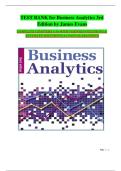
TEST BANK
BUSINESS ANALYTICS
Page | 1
, Table Of Contents
Chapter 1: Introduction To Business
Analytics Chapter 1: Appendix A1 Basic
Excel Skills Chapter 2: Database Analytics
Chapter 3: Data Visualization
Chapter 4: Descriptive Statistics
Chapter 5: Probability Distributions And Data
Modeling Chapter 6: Sampling And Estimation
Chapter 7: Statistical Inference
Chapter 8: Trendlines And Regression
Analysis Chapter 9: Forecasting Techniques
Chapter 10: Introduction To Data Mining
Chapter 11: Spreadsheet Modeling And
Analysis Chapter 12: Simulation And Risk
Analysis Chapter 13: Linear Optimization
Chapter 14: Integer And Nonlinear Optimization
Models Chapter 15: Optimization Analytics
Chapter 16: Decision Analysis
Page | 2
, Chapter 1: Introduction To Business Analytics
1) Descriptive Analytics:
A) Can Predict Risk And Find Relationships In Data Not Readily Apparent With Traditional Analyses.
B) Helps Companies Classify Their Customers Into Segments To Develop Specific Marketing
Campaigns.
C) Helps Detect Hidden Patterns In Large Quantities Of Data To Group Data Into Sets To Predict
Behavior.
D) Can Use Mathematical Techniques With Optimization To Make Decisions That Take Into
Account The Uncertainty In The Data.
Correct
Answer: B Diff: 1 Blooms:
Remember
Topic: Descriptive, Predictive, And Prescriptive Analytics
Lo1: Illustrate Examples Of Descriptive, Predictive, And Prescriptive Analytics.
2) A Manager At Gampco Inc. Wishes To Know The Company's Revenue And Profit In Its Previous
Quarter. Which Of The Following Business Analytics Will Help The Manager?
A) Prescriptive Analytics
B) Normative Analytics
C) Descriptive Analytics
D) Predictive Analytics Correct
Answer: C Diff: 1
Blooms: Apply Aacsb: Analytic Skills
Topic: Descriptive, Predictive, And Prescriptive Analytics
Lo1: Explain The Difference Between Descriptive, Predictive, And Prescriptive Analytics.
3) Predictive Analytics:
A) Summarizes Data Into Meaningful Charts And Reports That Can Be Standardized Or Customized.
Page | 3
,B) Identifies The Best Alternatives To Minimize Or Maximize An Objective.
C) Uses Data To Determine A Course Of Action To Be Executed In A Given Situation.
D) Detects Patterns In Historical Data And Extrapolates Them Forward In Time. Correct
Answer: D Diff: 2
Blooms: Remember
Topic: Descriptive, Predictive, And Prescriptive Analytics
Lo1: Illustrate Examples Of Descriptive, Predictive, And Prescriptive Analytics.
4) A Trader Who Wants To Predict Short-Term Movements In Stock Prices Is Likely To Use Analytics.
A) Predictive
B) Descriptive
C) Normative
D) Prescriptive Correct
Answer: A Diff: 1 Blooms: Apply Aacsb:
Analytic Skills
Topic: Descriptive, Predictive, And Prescriptive Analytics
Lo1: Explain The Difference Between Descriptive, Predictive, And Prescriptive Analytics.
5) Which Of The Following Questions Will Prescriptive Analytics Help A Company Address?
A) How Many And What Types Of Complaints Did They Resolve?
B) What Is The Best Way Of Shipping Goods From Their Factories To Minimize Costs?
C) What Do They Expect To Pay For Fuel Over The Next Several Months?
D) What Will Happen If Demand Falls By 10% Or If Supplier Prices Go Up 5%? Correct
Answer: B Diff: 2
Blooms: Understand Aacsb: Analytic Skills
Topic: Descriptive, Predictive, And Prescriptive Analytics
Lo1: Illustrate Examples Of Descriptive, Predictive, And Prescriptive Analytics.
Page | 4
, 6) The Demand For Coffee Beans Over A Period Of Three Months Has Been Represented In The Form
Of An L- Shaped Curve. Which Form Of Model Was Used Here?
A) Mathematical Model
B) Visual Model
C) Kinesthetic (Tactile) Model
D) Verbal Model Correct
Answer: B Diff: 1 Blooms: Apply Aacsb:
Analytic Skills
Topic: Models In Business Analytics
Lo1: Explain The Concept Of A Model And Various Ways A Model Can Be Characterized.
7) Decision Variables:
A) Cannot Be Directly Controlled By The Decision Maker.
B) Are Assumed To Be Constant.
C) Are Always Uncertain.
D) Can Be Selected At The Discretion Of The Decision Maker.
Correct
Answer: D Diff: 2 Blooms:
Understand
Topic: Models In Business Analytics
Lo1: Define And List The Elements Of A Decision Model.
8) Identify The Uncontrollable Variable From The Following Inputs Of A Decision Model.
A) Investment Returns
B) Machine Capacities
C) Staffing Levels
Page | 5
,D) Intercity Distances Correct
Answer: A Diff: 1
Blooms: Apply
Topic: Models In Business Analytics
Lo1: Define And List The Elements Of A Decision Model.
9) Which Of The Following Inputs Of A Decision Model Is An Example Of Data?
A) Estimated Consumer Demand
B) Inflation Rates
C) Costs
D) Investment Allocations Correct
Answer: C Diff: 1
Blooms: Remember
Topic: Data For Business Analytics
Lo1: Define And List The Elements Of A Decision Model.
10) Descriptive Decision Models:
A) Aim To Predict What Will Happen In The Future.
B) Describe Relationships But Do Not Tell A Manager What To Do.
C) Help Analyze The Risks Associated With Various Decisions.
D) Do Not Facilitate Evaluation Of Different Decisions. Correct
Answer: B Diff: 2
Blooms: Understand
Topic: Models In Business Analytics
Lo1: Explain The Concept Of A Model And Various Ways A Model Can Be Characterized.
Page | 6
,11) Prescriptive Decision Models Help:
A) Make Predictions Of How Demand Is Influenced By Price.
B) Make Trade-Offs Between Greater Rewards And Risks Of Potential Losses.
C) Decision Makers Identify The Best Solution To Decision Problems.
D) Describe Relationships And Influence Of Various Elements In The Model. Correct
Answer: C Diff: 1
Blooms: Remember
Topic: Models In Business Analytics
Lo1: Define The Terms Optimization, Objective Function, And Optimal Solution.
12) The Manager At Soul Walk Inc., A Shoe Manufacturing Company, Wants To Set A New Price
(P) For A Shoe Model To Maximize Total Profit. The Demand (D) As A Function Of Price Is
Represented As:
D = 1,500 - 2.5p
The Total Cost (C) As A Function Of Demand Is Represented As: C = 3,200 + 3.5d
Which Of The Following Is A Model For Total Profit As A Function Of Price?
A) (1,508.75× Price) - (2.5 × Price2) - 8,450
B) (3.5 × Price2) + 3,200 - (1925.50 × Price)
C) (1,250 × Price) + (5 × Price2) - 8,320
D) [4521 + (4.5 × Price)] × Price - 9684.25
Correct
Answer: A Diff: 3 Blooms:
Apply
Topic: Models In Business Analytics
Lo1: Define The Terms Optimization, Objective Function, And Optimal Solution.
13) Which Decision Model Incorporates The Process Of Optimization?
A) Predictive
Page | 7
,B) Prescriptive
C) Descriptive
D) Normative Correct Answer: B Diff:
1 Blooms: RememberTopic: Models In
Business Analytics
Lo1: Define The Terms Optimization, Objective Function, And Optimal Solution.
14) Which Of The Following Is The First Phase In Problem Solving?
A) Defining The Problem
B) Analyzing The Problem
C) Recognizing The Problem
D) Structuring The Problem Correct
Answer: C Diff: 1
Blooms: Remember
Topic: Problem Solving And Decision Making
Lo1: List And Explain The Steps In The Problem-Solving Process.
15) Middle Managers In Operations:
A) Develop Staffing Plans.
B) Determine Product Mix.
C) Develop Advertising Plans.
D) Make Pricing Decisions. Correct
Answer: A Diff: 1
Blooms: Remember
Topic: Problem Solving And Decision Making
Lo1: List And Explain The Steps In The Problem-Solving Process.
Page | 8
,16) The Product Mix Is Determined By The:
A) Accounting Staff.
B) Middle Managers.
C) Finance Managers.
D) Top Managers.
Correct
Answer: D Diff: 1
Blooms: Remember
Topic: Problem Solving And Decision Making
Lo1: List And Explain The Steps In The Problem-Solving Process.
17) During Which Phase In Problem Solving Is A Formal Model Often Developed?
A) Analyzing The Problem
B) Structuring The Problem
C) Defining The Problem
D) Implementing The Solution Correct
Answer: B Diff: 1
Blooms: Remember
Topic: Problem Solving And Decision Making
Lo1: List And Explain The Steps In The Problem-Solving Process.
18) Which Of The Following Is True About Problem Solving?
A) Recognizing Problems Involves Stating Goals And Objectives.
B) Analyzing The Problem Involves Characterizing The Possible Decisions.
C) Decision Making Involves Translating The Results Of The Model In The Organization.
Page | 9
, D) Structuring The Problem Involves Identifying Constraints. Correct Answer:
D Diff: 2
Blooms: Understand
Topic: Problem Solving And Decision Making
Lo1: List And Explain The Steps In The Problem-Solving Process.
The Manager At Goody Woods Inc., A Manufacturer Of Wooden Utensil Sets, Has Observed That When The
Company Sells Its Sets At $240, 1,540 Units Are Sold, And When The Price Is Raised To
$320, Demand Falls To 1,220 Units. Use This Information To Answer The Following Two Questions.
19) Develop A Linear Model Relating The Demand For Goody Woods' Units To The Price. Correct
Answer: Economic Theory Tells Us That Demand For A Product Is Negatively Related To Its Price.
The Linear Model To Predict Demand As A Function Of Price Is:
D = A - Bp
Where D Is The Quantity Demanded, P Is The Unit Price, A Is A Constant That Estimates The Demand
When The Price Is Zero, And B Is The Slope Of The Demand Function.
Substituting The Values Given In The Data:
1,540 = A - (B × 240)
1,220 = A - (B × 320)
By Solving The Two Equations, Values Of A And B Can Be Found.
A = 2,500, Which Indicates The Demand For Wood Units When Price Is Zero,
B = 4, Which Is The Slope Of The Demand Function.
Substituting Values Of A And B In The Linear Demand Prediction Model: D = 2,500 -
4p Diff: 3
Blooms: Apply Aacsb: Analytic Skills Topic:
Predictive Spreadsheet Models.
Lo1: Build Spreadsheet Models For Descriptive, Predictive, And Prescriptive Applications.
Page | 10
BUSINESS ANALYTICS
Page | 1
, Table Of Contents
Chapter 1: Introduction To Business
Analytics Chapter 1: Appendix A1 Basic
Excel Skills Chapter 2: Database Analytics
Chapter 3: Data Visualization
Chapter 4: Descriptive Statistics
Chapter 5: Probability Distributions And Data
Modeling Chapter 6: Sampling And Estimation
Chapter 7: Statistical Inference
Chapter 8: Trendlines And Regression
Analysis Chapter 9: Forecasting Techniques
Chapter 10: Introduction To Data Mining
Chapter 11: Spreadsheet Modeling And
Analysis Chapter 12: Simulation And Risk
Analysis Chapter 13: Linear Optimization
Chapter 14: Integer And Nonlinear Optimization
Models Chapter 15: Optimization Analytics
Chapter 16: Decision Analysis
Page | 2
, Chapter 1: Introduction To Business Analytics
1) Descriptive Analytics:
A) Can Predict Risk And Find Relationships In Data Not Readily Apparent With Traditional Analyses.
B) Helps Companies Classify Their Customers Into Segments To Develop Specific Marketing
Campaigns.
C) Helps Detect Hidden Patterns In Large Quantities Of Data To Group Data Into Sets To Predict
Behavior.
D) Can Use Mathematical Techniques With Optimization To Make Decisions That Take Into
Account The Uncertainty In The Data.
Correct
Answer: B Diff: 1 Blooms:
Remember
Topic: Descriptive, Predictive, And Prescriptive Analytics
Lo1: Illustrate Examples Of Descriptive, Predictive, And Prescriptive Analytics.
2) A Manager At Gampco Inc. Wishes To Know The Company's Revenue And Profit In Its Previous
Quarter. Which Of The Following Business Analytics Will Help The Manager?
A) Prescriptive Analytics
B) Normative Analytics
C) Descriptive Analytics
D) Predictive Analytics Correct
Answer: C Diff: 1
Blooms: Apply Aacsb: Analytic Skills
Topic: Descriptive, Predictive, And Prescriptive Analytics
Lo1: Explain The Difference Between Descriptive, Predictive, And Prescriptive Analytics.
3) Predictive Analytics:
A) Summarizes Data Into Meaningful Charts And Reports That Can Be Standardized Or Customized.
Page | 3
,B) Identifies The Best Alternatives To Minimize Or Maximize An Objective.
C) Uses Data To Determine A Course Of Action To Be Executed In A Given Situation.
D) Detects Patterns In Historical Data And Extrapolates Them Forward In Time. Correct
Answer: D Diff: 2
Blooms: Remember
Topic: Descriptive, Predictive, And Prescriptive Analytics
Lo1: Illustrate Examples Of Descriptive, Predictive, And Prescriptive Analytics.
4) A Trader Who Wants To Predict Short-Term Movements In Stock Prices Is Likely To Use Analytics.
A) Predictive
B) Descriptive
C) Normative
D) Prescriptive Correct
Answer: A Diff: 1 Blooms: Apply Aacsb:
Analytic Skills
Topic: Descriptive, Predictive, And Prescriptive Analytics
Lo1: Explain The Difference Between Descriptive, Predictive, And Prescriptive Analytics.
5) Which Of The Following Questions Will Prescriptive Analytics Help A Company Address?
A) How Many And What Types Of Complaints Did They Resolve?
B) What Is The Best Way Of Shipping Goods From Their Factories To Minimize Costs?
C) What Do They Expect To Pay For Fuel Over The Next Several Months?
D) What Will Happen If Demand Falls By 10% Or If Supplier Prices Go Up 5%? Correct
Answer: B Diff: 2
Blooms: Understand Aacsb: Analytic Skills
Topic: Descriptive, Predictive, And Prescriptive Analytics
Lo1: Illustrate Examples Of Descriptive, Predictive, And Prescriptive Analytics.
Page | 4
, 6) The Demand For Coffee Beans Over A Period Of Three Months Has Been Represented In The Form
Of An L- Shaped Curve. Which Form Of Model Was Used Here?
A) Mathematical Model
B) Visual Model
C) Kinesthetic (Tactile) Model
D) Verbal Model Correct
Answer: B Diff: 1 Blooms: Apply Aacsb:
Analytic Skills
Topic: Models In Business Analytics
Lo1: Explain The Concept Of A Model And Various Ways A Model Can Be Characterized.
7) Decision Variables:
A) Cannot Be Directly Controlled By The Decision Maker.
B) Are Assumed To Be Constant.
C) Are Always Uncertain.
D) Can Be Selected At The Discretion Of The Decision Maker.
Correct
Answer: D Diff: 2 Blooms:
Understand
Topic: Models In Business Analytics
Lo1: Define And List The Elements Of A Decision Model.
8) Identify The Uncontrollable Variable From The Following Inputs Of A Decision Model.
A) Investment Returns
B) Machine Capacities
C) Staffing Levels
Page | 5
,D) Intercity Distances Correct
Answer: A Diff: 1
Blooms: Apply
Topic: Models In Business Analytics
Lo1: Define And List The Elements Of A Decision Model.
9) Which Of The Following Inputs Of A Decision Model Is An Example Of Data?
A) Estimated Consumer Demand
B) Inflation Rates
C) Costs
D) Investment Allocations Correct
Answer: C Diff: 1
Blooms: Remember
Topic: Data For Business Analytics
Lo1: Define And List The Elements Of A Decision Model.
10) Descriptive Decision Models:
A) Aim To Predict What Will Happen In The Future.
B) Describe Relationships But Do Not Tell A Manager What To Do.
C) Help Analyze The Risks Associated With Various Decisions.
D) Do Not Facilitate Evaluation Of Different Decisions. Correct
Answer: B Diff: 2
Blooms: Understand
Topic: Models In Business Analytics
Lo1: Explain The Concept Of A Model And Various Ways A Model Can Be Characterized.
Page | 6
,11) Prescriptive Decision Models Help:
A) Make Predictions Of How Demand Is Influenced By Price.
B) Make Trade-Offs Between Greater Rewards And Risks Of Potential Losses.
C) Decision Makers Identify The Best Solution To Decision Problems.
D) Describe Relationships And Influence Of Various Elements In The Model. Correct
Answer: C Diff: 1
Blooms: Remember
Topic: Models In Business Analytics
Lo1: Define The Terms Optimization, Objective Function, And Optimal Solution.
12) The Manager At Soul Walk Inc., A Shoe Manufacturing Company, Wants To Set A New Price
(P) For A Shoe Model To Maximize Total Profit. The Demand (D) As A Function Of Price Is
Represented As:
D = 1,500 - 2.5p
The Total Cost (C) As A Function Of Demand Is Represented As: C = 3,200 + 3.5d
Which Of The Following Is A Model For Total Profit As A Function Of Price?
A) (1,508.75× Price) - (2.5 × Price2) - 8,450
B) (3.5 × Price2) + 3,200 - (1925.50 × Price)
C) (1,250 × Price) + (5 × Price2) - 8,320
D) [4521 + (4.5 × Price)] × Price - 9684.25
Correct
Answer: A Diff: 3 Blooms:
Apply
Topic: Models In Business Analytics
Lo1: Define The Terms Optimization, Objective Function, And Optimal Solution.
13) Which Decision Model Incorporates The Process Of Optimization?
A) Predictive
Page | 7
,B) Prescriptive
C) Descriptive
D) Normative Correct Answer: B Diff:
1 Blooms: RememberTopic: Models In
Business Analytics
Lo1: Define The Terms Optimization, Objective Function, And Optimal Solution.
14) Which Of The Following Is The First Phase In Problem Solving?
A) Defining The Problem
B) Analyzing The Problem
C) Recognizing The Problem
D) Structuring The Problem Correct
Answer: C Diff: 1
Blooms: Remember
Topic: Problem Solving And Decision Making
Lo1: List And Explain The Steps In The Problem-Solving Process.
15) Middle Managers In Operations:
A) Develop Staffing Plans.
B) Determine Product Mix.
C) Develop Advertising Plans.
D) Make Pricing Decisions. Correct
Answer: A Diff: 1
Blooms: Remember
Topic: Problem Solving And Decision Making
Lo1: List And Explain The Steps In The Problem-Solving Process.
Page | 8
,16) The Product Mix Is Determined By The:
A) Accounting Staff.
B) Middle Managers.
C) Finance Managers.
D) Top Managers.
Correct
Answer: D Diff: 1
Blooms: Remember
Topic: Problem Solving And Decision Making
Lo1: List And Explain The Steps In The Problem-Solving Process.
17) During Which Phase In Problem Solving Is A Formal Model Often Developed?
A) Analyzing The Problem
B) Structuring The Problem
C) Defining The Problem
D) Implementing The Solution Correct
Answer: B Diff: 1
Blooms: Remember
Topic: Problem Solving And Decision Making
Lo1: List And Explain The Steps In The Problem-Solving Process.
18) Which Of The Following Is True About Problem Solving?
A) Recognizing Problems Involves Stating Goals And Objectives.
B) Analyzing The Problem Involves Characterizing The Possible Decisions.
C) Decision Making Involves Translating The Results Of The Model In The Organization.
Page | 9
, D) Structuring The Problem Involves Identifying Constraints. Correct Answer:
D Diff: 2
Blooms: Understand
Topic: Problem Solving And Decision Making
Lo1: List And Explain The Steps In The Problem-Solving Process.
The Manager At Goody Woods Inc., A Manufacturer Of Wooden Utensil Sets, Has Observed That When The
Company Sells Its Sets At $240, 1,540 Units Are Sold, And When The Price Is Raised To
$320, Demand Falls To 1,220 Units. Use This Information To Answer The Following Two Questions.
19) Develop A Linear Model Relating The Demand For Goody Woods' Units To The Price. Correct
Answer: Economic Theory Tells Us That Demand For A Product Is Negatively Related To Its Price.
The Linear Model To Predict Demand As A Function Of Price Is:
D = A - Bp
Where D Is The Quantity Demanded, P Is The Unit Price, A Is A Constant That Estimates The Demand
When The Price Is Zero, And B Is The Slope Of The Demand Function.
Substituting The Values Given In The Data:
1,540 = A - (B × 240)
1,220 = A - (B × 320)
By Solving The Two Equations, Values Of A And B Can Be Found.
A = 2,500, Which Indicates The Demand For Wood Units When Price Is Zero,
B = 4, Which Is The Slope Of The Demand Function.
Substituting Values Of A And B In The Linear Demand Prediction Model: D = 2,500 -
4p Diff: 3
Blooms: Apply Aacsb: Analytic Skills Topic:
Predictive Spreadsheet Models.
Lo1: Build Spreadsheet Models For Descriptive, Predictive, And Prescriptive Applications.
Page | 10