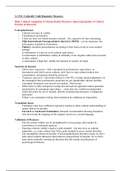
3.1 P9: Stereotypes
Kassin: Social Psychology
Stereotypes = beliefs/associations that link whole groups of people w/certain
traits/characteristics (belief)
Prejudice = negative feelings about others because of their connection to social group
(attitude)
Discrimination = behaviours (negative) directed against persons bc they are members of
certain group
Racism
- Modern racism = subtle form of prejudice that tends to surface when it’s socially
acceptable/easy to rationalise
- Aversive racism = mix between individual wanting to be fair, but still having
unconscious prejudicial feelings & beliefs
- Implicit racism = racism that is unconscious/unintentional
Stereotype Threat (more concerned w/stereotype & performance)
- Concern about being negatively evaluated based on negative stereotypes about one’s
group, can:
1) hinder achievement by increasing anxiety, triggering distracting thoughts.
2) cause individuals to disidentify from that domain; dismiss the domain as no longer
relevant to their self-esteem & identity
- Steele & Aronson study: test of intellectual ability, black students more influenced
by stereotype threat. If task was just research task, black students less impaired
Reporting their race before the test impaired black students’ performance, not white’s
- Black students also likely to perform worse on test that tests sports intelligence rather
than test of natural athletic ability
- Affected by negative stereotype even if they don’t believe in negative stereotype
How does stereotype threat cause all these effects?
- Triggers physiological arousal & stress
- Drains cognitive resources; loss of focus on task at hand bc of attempts to suppress
thoughts about relevant stereotype
- Impairs working memory
Causes of the Problem: Intergroup, Motivational, Cognitive & Cultural Factors
Social Categories & Intergroup Conflict
- Social categorisation = classification of persons into groups on the basis of common
attributes
Categorising people leads us to overestimate differences between groups and
underestimate differences within groups
- Distinctions between categories (race, gender, etc.) seen as more rigid & biologically
rooted than they actually are – people who think of race as stable, biologically
determined entity less likely to interact w/racial outgroup members, more likely to
accept racial inequalities than people who see race as socially determined
, Ingroup vs. Outgroups
- We exaggerate differences between our ingroup & outgroups, which helps reinforce
stereotypes
Outgroup homogeneity effect = assume that there is greater similarity among
members of outgroups than among members of one’s own group – there are subtle
differences between ‘us’, but ‘they’ are all the same. Outgroup members can also be
seen as looking alike
Why do people perceive outgroups as homogeneous?
1. People have less personal contact & familiarity w/members of outgroups
2. People do not encounter representative sample of outgroup members
Brain imaging research:
- Greater activation in fusiform area & orbitofrontal cortex upon seeing unfamiliar
faces if they are ingroup members rather than outgroup members
Dehumanising Outgroups
- Seeing outgroups (racial minorities) as objects rather than people
Reduced Empathy for Outgroup Members
- Less empathy (automatic reaction) towards outgroup members, some people may like
seeing outgroup people suffer
Fundamental Motives Between Groups
- Fundamental motive to protect ingroup, be suspicious of outgroup: self-protection
- Positive feelings towards ingroup: feelings of solidarity enhance sense of control,
associated w/psychological well-being. Identity fusion = sense of ‘oneness’ that
people feel w/group.
- Terror Management Theory: people cope w/fear of death by constructing
worldviews that help preserve important values, therefore favouring ingroup over
outgroup
E.g. supporting anti-Islamic statements if they had just written about thoughts of their
own death rather than thoughts of being paralysed
Motives Concerning Intergroup Dominance & Status
- Social dominance orientation = desire to see their ingroups dominant over other
groups, support values that contribute to oppression of other groups, don’t agree
w/group equality
- System justification theory = people are motivated to defend & justify existing
social, political, and economic conditions: protecting status quo. Beneficial for people
in power, but not for more disadvantaged groups
Robber’s Cave: Field Study into Intergroup Conflict
- Rattlers vs. Eagles competed against each other, eventually became hostile towards
each other
Kassin: Social Psychology
Stereotypes = beliefs/associations that link whole groups of people w/certain
traits/characteristics (belief)
Prejudice = negative feelings about others because of their connection to social group
(attitude)
Discrimination = behaviours (negative) directed against persons bc they are members of
certain group
Racism
- Modern racism = subtle form of prejudice that tends to surface when it’s socially
acceptable/easy to rationalise
- Aversive racism = mix between individual wanting to be fair, but still having
unconscious prejudicial feelings & beliefs
- Implicit racism = racism that is unconscious/unintentional
Stereotype Threat (more concerned w/stereotype & performance)
- Concern about being negatively evaluated based on negative stereotypes about one’s
group, can:
1) hinder achievement by increasing anxiety, triggering distracting thoughts.
2) cause individuals to disidentify from that domain; dismiss the domain as no longer
relevant to their self-esteem & identity
- Steele & Aronson study: test of intellectual ability, black students more influenced
by stereotype threat. If task was just research task, black students less impaired
Reporting their race before the test impaired black students’ performance, not white’s
- Black students also likely to perform worse on test that tests sports intelligence rather
than test of natural athletic ability
- Affected by negative stereotype even if they don’t believe in negative stereotype
How does stereotype threat cause all these effects?
- Triggers physiological arousal & stress
- Drains cognitive resources; loss of focus on task at hand bc of attempts to suppress
thoughts about relevant stereotype
- Impairs working memory
Causes of the Problem: Intergroup, Motivational, Cognitive & Cultural Factors
Social Categories & Intergroup Conflict
- Social categorisation = classification of persons into groups on the basis of common
attributes
Categorising people leads us to overestimate differences between groups and
underestimate differences within groups
- Distinctions between categories (race, gender, etc.) seen as more rigid & biologically
rooted than they actually are – people who think of race as stable, biologically
determined entity less likely to interact w/racial outgroup members, more likely to
accept racial inequalities than people who see race as socially determined
, Ingroup vs. Outgroups
- We exaggerate differences between our ingroup & outgroups, which helps reinforce
stereotypes
Outgroup homogeneity effect = assume that there is greater similarity among
members of outgroups than among members of one’s own group – there are subtle
differences between ‘us’, but ‘they’ are all the same. Outgroup members can also be
seen as looking alike
Why do people perceive outgroups as homogeneous?
1. People have less personal contact & familiarity w/members of outgroups
2. People do not encounter representative sample of outgroup members
Brain imaging research:
- Greater activation in fusiform area & orbitofrontal cortex upon seeing unfamiliar
faces if they are ingroup members rather than outgroup members
Dehumanising Outgroups
- Seeing outgroups (racial minorities) as objects rather than people
Reduced Empathy for Outgroup Members
- Less empathy (automatic reaction) towards outgroup members, some people may like
seeing outgroup people suffer
Fundamental Motives Between Groups
- Fundamental motive to protect ingroup, be suspicious of outgroup: self-protection
- Positive feelings towards ingroup: feelings of solidarity enhance sense of control,
associated w/psychological well-being. Identity fusion = sense of ‘oneness’ that
people feel w/group.
- Terror Management Theory: people cope w/fear of death by constructing
worldviews that help preserve important values, therefore favouring ingroup over
outgroup
E.g. supporting anti-Islamic statements if they had just written about thoughts of their
own death rather than thoughts of being paralysed
Motives Concerning Intergroup Dominance & Status
- Social dominance orientation = desire to see their ingroups dominant over other
groups, support values that contribute to oppression of other groups, don’t agree
w/group equality
- System justification theory = people are motivated to defend & justify existing
social, political, and economic conditions: protecting status quo. Beneficial for people
in power, but not for more disadvantaged groups
Robber’s Cave: Field Study into Intergroup Conflict
- Rattlers vs. Eagles competed against each other, eventually became hostile towards
each other