1
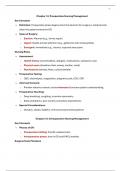
Chapter 14: Preoperative Nursing Management
Key Concepts
• Definition: Preoperative phase begins when the decision for surgery is made & ends
when the patient enters the OR.
• Types of Surgery:
o Elective: Planned (e.g., hernia repair)
o Urgent: Needs prompt attention (e.g., gallstones with cholecystitis)
o Emergent: Immediate (e.g., trauma, ruptured aneurysm)
Nursing Roles
• Assessment:
o Health history (comorbidities, allergies, medications, substance use)
o Physical exam (baseline vitals, airway, cardiac, renal)
o Psychosocial (anxiety, fears, cultural beliefs)
• Preoperative Testing:
o CBC, electrolytes, coagulation, pregnancy test, ECG, CXR
• Informed Consent:
o Provider obtains consent; nurse witnesses & ensures patient understanding.
• Preoperative Teaching:
o Deep breathing, coughing, incentive spirometry
o Early ambulation, pain control, procedure expectations
• Special Considerations:
o Geriatric, obese, diabetic, immunocompromised patients
Chapter 15: Intraoperative Nursing Management
Key Concepts
• Phases of OR:
o Preoperative holding: final ID, assessments
o Intraoperative phase: time in OR until PACU transfer
Surgical Team Members
, 2
• Surgeon • Circulating nurse (non-sterile,
• Scrub nurse/tech (sterile field) documentation, safety)
• Anesthesia provider
Nursing Priorities
• Aseptic Technique • Complications:
• Positioning to prevent nerve injury, o Malignant hyperthermia (rigid
pressure ulcers muscles, ↑ temp) — treat with
• Time-Out/Universal Protocol Dantrolene
o Correct patient, procedure, site o Blood loss, anaphylaxis,
• Anesthesia Monitoring: hypothermia
o General, regional, local,
conscious sedation
Chapter 16: Postoperative Nursing Management
Key Concepts
• Phases:
o Phase I (PACU): Immediate o Phase III: Extended observation
recovery; monitor ABCs or home care
o Phase II: Pre-discharge teaching
Priority Assessments
• Airway/Breathing: Stridor, hypoxia • Wound/Dressing: Monitor for
• Circulation: HR, BP, bleeding bleeding, drainage
• LOC: Neuro status, orientation • Urine Output: Should be ≥30 mL/hr.
• Pain Management: IV opioids, PCA
Common Complications
• Respiratory: Atelectasis, • GI: N/V/C, paralytic ileus
pneumonia, hypoventilation • GU: Retention, UTI
• Cardiovascular: DVT, PE,
hypotension, dysrhythmias
Chapter 14: Preoperative Nursing Management
Key Concepts
• Definition: Preoperative phase begins when the decision for surgery is made & ends
when the patient enters the OR.
• Types of Surgery:
o Elective: Planned (e.g., hernia repair)
o Urgent: Needs prompt attention (e.g., gallstones with cholecystitis)
o Emergent: Immediate (e.g., trauma, ruptured aneurysm)
Nursing Roles
• Assessment:
o Health history (comorbidities, allergies, medications, substance use)
o Physical exam (baseline vitals, airway, cardiac, renal)
o Psychosocial (anxiety, fears, cultural beliefs)
• Preoperative Testing:
o CBC, electrolytes, coagulation, pregnancy test, ECG, CXR
• Informed Consent:
o Provider obtains consent; nurse witnesses & ensures patient understanding.
• Preoperative Teaching:
o Deep breathing, coughing, incentive spirometry
o Early ambulation, pain control, procedure expectations
• Special Considerations:
o Geriatric, obese, diabetic, immunocompromised patients
Chapter 15: Intraoperative Nursing Management
Key Concepts
• Phases of OR:
o Preoperative holding: final ID, assessments
o Intraoperative phase: time in OR until PACU transfer
Surgical Team Members
, 2
• Surgeon • Circulating nurse (non-sterile,
• Scrub nurse/tech (sterile field) documentation, safety)
• Anesthesia provider
Nursing Priorities
• Aseptic Technique • Complications:
• Positioning to prevent nerve injury, o Malignant hyperthermia (rigid
pressure ulcers muscles, ↑ temp) — treat with
• Time-Out/Universal Protocol Dantrolene
o Correct patient, procedure, site o Blood loss, anaphylaxis,
• Anesthesia Monitoring: hypothermia
o General, regional, local,
conscious sedation
Chapter 16: Postoperative Nursing Management
Key Concepts
• Phases:
o Phase I (PACU): Immediate o Phase III: Extended observation
recovery; monitor ABCs or home care
o Phase II: Pre-discharge teaching
Priority Assessments
• Airway/Breathing: Stridor, hypoxia • Wound/Dressing: Monitor for
• Circulation: HR, BP, bleeding bleeding, drainage
• LOC: Neuro status, orientation • Urine Output: Should be ≥30 mL/hr.
• Pain Management: IV opioids, PCA
Common Complications
• Respiratory: Atelectasis, • GI: N/V/C, paralytic ileus
pneumonia, hypoventilation • GU: Retention, UTI
• Cardiovascular: DVT, PE,
hypotension, dysrhythmias