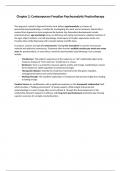
Chapter 2: Contemporary Freudian Psychoanalytic Psychotherapy
This approach, rooted in Sigmund Freud's work, defines psychoanalysis as a theory of
personality/psychopathology, a method for investigating the mind, and a treatment. Historically, it
evolved from hypnosis to treat symptoms like hysteria. Key theoretical developments include
instinctual drives, ego psychology (focus on defensive and coping mechanisms, adaptive functions of
the ego), object relations, and self-psychology. Contemporary Freudian approaches retain core
Freudian ideas while dispensing with concepts lacking scientific basis.
In practice, sessions are typically unstructured, inviting free association to uncover unconscious
material and defensive manoeuvres. Treatment often involves multiple sessions per week over many
years for psychoanalysis, or once/twice a week for psychoanalytic psychotherapy. Core concepts
include:
- Transference: The patient's experience of the analyst as an "old" relationship object to be
resolved. Analysis of "here-and-now" transference is a focus.
- Resistance: Seen as a protective measure against anxiety and change, manifesting in various
forms (blatant or subtle opposition to awareness/change).
- Therapeutic Alliance: Essential for treatment, fostered by the therapist's empathic,
nonjudgmental stance and careful interpretations.
- Working Through: The repetitive exploration of resistances that prevent insight from leading
to lasting change.
Curative factors are multifaceted, with a significant emphasis on the therapeutic relationship itself,
which provides a "holding environment" of steady support. While insight (enhanced self-
understanding) is crucial, change often occurs without it, through the direct experience of the
relationship. Research supports its efficacy, with long-term psychodynamic psychotherapy showing
superior outcomes for complex mental disorders.
, Chapter 4: Behaviour Therapy (BT)
Behaviour therapy is a diverse approach, distinguishing itself by focusing on immediate factors that
maintain problematic behaviours rather than on childhood origins. It is typically directive, involving
the therapist modelling new skills, teaching, and assigning homework. BT is often brief (e.g., 1 to 16
sessions) and strongly rooted in. empirical research
Clinical assessment in BT aims to understand the problem, plan treatment, and measure change,
utilizing a functional analysis (SORC model): identifying Stimuli (triggers), Organism variables
(individual factors), Responses (problem behaviours), and Consequences
(reinforcement/punishment). It employs a multimodal approach, gathering information from various
sources and methods like behavioural observation and diaries. Goal setting is collaborative and
ensures goals are safe, specific, measurable, and attainable. Psychoeducation is a common early
strategy to explain the treatment process and rationale.
Key strategies include:
- Exposure-based strategies: Used for fears and avoidance, often involving an exposure
hierarchy of feared situations.
- Response prevention: Preventing behaviours intended to reduce anxiety (e.g., compulsive
rituals), commonly used for OCD in conjunction with exposure.
The therapeutic relationship in BT has been debated, with some research suggesting its importance
can vary depending on the disorder, but therapist engagement is generally beneficial. The
mechanisms of change involve inhibitory learning (developing new, non-threat associations) and
increasing tolerance for fear and anxiety. BT also aims to help clients decanter from thoughts and
enhance emotion regulation skills. Ethically, BT emphasizes explicit and collaborative goal-setting to
prevent coercion. It is considered cost-effective and has substantial empirical support.
, Chapter 5: Cognitive Therapy (CT) and Cognitive-Behavioural
Therapy (CBT) ‘
CBT is an umbrella term encompassing various approaches, aiming to change unwanted emotions or
mental states by addressing maladaptive thinking patterns and behaviours. It is characterized as
problem-focused, present-focused, time-limited, and readily summarized in manuals.
Cognitive therapy specifically targets an individual's thoughts, beliefs, and expectations, ranging from
automatic thoughts to deeper schemas and core beliefs. Behavioural therapy focuses on modifying
maladaptive behaviours by altering their antecedents and consequences. Psychopathology is viewed
as extreme forms of normal emotional responses, often driven by negative automatic thoughts.
Assessment heavily relies on functional assessment (A-B-C model), gathering information on
Activating events, Beliefs, and emotional/behavioural Consequences. This approach is idiographic,
focusing on individual triggers and responses rather than solely on psychiatric diagnoses. Sessions
typically follow a structured agenda set collaboratively with the client, and homework is considered
critical for treatment success and skill generalization.
Core techniques include:
- Psychoeducation: Providing a "map" of symptoms and treatment, fostering realistic
expectations and client self-efficacy.
- Behavioural experiments: Empirically testing dysfunctional beliefs.
- Cognitive restructuring: Identifying, evaluating, and modifying automatic thoughts and core
beliefs, often through Socratic questioning.
CBT is one of the most widely implemented evidence-based approaches, developed and refined
through rigorous empirical methods like Randomized Controlled Trials (RCTs). It shows consistent
efficacy across a wide range of psychological disorders, often comparable or superior to other
treatments.
This approach, rooted in Sigmund Freud's work, defines psychoanalysis as a theory of
personality/psychopathology, a method for investigating the mind, and a treatment. Historically, it
evolved from hypnosis to treat symptoms like hysteria. Key theoretical developments include
instinctual drives, ego psychology (focus on defensive and coping mechanisms, adaptive functions of
the ego), object relations, and self-psychology. Contemporary Freudian approaches retain core
Freudian ideas while dispensing with concepts lacking scientific basis.
In practice, sessions are typically unstructured, inviting free association to uncover unconscious
material and defensive manoeuvres. Treatment often involves multiple sessions per week over many
years for psychoanalysis, or once/twice a week for psychoanalytic psychotherapy. Core concepts
include:
- Transference: The patient's experience of the analyst as an "old" relationship object to be
resolved. Analysis of "here-and-now" transference is a focus.
- Resistance: Seen as a protective measure against anxiety and change, manifesting in various
forms (blatant or subtle opposition to awareness/change).
- Therapeutic Alliance: Essential for treatment, fostered by the therapist's empathic,
nonjudgmental stance and careful interpretations.
- Working Through: The repetitive exploration of resistances that prevent insight from leading
to lasting change.
Curative factors are multifaceted, with a significant emphasis on the therapeutic relationship itself,
which provides a "holding environment" of steady support. While insight (enhanced self-
understanding) is crucial, change often occurs without it, through the direct experience of the
relationship. Research supports its efficacy, with long-term psychodynamic psychotherapy showing
superior outcomes for complex mental disorders.
, Chapter 4: Behaviour Therapy (BT)
Behaviour therapy is a diverse approach, distinguishing itself by focusing on immediate factors that
maintain problematic behaviours rather than on childhood origins. It is typically directive, involving
the therapist modelling new skills, teaching, and assigning homework. BT is often brief (e.g., 1 to 16
sessions) and strongly rooted in. empirical research
Clinical assessment in BT aims to understand the problem, plan treatment, and measure change,
utilizing a functional analysis (SORC model): identifying Stimuli (triggers), Organism variables
(individual factors), Responses (problem behaviours), and Consequences
(reinforcement/punishment). It employs a multimodal approach, gathering information from various
sources and methods like behavioural observation and diaries. Goal setting is collaborative and
ensures goals are safe, specific, measurable, and attainable. Psychoeducation is a common early
strategy to explain the treatment process and rationale.
Key strategies include:
- Exposure-based strategies: Used for fears and avoidance, often involving an exposure
hierarchy of feared situations.
- Response prevention: Preventing behaviours intended to reduce anxiety (e.g., compulsive
rituals), commonly used for OCD in conjunction with exposure.
The therapeutic relationship in BT has been debated, with some research suggesting its importance
can vary depending on the disorder, but therapist engagement is generally beneficial. The
mechanisms of change involve inhibitory learning (developing new, non-threat associations) and
increasing tolerance for fear and anxiety. BT also aims to help clients decanter from thoughts and
enhance emotion regulation skills. Ethically, BT emphasizes explicit and collaborative goal-setting to
prevent coercion. It is considered cost-effective and has substantial empirical support.
, Chapter 5: Cognitive Therapy (CT) and Cognitive-Behavioural
Therapy (CBT) ‘
CBT is an umbrella term encompassing various approaches, aiming to change unwanted emotions or
mental states by addressing maladaptive thinking patterns and behaviours. It is characterized as
problem-focused, present-focused, time-limited, and readily summarized in manuals.
Cognitive therapy specifically targets an individual's thoughts, beliefs, and expectations, ranging from
automatic thoughts to deeper schemas and core beliefs. Behavioural therapy focuses on modifying
maladaptive behaviours by altering their antecedents and consequences. Psychopathology is viewed
as extreme forms of normal emotional responses, often driven by negative automatic thoughts.
Assessment heavily relies on functional assessment (A-B-C model), gathering information on
Activating events, Beliefs, and emotional/behavioural Consequences. This approach is idiographic,
focusing on individual triggers and responses rather than solely on psychiatric diagnoses. Sessions
typically follow a structured agenda set collaboratively with the client, and homework is considered
critical for treatment success and skill generalization.
Core techniques include:
- Psychoeducation: Providing a "map" of symptoms and treatment, fostering realistic
expectations and client self-efficacy.
- Behavioural experiments: Empirically testing dysfunctional beliefs.
- Cognitive restructuring: Identifying, evaluating, and modifying automatic thoughts and core
beliefs, often through Socratic questioning.
CBT is one of the most widely implemented evidence-based approaches, developed and refined
through rigorous empirical methods like Randomized Controlled Trials (RCTs). It shows consistent
efficacy across a wide range of psychological disorders, often comparable or superior to other
treatments.