HED4805
Assignment 4
(EXCEPTIONAL ANSWERS)
Due 22 August 2025
, HED4805
Assignment 4
Due 22 August 2025
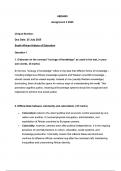
Question 1: “People’s education for people’s power” in the context of the
apartheid struggle
The phrase “People’s education for people’s power” emerged during South Africa’s anti-
apartheid movement in the 1980s as a rallying cry for an education system rooted in
liberation and social justice. Rooted in the resistance efforts led by organizations such
as the United Democratic Front (UDF) and the National Education Crisis Committee
(NECC), it encapsulated a vision where education was a tool for empowering the
oppressed majority to challenge racial, political, and economic inequalities embedded in
apartheid’s structure.
Historical Context and Meaning
The phrase was a direct response to the oppressive Bantu Education Act of 1953, which
institutionalized racially segregated and inferior education for Black South Africans. Its
aim was not merely to control but to dehumanize, reinforcing the racial hierarchy by
limiting the intellectual and socio-economic mobility of Black communities. The
movement’s slogan called for an education that would promote consciousness,
resistance, and agency, transforming learners from passive recipients into active
participants in their liberation.
Misrepresentation for Political Reasons
The apartheid regime and its supporters deliberately misrepresented “People’s
education for people’s power” to serve their political agenda. The regime falsely
portrayed the movement as a threat to national stability—often branding it as communist
or anarchist—aimed at inciting violence and chaos. This was a strategic effort to justify
repression, including banning organizations, arresting leaders, and deploying security
laws to suppress resistance.
Assignment 4
(EXCEPTIONAL ANSWERS)
Due 22 August 2025
, HED4805
Assignment 4
Due 22 August 2025
Question 1: “People’s education for people’s power” in the context of the
apartheid struggle
The phrase “People’s education for people’s power” emerged during South Africa’s anti-
apartheid movement in the 1980s as a rallying cry for an education system rooted in
liberation and social justice. Rooted in the resistance efforts led by organizations such
as the United Democratic Front (UDF) and the National Education Crisis Committee
(NECC), it encapsulated a vision where education was a tool for empowering the
oppressed majority to challenge racial, political, and economic inequalities embedded in
apartheid’s structure.
Historical Context and Meaning
The phrase was a direct response to the oppressive Bantu Education Act of 1953, which
institutionalized racially segregated and inferior education for Black South Africans. Its
aim was not merely to control but to dehumanize, reinforcing the racial hierarchy by
limiting the intellectual and socio-economic mobility of Black communities. The
movement’s slogan called for an education that would promote consciousness,
resistance, and agency, transforming learners from passive recipients into active
participants in their liberation.
Misrepresentation for Political Reasons
The apartheid regime and its supporters deliberately misrepresented “People’s
education for people’s power” to serve their political agenda. The regime falsely
portrayed the movement as a threat to national stability—often branding it as communist
or anarchist—aimed at inciting violence and chaos. This was a strategic effort to justify
repression, including banning organizations, arresting leaders, and deploying security
laws to suppress resistance.