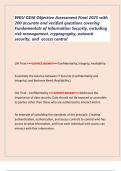
WGU C836 Objective Assessment Final 2025 with
200 accurate and verified questions covering
Fundamentals of Information Security, including
risk management, cryptography, network
security, and access control
CIA Triad <<<correct answer>>>Confidentiality, Integrity, Availability:
Essentially the balance between IT Security (Confidentiality and
Integrity,) and Business Need (Availability.)
CIA Triad - Confidentiality <<<correct answer>>>Addresses the
importance of data security. Data should not be exposed or accessible
to parties other than those who are authorized to interact with it.
An example of upholding the standards of this principle: Creating
authentication, authorization, and access controls to control who has
access to what information, and how each individual with access can
interact with that information.
,CIA Triad - Integrity <<<correct answer>>>This principle mandates that
data should not be tampered with or modified in such a way as to
compromise the reliability of the information.
An example of upholding the standards of this principle: Hashing or
encrypting data as it's in transit or at rest to monitor the information for
unauthorized changes or prevent attackers from accessing the data.
CIA Triad - Availability <<<correct answer>>>This principle focuses on
the need for businesses to balance the principles of _____________
and _____________, whilst also allowing authorized parties to access
and interact with data.
Information Security (InfoSec) <<<correct answer>>>
Parkerian Hexad - <<<correct answer>>>A less well-known model
named after Donn Parker. Provides a somewhat more complex variation
of the classic CIA triad.
Consists of six principles:
Confidentiality
Integrity
,Authenticity
Utility
Possession
Availability
Parkerian Hexad - Confidentiality <<<correct answer>>>Refers to our
ability to protect our data from those who are not authorized to view it.
Can be implemented at many levels of a process.
Parkerian Hexad - Integrity <<<correct answer>>>The ability to prevent
people from changing your data in an unauthorized or undesirable
manner. To maintain this principle, not only do you need to have the
means to prevent unauthorized changes to your data, but you need the
ability to reverse unwanted authorized changes.
The difference between this Parkerian version and the CIA version: The
data must be whole and completely unchanged from its previous state.
Parkerian Hexad - Authenticity <<<correct answer>>>This principle
allows you to say whether you've attributed the data in question to the
proper owner or creator.
For example:
, If you send an email message that is altered so that it appears to have
come from a different email address than the one from which it was
actually sent, you would be violating the ___________ of the email.
Parkerian Hexad - Utility <<<correct answer>>>Refers to how useful
the data is to you. This is the only principle of the Perkerian hexad that
is not necessarily binary in nature; you can have a variety of degrees of
_______, depending on the data and its format.
For example:
If we lost a shipment of backup tapes, some encrypted and some not,
an attacker or other unauthorized person would consider the encrypted
tapes to be of very little ______, as the data would not be readable.
However, the unencrypted tapes would be of much greater ________,
as the attacker or unauthorized person would be able to access the
data.
Parkerian Hexad - Possession (Control) <<<correct answer>>>Refers to
the physical disposition of the media on which the data is stored. This
enables you to discuss your loss of the data in its physical medium
without involving other factors such as availability.
200 accurate and verified questions covering
Fundamentals of Information Security, including
risk management, cryptography, network
security, and access control
CIA Triad <<<correct answer>>>Confidentiality, Integrity, Availability:
Essentially the balance between IT Security (Confidentiality and
Integrity,) and Business Need (Availability.)
CIA Triad - Confidentiality <<<correct answer>>>Addresses the
importance of data security. Data should not be exposed or accessible
to parties other than those who are authorized to interact with it.
An example of upholding the standards of this principle: Creating
authentication, authorization, and access controls to control who has
access to what information, and how each individual with access can
interact with that information.
,CIA Triad - Integrity <<<correct answer>>>This principle mandates that
data should not be tampered with or modified in such a way as to
compromise the reliability of the information.
An example of upholding the standards of this principle: Hashing or
encrypting data as it's in transit or at rest to monitor the information for
unauthorized changes or prevent attackers from accessing the data.
CIA Triad - Availability <<<correct answer>>>This principle focuses on
the need for businesses to balance the principles of _____________
and _____________, whilst also allowing authorized parties to access
and interact with data.
Information Security (InfoSec) <<<correct answer>>>
Parkerian Hexad - <<<correct answer>>>A less well-known model
named after Donn Parker. Provides a somewhat more complex variation
of the classic CIA triad.
Consists of six principles:
Confidentiality
Integrity
,Authenticity
Utility
Possession
Availability
Parkerian Hexad - Confidentiality <<<correct answer>>>Refers to our
ability to protect our data from those who are not authorized to view it.
Can be implemented at many levels of a process.
Parkerian Hexad - Integrity <<<correct answer>>>The ability to prevent
people from changing your data in an unauthorized or undesirable
manner. To maintain this principle, not only do you need to have the
means to prevent unauthorized changes to your data, but you need the
ability to reverse unwanted authorized changes.
The difference between this Parkerian version and the CIA version: The
data must be whole and completely unchanged from its previous state.
Parkerian Hexad - Authenticity <<<correct answer>>>This principle
allows you to say whether you've attributed the data in question to the
proper owner or creator.
For example:
, If you send an email message that is altered so that it appears to have
come from a different email address than the one from which it was
actually sent, you would be violating the ___________ of the email.
Parkerian Hexad - Utility <<<correct answer>>>Refers to how useful
the data is to you. This is the only principle of the Perkerian hexad that
is not necessarily binary in nature; you can have a variety of degrees of
_______, depending on the data and its format.
For example:
If we lost a shipment of backup tapes, some encrypted and some not,
an attacker or other unauthorized person would consider the encrypted
tapes to be of very little ______, as the data would not be readable.
However, the unencrypted tapes would be of much greater ________,
as the attacker or unauthorized person would be able to access the
data.
Parkerian Hexad - Possession (Control) <<<correct answer>>>Refers to
the physical disposition of the media on which the data is stored. This
enables you to discuss your loss of the data in its physical medium
without involving other factors such as availability.