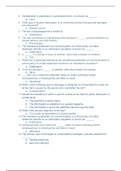
Class D Water Operator License Exam TCEQ-LATEST UPDATE
2025-MOSTLY TESTED QUESTIONS-COMPLETE QUESTIONS
WITH CORRECT DETAILED ANSWERS | RATED 100%
CORRECT!! ALREADY GRADED A+
T/F: In Texas, about 75% of all water is used for commercial, industrial, or agricultural purposes. -
(answers)True
Water covers approximately ________ of Earth's surface. - (answers)71%
Drought is an extended period when a region receives a deficiency in its ________ water supply. -
(answers)atmospheric, ground, or surface
T/F: Only about 1 gallon of tap water per person/day is used for drinking and cooking - (answers)True
Excluding outside water use, the average household uses about _______ gallons of water per month for
inside use - (answers)2,000
T/F: Only 3% of all the fresh water on earth can be easily accessed for use. - (answers)False (only 1%)
T/F: In 1978, the Texas Department of Health (TDH) assumed primacy over the Safe Drinking Water Act
from the EPA. - (answers)True
T/F: PWS officials should be pro-active in their approach to terrorism. - (answers)True
_________ permits the owner of a well to pump as much water as desired, even if the water is drained
from beneath the land of others. - (answers)Rule of Capture
In Texas, agricultural water demand accounts for about ___% of the total water used. - (answers)57%
T/F: An example of a non-transient non-community PWS is a rural school. - (answers)True
,Monitoring average and maximum daily water ______ enables us to plan ahead for growth. -
(answers)Demand
T/F: The Safe Drinking Water Act sets standards for drinking water including physical, chemical,
bacteriological, and radiological characteristics. - (answers)True
"Potable" means water is safe to drink and has a measurable chlorine ________. - (answers)Residual
The plant operator is responsible for a sufficient supply of safe and ________ drinking water. -
(answers)Palatable
T/F: The Texas State Board of Fire Insurance requires utilities that provide fire protection to have a
minimum amount of water available based on 30 gals per person per day. - (answers)False (130 gals per
person per day)
T/F: The primary state regulator of water utilities is the TCEQ. - (answers)True
T/F: All community and non-transient non-community PWS, regardless of source of water, must be
under the supervision of a licensed water works operator. - (answers)True
Meter readers bring in operating revenue and profoundly impact _____ relations. - (answers)Public
The federal regulator of drinking water is the _____. - (answers)EPA
T/F: Duties of distribution operator include repairing leaks, making taps, flushing mains, and taking
radiological samples. - (answers)False (Repair leaks, Make taps, Flush mains, Operate pumps, Take
*bacteriological* samples)
A service area has 1000 service connections. What can we estimate the population of this service area
to be? - (answers)3,000 (multiply connections x 3)
, T/F: The State must be notified after an existing facility is changed or after construction of a new facility.
- (answers)False (must notify *before*)
T/F: A Class "D" license is valid for 2 years at ground and purchase water systems with 250 connections
or less. - (answers)False (3 years)
T/F: The physical characteristics of water are color, taste, odor, temperature, and turbidity. -
(answers)True
An alkaline or basic solution has a pH greater than ____. - (answers)7
T/F: The terms mg/L and ppm are not interchangeable. - (answers)False (they are interchangeable)
Suspended solids in water cannot be filtered out. - (answers)False (they can)
Solids, water hardness, pH and gases are ____ characteristics. - (answers)Chemical
T/F: There are 2 hydrogen atoms and 1 oxygen atom in each water molecule. - (answers)True
T/F: The State recommends a water pH of less than 7 to be maintained at all time. - (answers)False (The
state recommends a pH slightly greater than 7 and for the water to be non-corrosive.)
T/F: Taste and odor can come from organisms such as vegetation, bacteria, and algae, and from certain
chemicals and metals. - (answers)True
T/F: The deeper the well, the warmer the water. - (answers)True
T/F: The threshold odor number (TON) relates to the number of dilutions needed for the water to be
tasteless. - (answers)False (It reflects the number of dilutions needed for water sample to be *odorless*)
2025-MOSTLY TESTED QUESTIONS-COMPLETE QUESTIONS
WITH CORRECT DETAILED ANSWERS | RATED 100%
CORRECT!! ALREADY GRADED A+
T/F: In Texas, about 75% of all water is used for commercial, industrial, or agricultural purposes. -
(answers)True
Water covers approximately ________ of Earth's surface. - (answers)71%
Drought is an extended period when a region receives a deficiency in its ________ water supply. -
(answers)atmospheric, ground, or surface
T/F: Only about 1 gallon of tap water per person/day is used for drinking and cooking - (answers)True
Excluding outside water use, the average household uses about _______ gallons of water per month for
inside use - (answers)2,000
T/F: Only 3% of all the fresh water on earth can be easily accessed for use. - (answers)False (only 1%)
T/F: In 1978, the Texas Department of Health (TDH) assumed primacy over the Safe Drinking Water Act
from the EPA. - (answers)True
T/F: PWS officials should be pro-active in their approach to terrorism. - (answers)True
_________ permits the owner of a well to pump as much water as desired, even if the water is drained
from beneath the land of others. - (answers)Rule of Capture
In Texas, agricultural water demand accounts for about ___% of the total water used. - (answers)57%
T/F: An example of a non-transient non-community PWS is a rural school. - (answers)True
,Monitoring average and maximum daily water ______ enables us to plan ahead for growth. -
(answers)Demand
T/F: The Safe Drinking Water Act sets standards for drinking water including physical, chemical,
bacteriological, and radiological characteristics. - (answers)True
"Potable" means water is safe to drink and has a measurable chlorine ________. - (answers)Residual
The plant operator is responsible for a sufficient supply of safe and ________ drinking water. -
(answers)Palatable
T/F: The Texas State Board of Fire Insurance requires utilities that provide fire protection to have a
minimum amount of water available based on 30 gals per person per day. - (answers)False (130 gals per
person per day)
T/F: The primary state regulator of water utilities is the TCEQ. - (answers)True
T/F: All community and non-transient non-community PWS, regardless of source of water, must be
under the supervision of a licensed water works operator. - (answers)True
Meter readers bring in operating revenue and profoundly impact _____ relations. - (answers)Public
The federal regulator of drinking water is the _____. - (answers)EPA
T/F: Duties of distribution operator include repairing leaks, making taps, flushing mains, and taking
radiological samples. - (answers)False (Repair leaks, Make taps, Flush mains, Operate pumps, Take
*bacteriological* samples)
A service area has 1000 service connections. What can we estimate the population of this service area
to be? - (answers)3,000 (multiply connections x 3)
, T/F: The State must be notified after an existing facility is changed or after construction of a new facility.
- (answers)False (must notify *before*)
T/F: A Class "D" license is valid for 2 years at ground and purchase water systems with 250 connections
or less. - (answers)False (3 years)
T/F: The physical characteristics of water are color, taste, odor, temperature, and turbidity. -
(answers)True
An alkaline or basic solution has a pH greater than ____. - (answers)7
T/F: The terms mg/L and ppm are not interchangeable. - (answers)False (they are interchangeable)
Suspended solids in water cannot be filtered out. - (answers)False (they can)
Solids, water hardness, pH and gases are ____ characteristics. - (answers)Chemical
T/F: There are 2 hydrogen atoms and 1 oxygen atom in each water molecule. - (answers)True
T/F: The State recommends a water pH of less than 7 to be maintained at all time. - (answers)False (The
state recommends a pH slightly greater than 7 and for the water to be non-corrosive.)
T/F: Taste and odor can come from organisms such as vegetation, bacteria, and algae, and from certain
chemicals and metals. - (answers)True
T/F: The deeper the well, the warmer the water. - (answers)True
T/F: The threshold odor number (TON) relates to the number of dilutions needed for the water to be
tasteless. - (answers)False (It reflects the number of dilutions needed for water sample to be *odorless*)