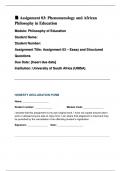
📄 Assignment 03: Phenomenology and African
Philosophy in Education
Module: Philosophy of Education
Student Name:
Student Number:
Assignment Title: Assignment 03 – Essay and Structured
Questions
Due Date: [Insert due date]
Institution: University of South Africa (UNISA)
HONESTY DECLARATION FORM
Name: ___________________
Student number: ____________ Module Code: _______________
I declare that this assignment is my own original work. I have not copied anyone else’s
work or allowed anyone else to copy mine. I am aware that plagiarism is fraud and may
be punished by the cancellation of an offending student’s registration.
Signature: _______________ Date: ___________________
, Question 1: Name TWO philosophers who were associated with
Phenomenology
Edmund Husserl: Regarded as the father of phenomenology, Husserl
developed the philosophical approach of exploring human experience as it is
lived, free from preconceived theories or scientific explanations (Husserl, 1970).
Martin Heidegger: A student of Husserl, Heidegger expanded phenomenology
by integrating existential themes. He emphasized the importance of being and
the way humans exist in and interpret the world (Heidegger, 1962).
Question 2: Identify FIVE characteristics of Phenomenology
1. Focus on Lived Experience: Phenomenology centres on the way individuals
experience life, emphasizing personal perception rather than scientific
abstraction.
2. Rejection of Preconceived Notions: It encourages educators and philosophers
to set aside assumptions and approach phenomena with fresh perspectives
(Moran, 2000).
3. Emphasis on Subjectivity: Subjective experience is seen as valid and valuable,
especially in educational contexts.
4. Concern with Meaning-Making: Phenomenology is interested in how meaning
is created through interaction with the world.
5. Anti-Reductionist Approach: It opposes reducing human experiences to mere
data or measurable outcomes and instead embraces the complexity of human
consciousness and understanding (Vandenberg, 1997).
Philosophy in Education
Module: Philosophy of Education
Student Name:
Student Number:
Assignment Title: Assignment 03 – Essay and Structured
Questions
Due Date: [Insert due date]
Institution: University of South Africa (UNISA)
HONESTY DECLARATION FORM
Name: ___________________
Student number: ____________ Module Code: _______________
I declare that this assignment is my own original work. I have not copied anyone else’s
work or allowed anyone else to copy mine. I am aware that plagiarism is fraud and may
be punished by the cancellation of an offending student’s registration.
Signature: _______________ Date: ___________________
, Question 1: Name TWO philosophers who were associated with
Phenomenology
Edmund Husserl: Regarded as the father of phenomenology, Husserl
developed the philosophical approach of exploring human experience as it is
lived, free from preconceived theories or scientific explanations (Husserl, 1970).
Martin Heidegger: A student of Husserl, Heidegger expanded phenomenology
by integrating existential themes. He emphasized the importance of being and
the way humans exist in and interpret the world (Heidegger, 1962).
Question 2: Identify FIVE characteristics of Phenomenology
1. Focus on Lived Experience: Phenomenology centres on the way individuals
experience life, emphasizing personal perception rather than scientific
abstraction.
2. Rejection of Preconceived Notions: It encourages educators and philosophers
to set aside assumptions and approach phenomena with fresh perspectives
(Moran, 2000).
3. Emphasis on Subjectivity: Subjective experience is seen as valid and valuable,
especially in educational contexts.
4. Concern with Meaning-Making: Phenomenology is interested in how meaning
is created through interaction with the world.
5. Anti-Reductionist Approach: It opposes reducing human experiences to mere
data or measurable outcomes and instead embraces the complexity of human
consciousness and understanding (Vandenberg, 1997).