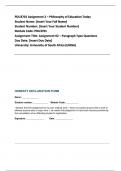
PDU3701 Assignment 2 – Philosophy of Education Today
Student Name: [Insert Your Full Name]
Student Number: [Insert Your Student Number]
Module Code: PDU3701
Assignment Title: Assignment 02 – Paragraph Type Questions
Due Date: [Insert Due Date]
University: University of South Africa (UNISA)
HONESTY DECLARATION FORM
Name: _____________
Student number: ____________ Module Code: __________
I declare that this assignment is my own original work. I have not copied anyone else’s work or
allowed anyone else to copy mine. I am aware that plagiarism is fraud and may be punished by
the cancellation of an offending student’s registration.
Signature: ______________ Date: ______________
, Question 1
1.1Define "philosophy of education" and explain its purpose. Why is it
important for educators to study the philosophy of education?
The philosophy of education refers to a branch of philosophy that deals with the nature, goals,
and problems of education. It involves critical thinking about education’s aims, values, and
methods, drawing on broader philosophical traditions such as epistemology (the nature of
knowledge), ethics (moral values), and metaphysics (the nature of reality). Philosophy of
education seeks to clarify educational concepts and evaluate educational practices. It addresses
questions such as: What is the purpose of education? What should be taught? Who decides
what is valuable knowledge?
The purpose of philosophy of education is to help educators reflect critically on their work. It
promotes an understanding of different educational theories and practices, guiding decisions
around curriculum design, teaching strategies, and assessment. Furthermore, it supports
educators in developing a coherent set of beliefs about teaching and learning.
It is important for educators to study the philosophy of education because it cultivates critical
thinking, encourages ethical decision-making, and provides a deeper understanding of the
cultural and political implications of education. By engaging with philosophical inquiry,
educators become more reflective and intentional in their practice, fostering meaningful
learning environments and advocating for educational equity (Higgs & Letseka, 2022).
1.2 Discuss the tenets of pragmatism.
Pragmatism is a philosophical tradition that originated in the United States in the late 19th
century with thinkers such as Charles Sanders Peirce, William James, and later John Dewey. In
education, pragmatism emphasizes practical consequences, experiential learning, and the
dynamic nature of knowledge.
Key tenets of pragmatism in education include:
1. Learning through experience: Pragmatism emphasizes that learners gain knowledge
best through direct interaction with their environment. Learning is not passive but
active and problem-oriented.
2. Problem-solving approach: Education should equip learners with the ability to solve
real-life problems, encouraging critical thinking and creativity.
Student Name: [Insert Your Full Name]
Student Number: [Insert Your Student Number]
Module Code: PDU3701
Assignment Title: Assignment 02 – Paragraph Type Questions
Due Date: [Insert Due Date]
University: University of South Africa (UNISA)
HONESTY DECLARATION FORM
Name: _____________
Student number: ____________ Module Code: __________
I declare that this assignment is my own original work. I have not copied anyone else’s work or
allowed anyone else to copy mine. I am aware that plagiarism is fraud and may be punished by
the cancellation of an offending student’s registration.
Signature: ______________ Date: ______________
, Question 1
1.1Define "philosophy of education" and explain its purpose. Why is it
important for educators to study the philosophy of education?
The philosophy of education refers to a branch of philosophy that deals with the nature, goals,
and problems of education. It involves critical thinking about education’s aims, values, and
methods, drawing on broader philosophical traditions such as epistemology (the nature of
knowledge), ethics (moral values), and metaphysics (the nature of reality). Philosophy of
education seeks to clarify educational concepts and evaluate educational practices. It addresses
questions such as: What is the purpose of education? What should be taught? Who decides
what is valuable knowledge?
The purpose of philosophy of education is to help educators reflect critically on their work. It
promotes an understanding of different educational theories and practices, guiding decisions
around curriculum design, teaching strategies, and assessment. Furthermore, it supports
educators in developing a coherent set of beliefs about teaching and learning.
It is important for educators to study the philosophy of education because it cultivates critical
thinking, encourages ethical decision-making, and provides a deeper understanding of the
cultural and political implications of education. By engaging with philosophical inquiry,
educators become more reflective and intentional in their practice, fostering meaningful
learning environments and advocating for educational equity (Higgs & Letseka, 2022).
1.2 Discuss the tenets of pragmatism.
Pragmatism is a philosophical tradition that originated in the United States in the late 19th
century with thinkers such as Charles Sanders Peirce, William James, and later John Dewey. In
education, pragmatism emphasizes practical consequences, experiential learning, and the
dynamic nature of knowledge.
Key tenets of pragmatism in education include:
1. Learning through experience: Pragmatism emphasizes that learners gain knowledge
best through direct interaction with their environment. Learning is not passive but
active and problem-oriented.
2. Problem-solving approach: Education should equip learners with the ability to solve
real-life problems, encouraging critical thinking and creativity.