
Question 1: Piecewise Function
OSCAR THE TUTOR
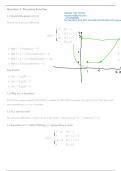
1.1 Sketch the graph of g(x)
+27737560989
for FAC MAC ECS DSC TAX QMI FIN INV BNU STA tutoria
The function g(x) is defined as:
⎧ x2 if x < 1
1 if 1 ≤ x < 2
g(x) = ⎨
if 2 ≤ x < 5
∣x∣
⎩
5 if x ≤ 5
For x < 1: Parabola y = x2 .
For 1 ≤ x < 2: Horizontal line y = 1.
For 2 ≤ x < 5: V-shaped graph y = ∣x∣.
For x ≤ 5: Horizontal line y = 5.
Key Points:
At x = 1: g(1) = 1.
At x = 2: g(2) = 2.
At x = 5: g(5) = 5.
1.2 Why is g a function?
A function assigns exactly one output (y-value) to each input (x-value). For g(x), every x has only one
corresponding y, so it is a function.
1.3 Is g one-to-one?
No, because different x-values can give the same y-value (e.g., g(−1) = 1 and g(1) = 1).
1.4 Equation of f(x) after shifting g(x) upwards by 4 units
⎧ x2 + 4 if x < 1
5 if 1 ≤ x < 2
f(x) = ⎨
∣x∣ + 4 if 2 ≤ x < 5
⎩
9 if x ≤ 5
, Question 2: Transformations
2.1 Transformation of f(x) = ∣x∣
x x
1. Stretch horizontally by 2: Replace x with 2 : f(x) 2
. =
2. Shift left by 6 units: Replace x with x + 6: f(x) = x+6
2 .
3. Shift downward by 4 units: Subtract 4: f(x) = x+6 2
− 4.
Final Equation:
x+6
f(x) = −4
2
2.2 Transformation of g(x) = x2
x2
1. Shrink vertically by 16 : Multiply by 16 : g(x)
= 6
.
2
2. Reflect about the x-axis: Multiply by −1: g(x) = − x6 .
2
3. Shift upward by 56 units: Add 56 : g(x)
= − x6 + 56 .
Final Equation:
x2 5
g(x) = − +
6 6
Question 3: Quadratic Function
3.1 Coordinate of B
Given the line 3y = x − 5, and B is the intersection point with f(x). Since B is an x-intercept of f , y = 0:
3(0) = x − 5 ⟹ x = 5
Coordinate of B : (5, 0).
3.2 Equation of f(x)
Given points:
A(−2, 0): 0 = a(−2)2 + b(−2) + c ⟹ 4a − 2b + c = 0.
B(5, 0): 0 = a(5)2 + b(5) + c ⟹ 25a + 5b + c = 0.
OSCAR THE TUTOR
1.1 Sketch the graph of g(x)
+27737560989
for FAC MAC ECS DSC TAX QMI FIN INV BNU STA tutoria
The function g(x) is defined as:
⎧ x2 if x < 1
1 if 1 ≤ x < 2
g(x) = ⎨
if 2 ≤ x < 5
∣x∣
⎩
5 if x ≤ 5
For x < 1: Parabola y = x2 .
For 1 ≤ x < 2: Horizontal line y = 1.
For 2 ≤ x < 5: V-shaped graph y = ∣x∣.
For x ≤ 5: Horizontal line y = 5.
Key Points:
At x = 1: g(1) = 1.
At x = 2: g(2) = 2.
At x = 5: g(5) = 5.
1.2 Why is g a function?
A function assigns exactly one output (y-value) to each input (x-value). For g(x), every x has only one
corresponding y, so it is a function.
1.3 Is g one-to-one?
No, because different x-values can give the same y-value (e.g., g(−1) = 1 and g(1) = 1).
1.4 Equation of f(x) after shifting g(x) upwards by 4 units
⎧ x2 + 4 if x < 1
5 if 1 ≤ x < 2
f(x) = ⎨
∣x∣ + 4 if 2 ≤ x < 5
⎩
9 if x ≤ 5
, Question 2: Transformations
2.1 Transformation of f(x) = ∣x∣
x x
1. Stretch horizontally by 2: Replace x with 2 : f(x) 2
. =
2. Shift left by 6 units: Replace x with x + 6: f(x) = x+6
2 .
3. Shift downward by 4 units: Subtract 4: f(x) = x+6 2
− 4.
Final Equation:
x+6
f(x) = −4
2
2.2 Transformation of g(x) = x2
x2
1. Shrink vertically by 16 : Multiply by 16 : g(x)
= 6
.
2
2. Reflect about the x-axis: Multiply by −1: g(x) = − x6 .
2
3. Shift upward by 56 units: Add 56 : g(x)
= − x6 + 56 .
Final Equation:
x2 5
g(x) = − +
6 6
Question 3: Quadratic Function
3.1 Coordinate of B
Given the line 3y = x − 5, and B is the intersection point with f(x). Since B is an x-intercept of f , y = 0:
3(0) = x − 5 ⟹ x = 5
Coordinate of B : (5, 0).
3.2 Equation of f(x)
Given points:
A(−2, 0): 0 = a(−2)2 + b(−2) + c ⟹ 4a − 2b + c = 0.
B(5, 0): 0 = a(5)2 + b(5) + c ⟹ 25a + 5b + c = 0.


